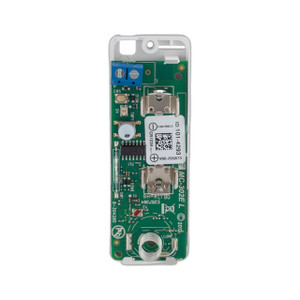
DSC PG9307 PowerG Wireless Recessed Door Contact
Overview
The DSC PG9307 is a wireless recessed door contact designed for deployments where visible security hardware cannot be tolerated. Operating on the PowerG 915 MHz frequency-hopping spread spectrum (FHSS) protocol with 128-bit AES encryption, it delivers secure, interference-resistant communication over distances up to 2 km in open air—roughly four times the reach of conventional 345 MHz wireless systems. The flush-recessed form factor mounts entirely inside the door and frame, remaining invisible when the door is closed.
Key Features
- Recessed flush-mount installation: Unlike surface-mount contacts, the PG9307 sits completely concealed within the door frame. This eliminates the visual clutter that bothers architects, designers, and high-end residential owners. The magnetic reed switch mechanism remains functional regardless of concealment.
- 915 MHz PowerG with FHSS and AES-128 encryption: The 915 MHz band provides substantially longer range than older 345 MHz wireless systems operating in the same building. Frequency-hopping spreads the signal across 50 channels to avoid interference from Wi-Fi, Bluetooth, and other 2.4 GHz sources. 128-bit AES encryption protects against signal interception.
- 2 km open-air wireless range: This range reserve is significant in large commercial buildings, multi-floor installations, or where repeaters may be needed. Actual range depends on obstacles (steel, concrete, metal stud framing reduce distance), but the 2 km specification provides real margin for planning.
- 25 mm (1.0 in) magnetic gap distance: The contact operates reliably as long as the door-to-frame gap does not exceed 25 mm. Most standard residential and commercial door frames fall within this range, but site-specific measurement is required before installation—an oversized gap will cause false alarms or missed open events.
- CR123A lithium battery with 8-year rated life: Single-battery operation eliminates the need for paired AA or AAA cells. The 8-year lifespan reduces service call frequency; set a replacement reminder in your maintenance calendar to avoid surprise battery-induced failures. Battery life depends on door open/close frequency and supervisory check-in intervals configured on the panel.
- Front and rear tamper protection: Both sides of the contact detect physical removal or bypass attempts, triggering a tamper alarm on the panel. This prevents an attacker from simply extracting the device without triggering an alert.
- Operating temperature range -10°C to 55°C (14°F to 131°F): Adequate for climate-controlled interiors; outdoor or unheated applications near the cold limit require verification. Doors exposed to direct sunlight in warm climates may approach the upper limit in localized microenvironments.
- Dimensions 76 x 19 mm (3.0 x 0.75 in): The compact profile fits standard 1.75-inch (44 mm) door frames without excessive drilling or structural modification. Verify frame thickness and material before cutting—solid wood accepts recessed mounts more reliably than hollow-core doors or metal frames.
- Color options: white and brown: Two finishes allow the contact to blend with common door frame colors. Neither color is purely aesthetic; they simplify inventory management by matching the most common frame materials.
- Periodic supervisory reporting: The contact sends regular check-in signals to the panel confirming the device is powered and communicating. This detects dead batteries, loss of RF signal, or panel misconfiguration before an intrusion event occurs.
Integration & Compatibility
The PG9307 pairs with any DSC PowerG-compatible panel or hub supporting 915 MHz wireless devices. This includes recent models of the DSC Neo, PowerSeries Pro, and commercial alarm control panels. The device requires that the panel already be configured to accept PowerG sensors; older 345 MHz–only panels cannot be simply software-updated to PowerG frequency. Verify panel compatibility before ordering the contact itself.
When to choose a different model
The PG9307 is the premium recessed option in the DSC PowerG lineup. If aesthetics are not a concern and installation cost matters, the surface-mount PG9303 offers the same wireless performance and encryption at lower cost and simpler installation. For outdoor or fully sealed enclosure applications, verify the operating temperature and moisture resistance of the PG9307 against your specific environment; consult the installation guide for environmental ratings. If 25 mm gap distance is insufficient for your door frames, remeasure before specifying—recessed contacts are not adjustable after installation.
Frequently Asked Questions
Q: What drill bit diameter should I use for the PG9307 recessed mounting hole?
A: Consult the installation guide provided with the unit. An oversized hole compromises the magnetic alignment between the two halves of the contact, causing false alarms or missed openings. The correct bit size is non-negotiable.
Q: Can the PG9307 work with a non-DSC panel if I use a third-party 915 MHz receiver?
A: No. The PG9307 operates exclusively on the proprietary PowerG protocol with DSC-specific encryption and messaging. Third-party receivers cannot decode the signal. You must use a DSC panel or DSC-branded wireless hub.
Q: What happens if my door frame is thicker or thinner than standard?
A: Verify the door frame thickness and the actual door-to-frame gap before installation. The contact is drilled to fit specific frame dimensions; significant deviation may require custom drilling or make the recess infeasible. Field adjustment is difficult once mounted.
Q: How often do I need to replace the CR123A battery?
A: DSC rates the battery for 8 years under typical usage (moderate door open/close frequency). Heavy-traffic doors and frequent supervisory reporting may reduce this. Plan battery replacement every 8 years as a baseline; some installers replace at 6–7 years to avoid surprise failures.
Q: Does the 2 km range apply indoors in a commercial building?
A: No. The 2 km specification is open-air range. Concrete, steel framing, metal studs, and multiple floors significantly reduce effective range indoors. Expect 100–300 m typical in a commercial building depending on construction. Plan repeaters or base station placement accordingly.
Q: Is the PG9307 suitable for exterior doors in a cold climate?
A: The operating range is −10°C to 55°C. Doors in unheated vestibules or outdoor alcoves that regularly drop below −10°C are outside the rated range. In cold climates, reserve the PG9307 for heated interior spaces or verify field performance in the actual deployment environment.
Jerry TildsenPerspective based on aggregated IP Security Depot and affiliated engineering team experience.
The PG9307 is the premium recessed door contact in the PowerG lineup. I specify it for custom homes and upscale commercial lobbies where the architect or owner will not accept visible surface-mount contacts. The 2 km open-air range on PowerG also provides substantial range margin in large buildings where panel placement may be remote from monitored entry points.
Technical Highlights:
- Flush-recessed design: Completely invisible when the door is closed, eliminating the visual clutter that surface-mount contacts introduce. Ideal for finishes-sensitive environments where every detail matters to the end user or design authority.
- 8-year CR123A battery life: A single lithium battery lasts significantly longer than dual-cell alternatives, reducing service call frequency and spare parts inventory. Set a calendar reminder for year 7 to schedule replacement before failures occur.
- PowerG 915 MHz FHSS protocol: Roughly four times the range of older 345 MHz systems, and frequency-hopping avoids interference from Wi-Fi and cellular equipment competing for airspace in modern buildings.
- 128-bit AES encryption: Protects the open/close signal from interception or replay attacks, a real security concern in high-security commercial installations.
Deployment Considerations:
- Drill hole sizing and frame depth tolerance are critical. An oversized hole allows the magnet and reed switch halves to shift, degrading performance. Measure the door frame thickness and gap distance before committing to the recessed design.
- The 25 mm gap distance is adequate for most standard doors, but heavy-duty commercial frames or custom millwork may exceed this specification. Verify on-site before specifying the PG9307.
- Indoor range expectations are 100–300 m in typical commercial construction—not 2 km. Plan panel location or repeater placement accordingly; the 2 km specification is strictly open-air performance.
For standard office or retail installations where aesthetics are not a primary constraint, the surface-mount PG9303 is easier to install, costs less, and offers identical wireless performance and encryption. Reserve the PG9307 for high-end custom installations, architectural finishes-sensitive spaces, or situations where the building owner has explicitly rejected visible hardware.