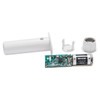
DMP 1132 Wireless Recessed Door Contact
Overview
The DMP 1132 is a wireless recessed door contact designed to integrate into door and window monitoring systems across multi-door security deployments. Built with HID credential architecture compatibility, the 1132 delivers reliable wireless communication for both access control and zone monitoring workflows without protruding hardware — the recessed form factor sits flush within standard door frames, reducing damage risk and maintaining clean aesthetics in commercial and institutional facilities.
Key Features
- Wireless Communication: Eliminates hardwired sensor runs to the control panel, reducing installation labor and enabling retrofit deployments where cabling through walls or jambs is impractical.
- Recessed Form Factor: Mounts flush within the door frame without protrusions, preventing accidental damage and maintaining professional appearance in high-traffic entry points.
- HID Credential Integration: Works within DMP access control environments, allowing door contact status to feed directly into credential-based access workflows and audit trails.
- Multi-Door Scalability: Wireless architecture supports deployment across dozens of entry points without point-to-point wiring, simplifying system expansion and reducing infrastructure costs.
- Zone Monitoring Compatibility: Integrates into both access control and standalone zone monitoring systems, making it flexible for mixed security architectures.
Integration & Compatibility
The DMP 1132 operates as part of the broader DMP access control ecosystem. Its wireless protocol and HID credential support mean it pairs with DMP-based readers, controllers, and management software without additional gateway hardware. The recessed design works with standard commercial door frames — confirm frame depth and magnet alignment during installation to ensure reliable trigger.
Deployment Considerations
Wireless door contacts require line-of-sight or clear RF path to the receiver — walls, metal frames, and dense masonry can degrade signal strength. Test RF coverage before final installation, especially in basement or interior corridor deployments. The recessed mounting requires careful hole sizing and alignment; use the manufacturer's template to avoid rework. Because the 1132 feeds zone status into access control workflows, ensure your controller firmware supports door contact inputs and that your monitoring software is configured to log and alarm on unexpected open/close transitions.
When to Choose a Different Model
If hardwired installation is acceptable and RF interference is a concern, consider a wired recessed contact in the same DMP family — eliminates wireless protocol dependencies at the cost of installation labor. For outdoor door monitoring in high-humidity or salt-spray environments, verify IP and corrosion ratings; the 1132 is specified for commercial interiors. If you need long-distance wireless range beyond typical building interiors, consult the RF specification sheet to confirm coverage in your facility's layout.
Frequently Asked Questions
Q: Does the DMP 1132 work with non-DMP access control systems?
A: The 1132 is designed for DMP environments with HID credential architecture. Compatibility with third-party systems depends on whether those systems support the wireless protocol and door contact inputs that the 1132 uses. Consult your system integrator or DMP technical support to confirm interoperability.
Q: What is the wireless range of the DMP 1132?
A: Wireless range depends on building materials, RF interference, and receiver placement. Typical coverage spans one to three floors in standard commercial construction. Conduct an RF site survey before deployment to identify dead zones or repeater locations.
Q: Can the DMP 1132 be used for both door and window monitoring?
A: Yes. The contact is designed for both door and window applications. Install the magnet on the moving element (door or window sash) and the contact body on the fixed frame.
Q: What happens if the wireless signal is lost?
A: Loss of signal depends on your controller configuration. Most DMP setups will log the event and can trigger an alarm if configured to do so. Battery-backed receivers should maintain local logging; consult your system documentation for failure mode details.
Q: Is battery replacement required on the DMP 1132?
A: The 1132 is wireless, so it includes a battery. Typical replacement intervals are 3–5 years depending on usage and firmware. Your access control software should provide low-battery alerts well before depletion.
Q: Does the DMP 1132 integrate with mobile access or credential readers?
A: The 1132 provides door contact status (open/closed) to your DMP system. Integration with mobile credentials or specific readers depends on your DMP controller and software version. Consult your integrator to confirm which credential technologies work with your deployment.
Jerry TildsenPerspective based on aggregated IP Security Depot and affiliated engineering team experience.
The DMP 1132 solves a real problem in retrofit and new installations where door monitoring needs to scale across multiple entry points without dedicated wiring runs. Wireless recessed contacts eliminate the labor of running sensor wire through walls and conduit — a meaningful cost saver on multi-door campuses, office parks, or warehouse facilities. Because the 1132 pairs directly with HID credential architecture, door contact status feeds into your access audit trail, so you know not just who accessed a door, but whether they actually opened it or if an alarm occurred during their session.
Technical Highlights:
- Wireless Protocol: Eliminates hardwire dependencies, reducing installation time and enabling phased rollouts across large facilities where pulling sensor wire would require scaffold or temporary closures.
- Recessed Design: Flush mounting prevents protrusion damage on high-traffic doors and maintains code compliance for accessibility in ADA-regulated spaces where hardware must not project into the path of travel.
- HID Integration: Door status automatically logs against credential events, so access audit trails show not just "Card X entered at 14:32" but "Card X entered; door contact confirmed open at 14:32" — critical for forensic analysis and compliance investigations.
Deployment Considerations:
- RF site survey is non-negotiable in multi-floor or masonry-heavy buildings. Test signal strength before committing to wireless; repeaters or relocated receivers may be necessary in basements or interior core areas.
- Battery life typically runs 3–5 years; your software should alert on low-battery status months before failure. Build replacement into your preventive maintenance calendar to avoid silent sensor failures during audits.
- Recessed mounting requires precise hole sizing and magnet alignment — install using the manufacturer's template to avoid rework on frame-mounted doors where repositioning is difficult.
Deploy the 1132 in access control environments where you need both wireless convenience and tight integration between door status and credential events — warehouse access gates, office building lobbies, data center cages, or institutional multi-floor deployments where wired sensors would be cost-prohibitive. Skip it if your facility has RF-hostile environments (heavy machinery, metal framing, high-density EMI) or if you need hardwired assurance over wireless convenience.