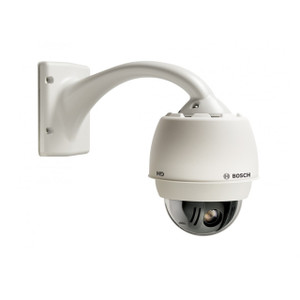
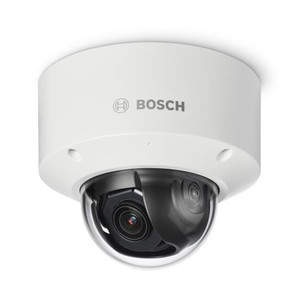
Bosch NDE-8704-RL-H 8MP PTRZ Starlight IR Hydro Dome Camera
Overview
The Bosch NDE-8704-RL-H is an 8-megapixel pan-tilt-rotate-zoom (PTRZ) dome built for demanding outdoor and high-abuse installations — the kind of site where a standard dome would fail inside a year. Starting from a 1/1.8" UHD 4K sensor with Starlight low-light technology, a 3.9–10mm motorized varifocal lens, and a dual-rating of IP66/IP67 plus IK11 vandal resistance, this camera is engineered for environments that combine physical threat, weather extremes, and the need for forensic-grade video. The NDE-8704-RL-H (often searched as NDE 8704 RL H) sits squarely in the Bosch Security IP camera line, purpose-built for sites where you need both intelligent edge analytics and hardware that can withstand a direct hit.
Key Features
- 8MP / 4K UHD on a 1/1.8" Sensor: The larger 1/1.8" sensor format captures more light per pixel than the 1/2.8" sensors common in entry-tier 4K cameras. In practical terms, that translates to cleaner frames at dusk and in artificially lit environments — fewer grain artifacts, more reliable analytics triggers at the edges of the IR zone.
- Starlight Low-Light Technology: Starlight processing is designed to retain color detail at light levels where most cameras shift to black-and-white. For parking structures, service yards, or covered loading docks running on minimal ambient light, this means color-identifiable footage — jacket color, vehicle color — without adding supplemental lighting infrastructure.
- HDR (High Dynamic Range): HDR is not a marketing label here — it's the practical solution for entrances, gates, and perimeter transition zones where a bright exterior and a shadowed interior appear in the same frame. Without HDR, you get a blown-out sky or a black interior; with it, you get usable detail in both zones simultaneously.
- 3.9–10mm Motorized Varifocal Lens with PTRZ: The pan-tilt-rotate-zoom form factor means installers can set coverage remotely without physically repositioning the dome housing. On ceiling grids, suspended structures, or any install where re-accessing the mount is difficult, this is a genuine labor-saver at commissioning and when coverage requirements shift after deployment. Pair this with a compatible dome mount or pendant adapter to maximize install flexibility.
- 30m (98 ft) IR Illumination: Integrated IR at 30 meters covers a standard aisle, corridor, or parking bay without a separate illuminator. The DORI figures give you the precise planning numbers: detection at 47m / 190m (depending on configuration), recognition at 9m / 38m, and identification at 5m / 19m. Size your coverage zones against these before deployment — don't assume IR range equals identification range.
- IVA Pro — Persons and Vehicles Analytics: IVA Pro is Bosch's edge-based intelligent video analytics running directly on the camera processor. Person and vehicle classification at the edge means your NVR or VMS receives pre-filtered metadata rather than raw motion events — dramatically fewer false alarms from environmental noise (tree movement, lighting changes, animals) and faster response to actual intrusion or vehicle-entry events.
- IP66 / IP67 Dual Ingress Rating: IP66 handles direct rain and dust jets; IP67 adds protection against temporary immersion up to 1 meter. The NDE-8704-RL-H qualifies for both, which matters in installations subject to pressure washing, flooding risk, or environments where cleaning crews will hose down the area around the camera. This camera's "hydro" designation reflects that real-world cleaning scenario.
- IK11 Vandal Resistance: IK11 is the highest standardized impact rating for security enclosures — defined as resistance to 20 joules of impact energy. For context, IK10 (the more common rating) covers 20 joules as well, but IK11 extends to 50 joules in some regional standards. At sites with documented vandalism risk — transit stations, correctional facilities, sports venues — IK11 is the specification to require.
- Operating Range: -50°C to +60°C (-58°F to +140°F): This is an unusually wide thermal envelope. Most outdoor security cameras are rated to -40°C; the extra 10 degrees of cold tolerance matters at sites in northern climates with extreme winter lows, refrigerated warehouses, or cold-chain logistics facilities where cameras must survive both the storage zone and seasonal outdoor extremes.
- PoE+ Power Input: PoE+ (802.3at) supplies up to 30W over a single CAT cable — enough to power the camera and its IR without a separate power run. When planning your PoE switch budget, factor in the at-spec draw rather than the minimum; PTRZ mechanisms and IR together can pull toward the upper range of the PoE+ envelope.
- Dual microSD Card Storage: Two microSD card slots support local edge recording — a genuine redundancy option for sites with unreliable WAN connectivity, or as a backup if the primary NVR loses connection. This also supports pre-buffering and incident extraction without pulling footage over the network.
- Network Cybersecurity Stack: HTTPS, TLS 1.2, AES-256, 802.1X, TPM, and PKI are all present. TPM-based key storage and PKI mean camera identity can be provisioned and verified as part of a zero-trust network architecture — relevant on enterprise or government networks requiring hardware-rooted device authentication.
- Electronic Image Stabilization: For installations on structures subject to vibration — bridge abutments, gantries, HVAC-adjacent mounts, industrial rooftop equipment pads — electronic stabilization compensates for minor continuous motion that would otherwise smear the image and degrade analytics accuracy.
- Quad Streaming: Four simultaneous streams allow the camera to serve a high-res archive stream, a lower-bandwidth live view, an analytics-optimized stream, and a remote monitoring feed concurrently — without re-encoding on a separate device. Relevant when integrating across a VMS, a PSIM, and a remote guard station at the same time.
Integration & Compatibility
The NDE-8704-RL-H's network security stack — HTTPS, TLS 1.2, AES-256, 802.1X, TPM, and PKI — is compatible with enterprise network access control frameworks. The camera's PTRZ design and IVA Pro analytics output metadata in formats consumable by Bosch's Video Management System (BVMS) and, via ONVIF, by third-party VMS platforms. IVA Pro's person/vehicle classification reduces the load on server-side analytics licenses by doing classification at the camera edge. For large multi-site deployments, this edge-analytics approach meaningfully reduces per-channel VMS analytics licensing costs. Review your VMS vendor's ONVIF Profile S/T/G support before deploying at scale.
Frequently Asked Questions
Q: What is the maximum IR range on the Bosch NDE-8704-RL-H?
A: The NDE-8704-RL-H provides up to 30 meters (98 feet) of IR illumination. Note that this is the illumination range — DORI identification distance is 5m / 19m depending on configuration, and recognition is 9m / 38m. Plan coverage zones against DORI distances, not raw IR range.
Q: What ingress and impact ratings does the NDE-8704-RL-H carry?
A: The camera is rated IP66 and IP67 for ingress protection — covering sustained rain, dust, and temporary immersion — plus IK11 for vandal and impact resistance, which is the highest standardized impact rating for security enclosures.
Q: What analytics does the NDE-8704-RL-H support on the edge?
A: The NDE-8704-RL-H runs Bosch IVA Pro (Intelligent Video Analytics Pro), which classifies Persons and Vehicles at the camera edge. This reduces false alarms from environmental motion and delivers pre-filtered metadata to the VMS rather than raw motion events.
Q: What power standard does the NDE-8704-RL-H require?
A: The camera uses PoE+ (802.3at), which supplies up to 30W over a single CAT cable. A standard 802.3af (15.4W) PoE port is insufficient — verify your switch supports 802.3at on the port you plan to use.
Q: Does the NDE-8704-RL-H support local storage?
A: Yes. The NDE-8704-RL-H includes dual microSD card slots, enabling edge recording for redundancy or offline buffering. This is useful for sites with intermittent WAN connectivity where continuous NVR connection cannot be guaranteed.
Q: What is the operating temperature range for the NDE-8704-RL-H?
A: The camera operates from -50°C to +60°C (-58°F to +140°F), which is a wider cold-weather envelope than most outdoor IP cameras. This makes it suitable for extreme northern climates, refrigerated logistics facilities, and cold-chain environments.
The spec that stands out to me on the NDE-8704-RL-H is the -50°C cold floor combined with IK11 and the dual IP66/IP67 rating — that combination is not common in a single SKU, and it signals a camera built for sites where the environment is genuinely hostile, not just damp. When I evaluate a PTRZ for a difficult install, I look at whether the hardware will still be serviceable in two years; the NDE-8704-RL-H's ratings suggest yes.
Technical Highlights:
- IK11 Impact Rating: Rated to resist 50 joules of impact energy in some regional standards — the highest tier for dome enclosures. Transit, corrections, and stadium concourse installs where physical tampering is expected are the right application; an IK10 dome in those environments is a maintenance liability.
- IVA Pro Edge Analytics: Person and vehicle classification runs on the camera processor, not on a server analytics license. On a 64-camera deployment, that delta in server-side analytics licensing costs is meaningful — and the pre-filtered metadata stream reduces storage I/O on the NVR compared to continuous motion-event recording.
- Dual microSD + Quad Streaming: Two card slots support simultaneous local redundancy and primary stream delivery. Combined with quad streaming, you can run a high-res archival stream, a compressed live view, an analytics feed, and a remote access stream concurrently — relevant for multi-platform integrations where the camera is the shared source.
Deployment Considerations:
- Confirm your PoE switch port supports 802.3at (PoE+) before ordering — a standard 802.3af port will not supply sufficient power for the PTRZ mechanism and IR together. Budget accordingly in your switch power plan.
- DORI identification distance tops out at 5m / 19m depending on configuration — verify this against your forensic identification requirement before committing to placement. If you need license-plate-grade reads beyond 19 meters, this camera's optics (3.9–10mm) are not the right tool; consider a longer-focal-length fixed camera for that specific zone.
This camera is the right call for high-security perimeter and transition-zone installs — prison external corridors, cold-climate port facilities, pressure-washed food processing perimeters, or any site that combines routine physical abuse with the need for edge-filtered IVA Pro alerts delivered cleanly to a BVMS or ONVIF-compatible VMS.