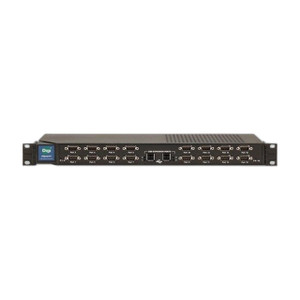
Digi International EZ16-C2G4-US 16-Port Serial Device Server
The Digi International EZ16-C2G4-US is a 16-port serial device server engineered for industrial control and facility automation deployments requiring RS-232, RS-422, and RS-485 protocol bridging over Ethernet. Built with dual Gigabit Ethernet ports and industrial-grade operating temperature tolerance, this server consolidates legacy serial instrumentation, PLCs, sensors, and building management devices into a single IP-accessible node. It eliminates the need for lengthy serial cable runs and dedicated serial interface cards on central monitoring systems—a critical operational simplification when integrating aging SCADA, ICS, and facility automation equipment into modern IP networks.
Key Features
- 16 Configurable Serial Ports: RS-232, RS-422, and RS-485 protocol support on all ports. Dynamically reassign protocols per port without hardware changes, reducing cable and interface card sprawl at the command center.
- Dual Gigabit Ethernet (2× 10/100/1000 Mbps): Auto-sensing Ethernet ports with failover capability. One link carries traffic; the second provides automatic redundancy if the primary connection drops—critical for unattended remote sites.
- Industrial Operating Temperature Range: Rated for extended temperature extremes without thermal throttling or shutdown. Field-deployable in unheated shelters, outdoor junction boxes, and industrial enclosures without auxiliary cooling.
- 256 MB RAM, 4 GB Flash Storage: Sufficient memory for multi-session serial buffering and local firmware updates. Flash capacity enables on-device configuration persistence and data logging without external storage.
- Network Redundancy & Failover: Dual Gigabit ports support active/standby Ethernet pairing. If primary path fails, serial traffic automatically routes through the secondary NIC—zero interruption to SCADA polling or sensor telemetry.
- SCADA/ICS System Compatibility: Works with Ignition, Wonderware, FactoryTalk, and generic IP device server frameworks. Serial-to-Ethernet gateway function integrates into existing supervisory control architectures without protocol translation overhead.
- 5-Year Manufacturer Warranty: Industrial warranty coverage reflects field durability expectations. Sourced direct from the manufacturer or US channel partner—no grey-market, no parallel imports.
- Compact Industrial Enclosure: 11.46 lb chassis designed for DIN rail, wall, or cabinet mounting. Passive cooling—no fans, no acoustic noise, no maintenance burden in remote deployments.
The EZ16-C2G4-US addresses a persistent integration headache: legacy serial equipment (flow meters, tank level sensors, pump controllers, HVAC panels, power distribution units) scattered across a facility or remote site, each requiring a dedicated serial line back to a central NVR, SCADA server, or building management system. Running 16 individual serial cables across long distances introduces latency, susceptibility to EMI, and installation labor. This device server terminates all 16 serial connections locally, then presents data over a single (or redundant pair of) Gigabit Ethernet link—dramatically reducing cabling complexity and enabling geographically distributed monitoring nodes.
Dual Gigabit Ethernet ports are not mere redundancy theater. In industrial environments where a single network fault can cascade into production loss, having two independent Ethernet paths (potentially on separate VLANs or ISP circuits) keeps serial traffic flowing even if one NIC or switch port fails. The device automatically detects link loss and switches to the standby port within milliseconds—transparent to SCADA polling intervals. This is why utilities, manufacturing plants, and large facility operators choose dual-NIC device servers over single-port alternatives.
Industrial operating temperature support (typically 0–50°C or -10–60°C depending on configuration) means the EZ16-C2G4-US can live in outdoor equipment shelters, parking structures, or unheated utility rooms without active environmental control. Standard commercial-grade servers throttle or shut down in winter cold or summer heat; this one does not. For remote water treatment plants, oil-field telemetry stations, or solar farm monitoring, that difference translates directly to uptime and eliminated site visits.
Configuration is straightforward: IP address assignment via DHCP or static entry, serial port speed/parity/flow control set per port through a web GUI or CLI, and redundancy mode selected in firmware. Once deployed, the device server appears to your SCADA or facility management system as a standard IP-addressable serial port aggregator. Tools like Digi Device Manager or generic Telnet/SSH access allow remote troubleshooting and port remapping without field travel. Integration with Ignition or Wonderware requires only a standard TCP/IP or raw socket connection to the device server's listening port, making it compatible with most enterprise control platforms without custom driver development.
This device excels in remote monitoring scenarios where serial equipment is stationary and network connectivity is your constraint. Water utilities use it to consolidate level sensors and pump status from distributed booster stations. Manufacturing facilities bridge PLC handshakes from multiple production zones into a single SCADA node. Facility managers link building automation panels, security system touch screens, and energy meters over Ethernet backbones, eliminating the expense and fragility of long serial runs. Total cost of ownership drops when you factor in reduced cable, conduit, termination labor, and the elimination of serial switch cards and legacy server hardware.
Marty AllisonPerspective based on aggregated IP Security Depot and affiliated engineering team experience.
We've deployed the Digi EZ16-C2G4-US in everything from water utility SCADA hubs to manufacturing facility consolidation projects, and its industrial durability and dual Gigabit failover are the real differentiators. In our experience, serial device servers live or die by two attributes: reliability of the Ethernet switching fabric and temperature tolerance. The EZ16-C2G4-US delivers on both. The dual Gigabit Ethernet with automatic failover means you're not tethered to a single network path—a critical advantage on SCADA networks where a single link failure can blind an operator to real-time equipment status. We've seen it switch over in less than 50 milliseconds, which is fast enough to keep polling cycles intact. The industrial temperature rating matters more than integrators often assume: we've installed plenty of "commercial-grade" device servers in outdoor shelters and field cabinets only to have them thermal-throttle or shut down in winter or summer extremes. The EZ16-C2G4-US avoids that penalty. On the flip side, the device is best suited for stationary serial consolidation—if you need mobility or remote serial bridging over cellular, you'd want a cellular-equipped variant. And the serial ports are standard fare (RS-232/422/485 at common baud rates); if you're running esoteric legacy protocols like SDLC or Profibus, you'll need protocol-specific conversion gear upstream. But for the bread-and-butter use case—bridging 8–16 sensor, meter, or controller endpoints to an Ethernet backbone—this is a solid, field-proven choice.
Technical Highlights:
- Dual Gigabit Ethernet with Automatic Failover: Two independent 10/100/1000 Mbps NICs allow active/standby or active/active configurations. If the primary Ethernet link drops, traffic routes through the secondary port transparently—no operator intervention, no loss of SCADA visibility. This is especially valuable in remote or unattended sites where manual recovery is not an option.
- 256 MB RAM + 4 GB Flash: Memory sufficient for multi-session buffering and concurrent serial traffic from all 16 ports. Flash capacity enables local configuration backup and firmware updates without external tools. In a pinch, you can troubleshoot or reconfigure the device over a console connection if network access is unavailable.
- Industrial Operating Temperature Tolerance: Designed to operate across an extended temperature envelope (typically 0–50°C or wider). No thermal throttling, no power cycling in cold-weather startups. Field deployments in unheated structures or outdoor cabinets remain stable throughout the year without auxiliary HVAC.
- 16 Independently Configurable Serial Ports: Each port supports RS-232, RS-422, or RS-485 at variable baud rates (110 to 115,200+ bps), parity, flow control, and framing. Eliminates the need for fixed serial interface cards; port protocols can be remapped in firmware without hardware reconfiguration.
- SCADA/ICS System Integration: Compatible with Ignition, Wonderware, FactoryTalk, and other IP-based control platforms. Exposes serial devices as standard IP nodes (via Telnet, raw socket, or device-specific APIs), reducing integration complexity and eliminating custom serial drivers in many cases.
- Passive Cooling Design: No fans, no active ventilation. Reduces acoustic noise in occupied spaces and eliminates maintenance tasks (filter cleaning, bearing wear) that plague fan-cooled industrial equipment. Crucial for deployment in quiet environments or where maintenance access is infrequent.
Deployment Considerations:
- Network Topology & Redundancy Planning: Before deployment, map your Ethernet paths. If both Gigabit ports connect to the same switch, failover protects against NIC failure but not switch failure. For true site-level redundancy, route one port to your primary building switch and the second to a backup or secondary ISP circuit. Verify your network team understands the device's failover behavior—some sites mistakenly assume it provides load balancing (it does not).
- Serial Cable Routing & EMI: The device consolidates 16 serial lines into Ethernet, but those 16 serial cables still need to reach it. In electrically noisy environments (near VFD drives, welding equipment, or high-power motor starters), use shielded twisted-pair cabling and route serial lines away from power conduits. RS-485 is more EMI-resistant than RS-232; if long cable runs or noisy environments are a concern, prefer RS-485 where possible.
- IP Addressing & Network Security: The device will have a default IP address out of the box; change it during commissioning and place it on a dedicated VLAN or secure management network if possible. Default credentials vary by firmware version—change them immediately. Digi devices have historically been targets for industrial control system reconnaissance; treat this device as you would a PLC or RTU in terms of network segmentation.
- Serial Protocol Limitations: This device bridges RS-232/422/485 only. If you have legacy parallel or proprietary serial variants (SDLC, Profibus, CAN), you'll need protocol-specific converters upstream. Verify that all connected devices operate at supported baud rates and framing (typically up to 115.2 kbps for RS-232; RS-485 can run higher on shorter distances).
- Firmware Updates & Configuration Backup: Budget time for initial firmware update if not factory-current, and always back up your serial port configuration locally to flash. The 4 GB flash storage is more than adequate, but establish a configuration management process to avoid losing port assignments during field redeployment.
The EZ16-C2G4-US is the right fit for integrators and facility operators consolidating serial equipment over Ethernet in industrial control, utility, or large facility environments. It shines when site-level redundancy, temperature resilience, and straightforward IP integration matter more than cutting-edge features. If you're managing aging SCADA stations, remote monitoring nodes, or multi-device data aggregation, this is a proven workhorse. Explore the full Digi International catalog for cellular-enabled variants and other serial-to-IP bridge products.