Digi International EZ02-CA00-GLB Connect EZ 2 Device Server
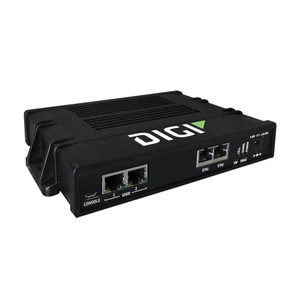
The Digi International EZ02-CA00-GLB is a compact serial-to-Ethernet device server designed for bridging legacy industrial, telecom, and access-control equipment to modern IP networks. It translates RS-232, RS-422, and RS-485 serial protocols to 10/100 Ethernet without requiring device firmware changes or field rewiring—critical when deploying across distributed facilities or retrofitting older control systems into network-managed infrastructure. Integrators routinely deploy these units to network-enable door controllers, legacy PACS systems, industrial sensors, and modem banks that lack native IP capability. The 4.5W typical power draw and compact DIN rail footprint make it suitable for cabinet consolidation and remote-site deployments where space and power budgets are tight.
Key Features
- Multi-protocol Serial Support: RS-232, RS-422, and RS-485 on a single unit. Eliminates the need for separate converters for mixed serial device types on the same network segment.
- 10/100 Mbps Auto-Sensing Ethernet: Dual RJ-45 ports with automatic speed negotiation. Backwards-compatible with legacy 10 Mbps infrastructure; no forced upgrades required.
- TrustFence Security Architecture: Integrated stateful packet inspection firewall (SPIF) with port forwarding and access control lists. Encrypts serial traffic over untrusted networks without burdening legacy devices.
- DIN Rail Mount: Compact 19.2 × 13.4 × 3.5 cm profile fits standard 35 mm DIN rails in electrical cabinets and wall-mounted panels. Reduces installation labor vs. separate wall brackets.
- 9–30 VDC Power Input: Wide input range accommodates both 12V battery backup and standard 24V industrial control supplies. Typical draw of 4.5W means extended runtime on UPS systems.
- DynDNS Support: Maintains connectivity in sites with dynamic public IP addresses. Auto-updates DNS entries without manual intervention or static IP leasing.
- Web-based Configuration & CLI Management: No proprietary software required. Configure firewall rules, port forwarding, and device parameters through browser or SSH terminal. Scriptable for bulk deployments.
- 5-Year Manufacturer Warranty: Industrial-grade reliability commitment. Covers device failure, not consumables or environmental damage.
The EZ02 bridges a critical gap in security and industrial networks where serial-dependent systems must coexist with IP infrastructure. Unlike software-based serial servers running on general-purpose PCs, this hardware appliance offers deterministic latency, isolation from host OS vulnerabilities, and persistence through network restarts. Deploying a dedicated device server reduces troubleshooting complexity: serial communication faults are logically separated from network and application layers, speeding mean-time-to-resolution (MTTR) in mixed-technology environments.
Security integrators frequently encounter door controllers, legacy DVRs, and access panels that communicate over serial links to central management stations. Rather than decommissioning working equipment, the EZ02 acts as a transparent IP gateway—preserving uptime and ROI while extending network reach. The TrustFence firewall mitigates the risk of exposing old serial protocols to untrusted networks by enforcing stateful rules and restricting inbound access to known management stations. This is especially valuable in multi-site deployments where field technicians need remote serial console access without hardening the legacy device itself.
Integration is straightforward: no ONVIF, RTSP, or API translation required. The device server preserves the original serial command set, meaning existing control software and scripts operate unchanged. Terminal emulation tools (PuTTY, HyperTerminal) and custom applications speak to the EZ02 as if they were directly connected to the serial device—the network is entirely transparent to the application layer. This compatibility eliminates the cost and risk of rewriting integration logic or retraining field staff on new interfaces.
The 5-year warranty and proven track record across telecom, industrial automation, and security markets make the EZ02 a low-risk choice for upgrading serial infrastructure without disrupting operations. Power consumption of 4.5W is negligible in cabinet deployments, and the DIN rail form factor means no additional mounting hardware or space allocation in crowded electrical enclosures. For organizations managing distributed sites with mixed-generation equipment, the EZ02 is a pragmatic bridge technology that extends infrastructure lifespan while maintaining vendor independence and operational simplicity.
Marty AllisonPerspective based on aggregated IP Security Depot and affiliated engineering team experience.
We've deployed the Digi EZ02 across dozens of retrofit and multi-site security projects, and it consistently solves the same integration headache: old serial infrastructure that refuses to die. The real strength here isn't the specs—it's the transparency. Unlike software serial servers or proprietary converters that demand driver installation and OS tuning, the EZ02 sits on the network as a transparent IP-to-serial translator. Your legacy door controller or modem bank doesn't know it's networked; your management software doesn't know it's talking across Ethernet. That simplicity is gold when you're troubleshooting at 2 a.m. or training new technicians. The TrustFence firewall is genuinely useful, too. Serial protocols were designed before network security existed; exposing raw RS-485 to the internet is a risk we see all too often in field deployments. The device server lets you clamp down with port forwarding rules and access lists without modifying the legacy equipment itself. Compared to industrial-grade alternatives (Lantronix, Phoenix Contact), the EZ02 offers a middle-ground pricing point and Digi's well-established support ecosystem.
Technical Highlights:
- Triple Serial Protocol Support (RS-232/422/485): Single unit handles all three standard serial variants without dip-switch reconfiguration or separate modules. In practice, this means you can network a door controller (RS-232), a legacy PACS modem bank (RS-422), and distributed industrial sensors (RS-485) all through the same device. Reduces BOM complexity and cabinet footprint significantly.
- Stateful Packet Inspection Firewall: Not just port filtering—the SPIF engine tracks connection state and inspects payload patterns. Mitigates man-in-the-middle attacks and rogue serial injection. Essential when serial links traverse untrusted networks (internet uplinks, wireless backhaul, cloud VPN tunnels).
- 9–30 VDC Input with 4.5W Draw: Wide input range eliminates the need for separate 12V or 24V SKU variants; a single part number works in solar-powered remote sites, battery backup cabinets, and industrial control racks. The low power envelope means the unit runs cool (passive DIN mount, no forced ventilation) and survives extended UPS runtime during mains failure.
- Dual RJ-45 Ports (10/100 Auto-Sensing): The second port enables daisy-chain or redundant network topologies. Auto-negotiation to 10 Mbps provides backwards compatibility with legacy Ethernet infrastructure that many integrators still maintain in older facilities.
- DynDNS + Web Configuration: No proprietary management platform required. Configure via browser or SSH. DynDNS integration means remote technicians can reach serial devices at stable hostnames even when branch sites have dynamic public IPs—common in smaller facilities that share internet links with retail tenants or hospitality operations.
Deployment Considerations:
- Serial speed and framing are preserved end-to-end, but total latency through the device is typically 5–50 ms depending on network congestion. Interactive serial sessions (terminal consoles) feel responsive; high-frequency sensor polling (>100 Hz) may benefit from local buffering or protocol tuning.
- The 10/100 Ethernet limit means gigabit backbone networks require a managed switch or PoE injector. For cabinet-local serial bridging, this is rarely a constraint; for distributed multi-site deployments, plan IP QoS policies to prevent congestion on shared uplinks.
- DIN rail mounting assumes standard 35 mm rail spacing. Verify cabinet rail type during site surveys; some older installations use non-standard rail widths that require adapter brackets.
- Security rule propagation is not dynamic. Firewall rules, port forwarding, and access lists must be applied via web interface or CLI; there's no central management API. For deployments of 10+ units, develop a configuration template and deploy via SSH scripting to maintain consistency.
- Reset and recovery require physical access (reset button on rear panel). In remote outdoor cabinets, document reset procedures with site contacts before commissioning. Remote reboot is available only if power cycling isn't disruptive.
The EZ02 is ideal for integrators managing aging infrastructure across multi-location clients—hospitality groups with legacy door systems, warehouses with industrial control networks, and security operations that can't justify forklift upgrades to serial-native IP equipment. If you're tired of explaining to customers why their 15-year-old access panel can't speak ONVIF, this is your answer. See the Digi International catalog for other networking and edge computing solutions.