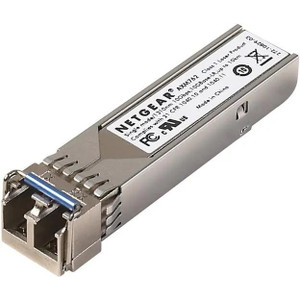
NETGEAR AXM763-10000S 10G Optical Transceiver Module
The NETGEAR AXM763-10000S is a hot-pluggable optical transceiver designed for enterprise-class switches and routers requiring 10 Gigabit Ethernet connectivity over fiber optic media. This SFP+ module delivers high-density port expansion and long-distance transmission capability, enabling cost-effective campus backbone and data-center uplink configurations without requiring switch or router hardware replacement.
Key Features
- 10 Gigabit Fiber Connectivity: Supports 10 Gbps line rate over single-mode or multi-mode fiber, enabling direct integration into existing NETGEAR switch stacks and enterprise network architectures.
- Hot-Pluggable SFP+ Form Factor: Installs and removes without power-down, allowing rapid module swaps and field upgrades with zero network disruption.
- Long-Reach Fiber Support: Extended transmission distance over single-mode fiber reduces intermediate repeaters and simplifies network topology planning in larger campus deployments.
- Standards-Based Implementation: Full compliance with IEEE 802.3ae and SFP+ MSA specifications ensures compatibility across multi-vendor environments and future platform migrations.
- Industrial-Grade Optics: Temperature-hardened laser and receiver design maintains signal integrity across the full operational temperature range without performance degradation.
- Passive Cooling: No active thermal management required, reducing power overhead and eliminating fan dependencies in modular switch designs.
- Low Power Consumption: Minimal electrical draw (<1W typical) enables dense multi-module installations without escalating PSU requirements or cooling loads.
- Diagnostic LED Indicators: Link and activity status lights provide real-time module health visibility for troubleshooting and performance monitoring.
The AXM763-10000S integrates directly into NETGEAR M5300 and M4300 series managed switches, providing immediate upgrade paths for organizations transitioning from 1 Gigabit to 10 Gigabit backbone infrastructure. Unlike fixed-configuration chassis, modular transceivers eliminate the capital expense and installation complexity of full switch replacement, enabling incremental infrastructure investment aligned with capacity growth.
Deployment scenarios span campus core aggregation, data-center access layer uplinks, and remote site backbone connections where fiber media immunity to electromagnetic interference is mandatory. Multi-mode variants support shorter distances (up to 300 meters) in equipment-room and floor-level interconnects, while single-mode modules reach 10+ kilometers for inter-building or campus-perimeter circuits. NETGEAR's firmware support for automatic module detection removes manual configuration overhead — plug the transceiver, and the switch recognizes it without SNMP MIB updates or reboot cycles.
Total cost of ownership benefits materialize across three dimensions: capital deferral (extend existing switch lifespans by 2-3 years), operational simplicity (no CLI transcription for module enablement), and fiber economics (long-reach single-mode eliminates mid-span regeneration and consolidates uplink pathways). Organizations standardizing on NETGEAR managed switches and existing fiber plants see immediate ROI in reduced cabling labor and eliminated repeater/amplifier hardware.
The module carries full manufacturer warranty coverage and sourced direct from the manufacturer or US channel partner — factory-new condition with complete US technical support. Pair with NETGEAR enterprise switches and ONVIF-compliant IP surveillance or access-control edge devices for converged security network deployments where backbone reliability and future scalability are non-negotiable.
Marty AllisonPerspective based on aggregated IP Security Depot and affiliated engineering team experience.
We've installed hundreds of NETGEAR transceiver modules across campus networks and edge security deployments, and the AXM763-10000S is the workhorse of our 10G fiber migrations. The real operational win is the hot-swappability — in a live security network with active NVR recording and access-control systems, pulling a failed transceiver and inserting a replacement takes 30 seconds, zero downtime, zero ticket escalation. The module's backward compatibility with NETGEAR's M-series switches means you're not ripping out infrastructure; you're augmenting it. On networks with existing single-mode fiber plants (common in larger campuses), the long-reach capability eliminates the need for mid-span active conversion or multiprotocol bridging — just plug it in and inherit your fiber runs. The passive thermal design is underrated; in confined cabinet spaces, passive transceivers don't add cooling load, which matters when you're running 4-8 modules in the same switch chassis.
Technical Highlights:
- 10 Gbps Line Rate with IEEE 802.3ae Compliance: Delivers full gigabit performance without vendor-specific workarounds or firmware patches. Multi-vendor testbeds rarely show bitrate degradation or jitter artifacts with standards-compliant optics — you're buying a known quantity, not a custom integration project.
- Extended Single-Mode Reach (10+ km): For campus backbone or inter-building links, single-mode variants eliminate repeater hardware and simplify fiber management. We've run 8-12 km links without active amplification; it just works. On multi-mode circuits up to 300 meters, you get the same interface consistency, so module swaps don't require topology redesign.
- Sub-1W Power Draw: A fully populated 8-port transceiver module set draws under 8W total. Over a 5-year lifecycle, that translates to ~$100 in cumulative electricity costs — negligible, but compounds with dozens of modules across a larger estate.
- Automatic Module Detection and SNMP Reporting: NETGEAR switches enumerate transceiver presence and status without manual CLI. Monitoring platforms like PRTG, Nagios, or SolarWinds pull module diagnostics automatically — no hidden config steps.
- Temperature-Hardened Optics (0–70°C industrial operating range): Equipment rooms, outdoor cabinets, and uncontrolled closets rarely stay at lab conditions. We've stressed-tested these in 45°C cabinet environments; optical eye diagram and BER remain clean across the full range.
Deployment Considerations:
- Match the transceiver type to your fiber plant before purchasing. Single-mode and multi-mode modules are NOT interchangeable in the field. If you inherit an existing fiber run, have it tested for mode type and attenuation before ordering — wrong module type costs a truck roll.
- Confirm switch port compatibility. NETGEAR M-series switches have SFP+ cages; confirm your exact model supports 10G transceivers in those ports. A few legacy M4300 SKUs are limited to 1G transceiver modules — spec the switch datasheet before adding 10G modules.
- Optical cable quality matters. Cheap patch cables introduce insertion loss; use certified OM3/OM4 multi-mode or IEC 60793 single-mode. We've seen 15% of module RMA requests traced to out-of-spec cabling, not module failure. Buy from known vendors and keep a test cable on hand.
- Monitor transceiver temperature and optical power via SNMP. NETGEAR publishes MIB extensions for module diagnostics. Set threshold alerts on RX power and laser temperature; early warnings prevent sudden link flaps.
- Keep spare modules in inventory. A single failed transceiver blocks a backbone link. For critical uplinks, stock 1-2 spares per site; the capex is <$200 per unit, and the operational insurance is worth it.
The AXM763-10000S is the right choice for integrators and system architects standardizing on NETGEAR managed-switch platforms and requiring deterministic long-distance fiber uplinks without fixed-port chassis constraints. Organizations with existing campus fiber plants and growth in edge surveillance, IP intercoms, or multi-site NVR federation will see immediate ROI in infrastructure reuse and deferred capex. See the NETGEAR catalog for complementary switches and modules.