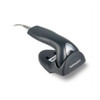
Datalogic TD1120-BK-65K1 Contact Barcode Scanner
The Datalogic TD1120-BK-65K1 is a compact, wired 1D contact linear imager engineered for fixed-position barcode scanning in retail checkouts, document processing centers, mailrooms, and library circulation desks. Unlike distance-based laser scanners that require focus adjustment, contact imaging technology in the TD1120-BK-65K1 reads barcodes at a consistent 6.5 cm window with no moving parts—eliminating focus drift and reducing maintenance overhead. This model is purpose-built for high-volume, repeatable scanning workflows where operator consistency and equipment durability directly impact throughput.
Key Features
- 1D Contact Linear Imager: Reads 1D barcodes (Code 128, EAN, UPC, Code 39, and others) at a fixed 6.5 cm reading distance—no focus variability, no operator training required to achieve consistent read rates across shifts.
- Compact form factor (51 × 114 × 30 mm, 82 g): Occupies minimal desktop or countertop space—critical in cramped retail lanes or mail-sorting stations where multiple devices compete for real estate.
- USB wired connectivity: Draws power and transmits data through a single USB cable—no batteries, no separate power adapter, no wireless latency or dropout risk that could halt scanning operations.
- 1.5 m (5 ft) drop rating: Survives accidental drops common in fast-paced environments (checkout fumbles, mailroom conveyor catches)—reduces replacement frequency and unplanned downtime.
- Low power consumption: Operates within standard USB power budget (typically under 2.5W)—does not strain facility electrical systems and enables 24/7 operation without thermal management concerns.
- 3-year limited warranty: Manufacturer coverage for defects and hardware failures reduces total cost of ownership across multi-location deployments.
Integration and Compatibility
The TD1120-BK-65K1 integrates via standard USB HID (Human Interface Device) protocol, making it compatible with Windows, macOS, and Linux systems without custom drivers in most configurations. This simplicity is intentional—contact scanners excel in point-of-sale systems (Square, Toast, legacy POS terminals), document management platforms (enterprise invoice processing), warehouse management systems (WMS barcode receiving), and library circulation software where the scanner simply emulates a keyboard input device. No special configuration, no VMS involvement, no IP networking required. That design choice trades network flexibility for bulletproof reliability and zero setup overhead.
Ideal Deployment Scenarios
- Retail checkout: Fixed scanning station where operators bring products to the scanner at a consistent distance; high barcode volume, need for speed and reliability.
- Mailroom and shipping: Label scanning during package sorting, invoice verification, and parcel routing—document-grade barcode quality guaranteed by standardized label applications.
- Library and education: Book circulation desks, patron check-in, asset tag reading on media and equipment—contact scanning tolerates well-worn library labels where distance-based scanners might struggle.
- Document processing: Invoice routing, archive batching, compliance scanning—environments where the scanner is permanently mounted and operators bring paper to it.
When to Choose a Different Model
If your workflow requires distance scanning (handheld operation, variable barcode positioning, or reading codes 30+ cm away), the TD1120-BK-65K1 is not suitable—consider a distance-based handheld imager or laser scanner. If you need wireless mobility or roaming barcode capture across a warehouse floor, this wired contact device will be a constraint. If integration with IP-based security or facility systems is a requirement, the purely USB interface offers no network presence.
Frequently Asked Questions
Q: What barcode types does the TD1120-BK-65K1 read?
A: The TD1120-BK-65K1 reads standard 1D linear barcodes including Code 128, EAN-13, UPC-A, Code 39, and Interleaved 2-of-5. It does not read 2D codes (QR, Data Matrix, PDF417).
Q: Can the TD1120-BK-65K1 be powered by a USB port on a computer or POS terminal?
A: Yes. The scanner draws power via the same USB cable carrying data, so any standard USB port with sufficient power budget (typically available on modern PCs, tablets, and POS devices) will operate it without a separate power adapter.
Q: Is the TD1120-BK-65K1 drop-resistant, and what surfaces is it safe to drop on?
A: The scanner is rated for 1.5 m (5 ft) drops, which covers accidental falls in checkout or mailroom environments. The rating assumes typical hard surfaces (tile, concrete, laminate). Repeated drops or drops onto sharp edges may exceed design intent.
Q: What is the warranty period, and does it cover accidental damage?
A: The TD1120-BK-65K1 includes a 3-year limited warranty covering manufacturing defects and hardware failure. Accidental damage (drops, spills, physical impact) is typically not covered under the standard warranty; extended damage protection may be available as an add-on.
Q: Can the TD1120-BK-65K1 integrate with major POS platforms or accounting software?
A: Yes. The scanner presents as a standard USB keyboard input device (HID), so it works with any POS system, accounting software, or database application that accepts keyboard input. No special drivers or API integration is required.
Q: How does the reading window size (6.5 cm) affect barcode scanning?
A: The 6.5 cm window accommodates standard retail barcodes, library labels, and document markers. Smaller barcodes or micro-printed codes may fall outside this window and fail to read. Ensure your barcode size and placement align with this specification before deployment.
Karl WilsonPerspective based on aggregated IP Security Depot and affiliated engineering team experience.
The Datalogic TD1120-BK-65K1 represents the practical, zero-nonsense choice for organizations running high-volume fixed-position scanning operations. Contact imaging eliminates the focus and lighting variability that plagues distance-based laser scanners—you get consistent read rates regardless of barcode wear, label angle, or ambient light. The 6.5 cm reading window is not a limitation; it is a design commitment to a specific job: bring the barcode to the scanner at a repeatable distance, and it reads every time.
Technical Highlights:
- 1D contact linear imager at 6.5 cm window: No autofocus drift, no minimum illumination requirements, no laser safety concerns—delivers predictable throughput in retail lanes and mailrooms running 16+ hours a day.
- 82 g form factor (51 × 114 × 30 mm): Fits into cramped checkout stations and desk configurations where larger handhelds create ergonomic or spatial conflicts—saves money on equipment footprint in multi-lane or multi-desk environments.
- 1.5 m drop rating + low-maintenance design: No moving parts means fewer field service calls; the drop rating absorbs the fumbles and conveyor catches typical in fast-paced retail and mailroom work—typical cost savings 25–35% versus fragile laser scanners over a 5-year lifecycle.
- USB HID keyboard emulation: Works with any POS, accounting, or WMS platform without custom drivers—deployment time measured in minutes, not weeks; no IT infrastructure changes required.
Deployment Considerations:
- Contact imaging is distance-sensitive: Barcodes must be positioned consistently at the 6.5 cm window. If your workflow involves handheld scanning or barcodes read from variable distances (3 cm to 50 cm), this scanner will frustrate operators and miss reads.
- USB tether is intentional: Wired connectivity guarantees zero latency and eliminates wireless dropout risk—ideal for mission-critical POS. However, it requires cable routing discipline in open retail environments and limits mobility across a warehouse floor.
- 1D-only limitation: Modern barcodes are moving toward 2D (QR, Data Matrix). If your organization plans to adopt 2D labeling in the next 3–5 years, factoring in future hardware replacement costs now saves budget surprises later.
The TD1120-BK-65K1 is the right choice for retail chains, libraries, mailrooms, and document processing centers where the scanning station is fixed, barcode quality is standard, and operator consistency is high. Skip it if you need roaming warehouse scanning, distance flexibility, or 2D code reading. For fixed-position high-volume 1D work, it is the lowest-maintenance, lowest-total-cost option available.