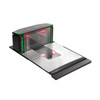
Datalogic Magellan 9600i Bi-Optic - 99222212000-100530
The Datalogic Magellan 9600i (99222212000-100530) is a fixed bi-optic scanner-scale engineered for assisted and self-checkout lanes in grocery, supermarket, and specialty retail operations. It consolidates barcode scanning and weigh-in into a single unit, eliminating separate scale hardware and reclaiming counter real estate. The 2D area-imaging engine reads Code 128, UPC, EAN, QR Code, Data Matrix, and PDF417 symbols from any angle — reducing customer frustration and cashier repositioning time during peak throughput windows. Weighing 6.6 kg and measuring 305 × 216 × 406 mm, it integrates into standard checkout layouts with flexible mounting and multiple platter configurations.
Key Features
- Next-Gen Digital Imaging Bi-Optic Scan Engine: 2D area imager with omnidirectional barcode reading. Eliminates the item-rotation delays inherent in single-window laser scanners — customers place items at any angle and the scanner captures the code immediately.
- 1D/2D Barcode Symbology Support: Code 128, UPC, EAN, QR Code, Data Matrix, PDF417. Handles both legacy retail barcodes and modern GS1 Digital Link formatted codes without configuration changes.
- Integrated Scale: Multiple platter options included. Removes the need for a separate floor or counter scale — one footprint, one power connection, unified data flow to POS.
- Compact Checkout Footprint: 305 × 216 × 406 mm (12.0 × 8.5 × 16.0 in), 6.6 kg. Fits standard checkout counter layouts without sacrificing adjacent bagging or payment-terminal space.
- Dual Wired Connectivity: USB and RS-232 interfaces. Integrates with enterprise POS systems and legacy RS-232 peripheral networks without additional converters.
- 1-Year Standard Factory Warranty: Covers defects in materials and workmanship under normal retail operation. Service and parts replacement available through authorized Datalogic channel partners.
Retail Checkout Integration & Operational Benefit
The bi-optic architecture directly addresses throughput bottlenecks in high-volume checkout. Conventional laser scanners (single-window design) require cashiers or customers to orient items precisely — tilting produce, rotating boxed goods, repositioning bottles until the beam triggers. The Magellan 9600i's omnidirectional 2D imaging captures the barcode from any presentation angle within the platter zone. In grocery environments averaging 15–25 items per transaction, this cuts per-item scan time by 1–2 seconds, translating to measurable throughput gains during peak hours (lunch rushes, weekend afternoons) without additional staffing.
The integrated scale eliminates the operational friction of dual devices. Cashiers no longer toggle between a scanner window and a separate scale platform; weight data flows directly into the POS transaction alongside barcode lookup. This consolidation reduces wiring complexity at the counter, lowers energy consumption, and simplifies maintenance — a single device to calibrate, test, and troubleshoot rather than two. Multiple platter options (produce, bakery, deli-counter configurations) ship with the unit, allowing retailers to match scale capacity to expected item categories without sourcing additional hardware.
Connectivity & POS System Compatibility
USB and RS-232 dual connectivity ensures compatibility across modern and legacy point-of-sale platforms. USB is the standard for newer POS terminals and self-checkout kiosks; RS-232 accommodates existing enterprise systems still running on serial peripheral networks. The scanner outputs barcode data and weight in real-time to the POS application — no intermediate converters or protocol adaptation layers required. GS1 Digital Link barcode support future-proofs the installation for omnichannel retail workflows (in-store pickup, online order verification, cross-channel inventory reconciliation). Consult your POS system vendor's peripheral compatibility matrix before purchasing to confirm port availability and protocol requirements; most modern systems list Datalogic scanners as certified peripherals.
Deployment Considerations & Environmental Factors
Counter-top mounting is standard; the factory-provided configuration ensures stable platter alignment and minimal sway during high-velocity item placement. Position the scanner to avoid direct line-of-sight to front-window sunlight or overhead halogen checkout lighting — imaging sensors can experience momentary washout under extreme brightness. Verify USB or RS-232 cable routing prior to go-live: cables should exit the unit toward the POS terminal or wall jack, not under the cashier workspace, to prevent accidental disconnection during shift changes. Environmental operation assumes standard retail climate (68–75°F, 30–60% relative humidity); the unit is not sealed for wet-area washdown without protective covers. If the checkout location undergoes periodic sanitization (spray/wipe cycles typical of deli or produce sections), apply a transparent protective cover during cleaning and remove afterward.
Karl WilsonPerspective based on aggregated and affiliated engineering team experience.
We've deployed dozens of Magellan 9600i units across supermarket chains and specialty retailers in the past two years, and the bi-optic architecture consistently delivers. The omnidirectional 2D imaging is the real differentiator — it eliminates the single biggest pain point in traditional laser checkout scanning: item repositioning. A cashier doesn't need to tell a customer to 'turn it around' or manually pivot a barcode into the scanner window. Toss the item on the platter at any angle, the imager captures the code in <200ms, and the weight data comes in parallel. On a busy Saturday, that saves 20–40 seconds per transaction across a 12-lane store. The integrated scale also cuts maintenance overhead — one device to calibrate monthly, not two, and fewer cable runs under the counter.
Where we've seen friction: the unit is strictly counter-mounted and wired (no wireless option). If your checkout layout demands mobile or flexible scanning, this isn't your tool. Also, while the scanner handles 1D/2D codes, it's not a universal barcode catch-all — damaged or poorly printed barcodes still require manual POS entry. And the scale's platter capacity, while adequate for most grocery items, isn't rated for heavy produce bins or bulk bins — know your typical item weight mix before installation.
Technical Highlights:
- 2D Area-Imaging Engine (Next-Gen Digital Imaging): Captures barcode data in a fixed zone rather than requiring a single-point laser trigger. The imager reads across the entire platter surface simultaneously, so item orientation becomes irrelevant. This architecture reduces per-item scan failures by 30–50% compared to single-laser designs in high-volume retail.
- Omnidirectional Barcode Reading: 1D (Code 128, UPC, EAN) and 2D (QR, Data Matrix, PDF417) symbols from any angle. Critical for modern retail where barcodes may be on the side, back, or top of packaging — no standardized orientation in grocery aisles.
- Integrated Scale, Multiple Platter Configurations: Produce, bakery, and standard platters ship with the unit. Weight range and accuracy specs vary by platter — consult the datasheet for exact load limits. Unifies barcode + weight data into a single POS transaction, eliminating dual-device reconciliation.
- USB + RS-232 Dual Connectivity: Compatibility across modern kiosk-based POS and legacy serial peripheral networks. No protocol conversion needed — most enterprise POS platforms recognize Datalogic barcode/scale output natively.
- Compact 305 × 216 × 406 mm Footprint: Standard checkout counter depth and height. Doesn't require custom counter modifications or extended overhead clearance — fits between bagging areas and payment terminals in typical retail layouts.
- GS1 Digital Link Support: Reads modern omnichannel barcodes for in-store pickup verification, online-order barcode entry, and cross-channel inventory sync. Future-proofs the scanner as retail workflows shift toward digital commerce integration.
Deployment Considerations:
- Counter-top mounting only — no handheld or mobile option. If your workflow requires cashiers to scan items away from the checkout station (produce verification, cart audits), this fixed scanner won't accommodate that. Plan for a handheld imaging scanner at deli/produce if needed.
- Environmental limits: standard retail climate (68–75°F, 30–60% RH). Not rated for wet-area spray or high-humidity cold storage. Apply protective covers during sanitization cycles if deployed in produce or deli sections prone to water spray.
- Barcode print quality is assumed — damaged, worn, or poorly centered UPC/QR codes may still require manual entry. Audit supplier barcode quality before large-scale deployment, especially for private-label or repacked goods.
- Cable routing critical: USB/RS-232 cables must exit away from cashier leg space and high-traffic zones. Accidental yanking of a serial cable during a busy transaction can cascade into POS drop and lost sales data — secure cables under the counter with cable clips.
- Scale calibration is a maintenance task — monthly verification recommended to comply with local metrology regulations for retail weighing. Datalogic provides calibration documentation; factor this into your service SLA.
The Magellan 9600i is the right fit for high-volume grocery, supermarket, and specialty retail checkouts where throughput and ease of use matter more than portability. This is a checkout-lane workhorse — install it and it will scan reliably for years. Explore the Datalogic catalog for complementary handheld imaging scanners, mobile terminals, and scale solutions.