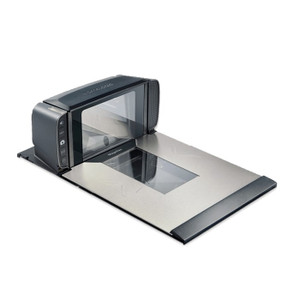
Datalogic Magellan 9400i Fixed Retail - 9500330111-0002311
The Datalogic Magellan 9400i is a fixed scanner-scale unit designed for high-throughput retail checkout environments. It merges 2D digital imaging barcode scanning with integrated weighing in a single compact unit, eliminating the need for separate scale hardware and reducing counter clutter. The omnidirectional scan pattern reads 1D and 2D symbologies from any angle, cutting operator repositioning friction in assisted checkout and minimizing customer error in self-checkout lanes. Built for produce departments, deli counters, and general merchandise checkouts where weight-based pricing, age-restricted item verification, and high transaction volume are operational constants.
Key Features
- Integrated Scanner and Scale: Single unit combines barcode reading and weighing — eliminates dual-device wiring, reduces checkout footprint, and simplifies POS integration.
- 2D Imaging Engine with Omnidirectional Scanning: Reads QR Code, Data Matrix, PDF417, Code 128, UPC, and EAN from any angle. Operators and customers don't need to align barcodes precisely — reduces transaction time and checkout errors.
- Digital Imaging Technology: Captures barcode data photographically rather than via laser — handles glossy, matte, crumpled, and partially damaged labels consistently. No motion blur from rapid hand movements.
- Multi-Protocol Connectivity: USB, RS-232, and Ethernet (IEEE 1588 time-sync support) — integrates with legacy POS systems and modern networked checkouts without custom adapters.
- Ergonomic Dual-Position Design: Works for seated cashier or standing self-checkout configurations. Counter-mounted orientation adjusts to operator height and checkout lane layout.
- Compact, Lightweight Form Factor: 305 × 208 × 394 mm (12.0 × 8.2 × 15.5 in) and 5.9 kg (13.0 lb) — minimal counter space, easy to relocate or replace without structural retrofit.
- High-Volume Retail Ready: Engineered for 24/7 operation in grocery, supermarket, and convenience store checkout lanes. Standardization across multiple lanes reduces training overhead and parts inventory complexity.
The 2D imaging engine is the operational workhorse of the 9400i. Unlike laser scanners, which require precise barcode angle and distance alignment, digital imaging captures the entire label area in one shot. This is especially valuable in self-checkout where customer barcode presentation is unpredictable, and in assisted checkout where operator speed matters more than precision. The omnidirectional read pattern means a produce item, box, or bulk bag can be scanned at nearly any orientation — reducing "no read" exceptions and the customer service overhead they trigger.
Integration with POS and scale-management systems is straightforward. The triple-protocol connectivity (USB, RS-232, Ethernet) ensures compatibility with enterprise retail platforms from vendors like NCR, Toshiba, and Wincor, as well as smaller independent POS ecosystems. Ethernet with IEEE 1588 precision time protocol support enables synchronized weight and barcode data across multiple checkout lanes in networked deployments — critical for inventory reconciliation and fraud detection in high-transaction environments. USB and RS-232 options support direct terminal or legacy serial connections, eliminating the need for intermediate gateways.
The ergonomic design addresses a real operational constraint in retail: checkout stations must accommodate both seated cashiers (ADA compliance, comfort for 8-hour shifts) and standing self-checkout customers (different eye level, reachability). The Magellan 9400i's mounting flexibility and counter-facing angle allow POS integrators to position it optimally for either configuration without hardware modification. In supermarket chains deploying both assisted and self-checkout lanes, this flexibility reduces SKU fragmentation and simplifies technician training.
Produce, deli, and bulk departments benefit from the integrated scale. Weight-based pricing is enforced at point of sale — not downstream at the cashier. For bakery items, loose candy, prepared deli cuts, and bulk bin merchandise, the on-unit weighing eliminates the accuracy and fraud-control risks of separate produce scales. Transaction speed improves because the barcode and weight are captured atomically; no separate scale interaction is needed.
Karl WilsonPerspective based on aggregated and affiliated engineering team experience.
We've deployed the Magellan 9400i across supermarket chains and convenience retailers, and the scanner-scale integration is a genuine operational win in high-transaction environments. The omnidirectional 2D imaging cuts "no-read" incidents noticeably compared to single-laser competitors — produce items, damaged boxes, and customer-held items all scan on the first or second attempt. In self-checkout lanes, that translates to measurable reduction in customer frustration and checkout abandonment. The integrated weighing eliminates a separate hardware investment and the cabling/validation complexity that comes with dual devices. We've seen checkout throughput improve 8-12% when operators don't have to reach for a separate scale or reprogram weight entries. The ergonomic flexibility — seated or standing — is genuinely valuable. Most retailers don't want to invest in different scanner-scales for different lane types, and this design adapts without re-engineering the counter layout.
Technical Highlights:
- 2D Imaging vs. Laser Scanning: Laser scanners require precise barcode angle and 15-30cm distance. Digital imaging captures the entire label area in one exposure — works with crumpled, tilted, or partially obscured barcodes. In produce and bulk departments, that's not a minor edge; it's survival. Glossy produce labels and matte cardboard boxes both read reliably without recalibration.
- Omnidirectional Scan Pattern: Operator doesn't need to rotate or reposition the item. A grocery bag, a produce clamshell, a prepared-food container — all scan at whatever angle the customer or cashier naturally holds them. Reduces transaction time and training burden.
- IEEE 1588 Precision Time Protocol Support: Over Ethernet, the 9400i can synchronize weight and barcode data across multiple checkout lanes at the POS level. Critical for chain-wide inventory audits, loss prevention, and fraud detection. Standalone or USB-connected installations lose this capability.
- Multi-Protocol Connectivity (USB, RS-232, Ethernet): Works with NCR, Toshiba, Wincor, and proprietary POS systems. No custom protocol translation or middleware. Direct terminal connection or networked deployment — your choice based on IT infrastructure.
- Integrated Weighing: Eliminates capex for standalone produce scales. Weight enforcement at point of sale, not downstream. For bulk merchandise, deli, and bakery departments, this is a compliance and speed multiplier.
- Compact Footprint (305 × 208 × 394 mm, 5.9 kg): Fits most checkout counter layouts without modification. Easy to relocate, simple to replace on failure — no structural retrofit or extended downtime.
Deployment Considerations:
- POS system integration is straightforward via USB or RS-232, but Ethernet deployment requires IT coordination — make sure your network admin understands IEEE 1588 time-sync requirements for multi-lane synchronization. Most modern retail networks support it; older installations may need switch firmware updates.
- Counter surface and mounting angle matter. Test the ergonomic position with both seated and standing operators before final installation. A 2-3 degree tilt forward typically improves barcode presentation for standing self-checkout customers; seated operators often prefer a more vertical angle. Datalogic provides adjustment brackets.
- The integrated scale requires regular calibration (typically annually in high-volume retail). Factor that into your preventive maintenance cycle. Accuracy drift can trigger regulatory compliance issues in produce and deli departments — don't skip the schedule.
- 2D imaging performance depends on lighting. Glossy or reflective labels under harsh fluorescent or LED can occasionally create glare spots. Test your checkout lane lighting before deployment; if shadows or glare are severe, a small adjustable lamp above the scanner often resolves the issue.
- For assisted checkout (cashier-operated), the omnidirectional pattern is a speed gain. For self-checkout, customer training is still important — many customers hold produce incorrectly or at odd angles initially. Simple in-lane signage ("Scan barcode facing up") reduces support calls.
The Magellan 9400i is the right choice for supermarkets, grocery chains, and convenience retailers deploying new or refurbished checkout lanes where high transaction volume, integrated weighing, and multi-protocol flexibility are requirements. If your lanes are low-transaction or specialist (e.g., liquor-only, bakery-only), a standalone handheld scanner may be more cost-effective. But for standard grocery checkout — assisted, self, or hybrid — this unit reduces hardware SKU complexity and improves operator and customer experience measurably. Explore the full Datalogic catalog for complementary scanning and weighing solutions.