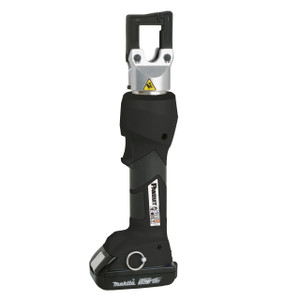
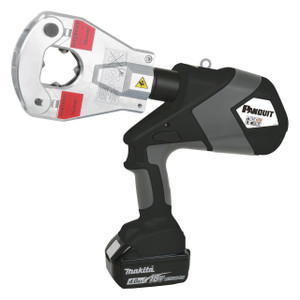
Image coming soon
Product images are provided for reference and may not represent the exact model, configuration, or included components.

No Bots, Just Experts

Questions about this product? Free pre-sales support from a senior specialist — product questions, compatibility checks, BOM quotes, price confirmation — typically answered within one business day. Need camera placement or system design work? Engineering time is $175 per hour (qty 1 = 1 hour). Hardware buyers get up to one hour ($175) credited back on their order.

Description

Panduit CT-1701 Controlled Cycle Crimp Tool for #10–#2 AWG

Overview

The Panduit CT-1701 is a controlled-cycle crimp tool engineered for reliable, repeatable terminations across a five-position rotating die index — covering wire sizes from #10 down to #2 AWG. Whether you're terminating copper conductors on a structured cabling backbone, wiring a power distribution panel, or commissioning grounding runs in a rack environment, the CT-1701 (often searched as CT 1701) enforces consistent crimp geometry via a 15 lbs-force (67 N) minimum preload threshold, so every termination either meets spec or doesn't complete the cycle. That mechanical interlock is the defining feature for installers who need documented, auditable crimp quality rather than operator-feel feedback.

Panduit positions this tool within its broader Panduit structured cabling and termination line as a production-grade crimper suited to commercial and industrial environments where connection integrity directly affects system uptime. If you're sourcing for a structured cabling project, this sits alongside cable management and termination hardware as a core field tool.

Key Features

  • 5-Position Rotating Die Head (#10–#2 AWG): The rotating die index lets a single tool cover five conductor sizes without swapping dies mid-run. In practice, that means a technician wiring a 20-circuit panel doesn't have to stop to change tooling between #10 branch circuits and #2 feeder runs — real time savings on high-count termination jobs.
  • Controlled Cycle Mechanism with 15 lbs-force Preload: The tool won't release until it reaches a minimum 15 lbs-force (67 N) preload, preventing the partially-crimped termination that passes visual inspection but fails under load. On safety-critical runs — grounding conductors, emergency circuits — this is the difference between a documented connection and a liability.
  • GO/NO-GO Die Geometry per Position: Each die index carries a defined GO and NO-GO diameter pair. At P10, GO is 0.099
Specifications
Tool Number: CT-1701
Die Index P10 GO Dia: 0.099"
Die Index P10 NO GO Dia: 0.109"
Die Index P10 GO Dia Metric: 2,51 mm
Die Index P10 NO GO Dia Metric: 2,76 mm
Die Index P8 GO Dia: 0.179"
Die Index P8 NO GO Dia: 0.201"
Die Index P8 GO Dia Metric: 4,54 mm
Die Index P8 NO GO Dia Metric: 5,10 mm
Die Index P6 GO Dia: 0.217"
Die Index P6 NO GO Dia: 0.238"
Die Index P6 GO Dia Metric: 5,51 mm
Die Index P6 NO GO Dia Metric: 6,04 mm
Die Index P4 GO Dia: 0.273"
Die Index P4 NO GO Dia: 0.295"
Die Index P4 GO Dia Metric: 6,93 mm
Die Index P4 NO GO Dia Metric: 7,49 mm
Die Index P2 GO Dia: 0.351"
Die Index P2 NO GO Dia: 0.374"
Die Index P2 GO Dia Metric: 8,91 mm
Die Index P2 NO GO Dia Metric: 9,49 mm
Preload Force: 15 lbs-force (67 N) Minimum
Wire Range: #10 - #2 AWG
Wire Range Copper: #14 - 10 AWG
Die Positions: 5-Position Rotating
Q&A
Reviews

Panduit CRIMP TOOL CONTROLLED CYCLE - CT-1701

$424.45
$302.99

RELATED PRODUCTS

System Design, Deployment & Technical Support

Support services and planning resources for commercial surveillance, access control, and infrastructure deployments.

Fixed scope • Fixed price

System Design Assistance

  • Get help validating product compatibility
  • Coverage requirements
  • Storage planning and deployment architecture before you buy.
Request Design Help

Deployment & Configuration Support

  • Access fixed-scope support for rollout planning
  • User setup guidance
  • Migration and system standardization across single-site or multi-site deployments
View Support Services

Guides, Tools & Calculators

  • PoE requirements
  • Storage retention
  • Camera selection and deployment methodology
Open Technical Resources