
Hanwha QNF-9010 vs i-PRO S4176A: Specification Comparison
Both the Hanwha QNF-9010 and the i-PRO WV-S4176A are 12-megapixel indoor fisheye IP cameras designed for single-sensor 360-degree ceiling coverage in commercial environments. This comparison examines their imaging performance, physical installation requirements, and system-integration capabilities to help installers and IT buyers determine which unit better fits a given deployment. Neither camera includes IR illumination, and both rely on ambient light. Pricing, availability, and subjective image quality are outside scope; all claims below are derived solely from the published specifications provided.
In This Guide
How do the imaging specs compare?
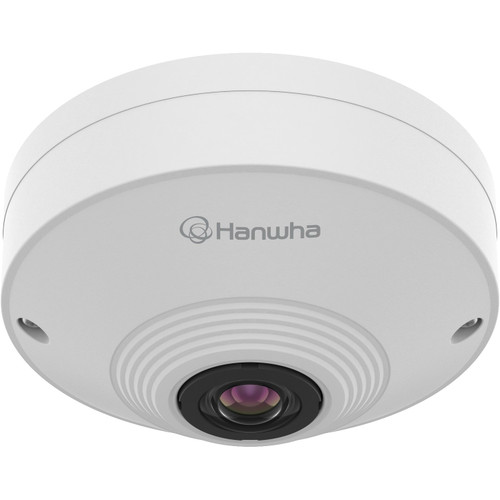
The QNF-9010 uses a 1/2.3-inch 12MP CMOS sensor with a 1.08 mm f/2.2 lens, delivering a 187° horizontal and vertical field of view and a native resolution of 3008×3008 pixels. Its minimum color illumination is rated at 0.39 lux, and it provides 120 dB WDR via Hanwha's SSDR/BLC processing. DORI detection reach is 34.9 m, with identification at 3.5 m.
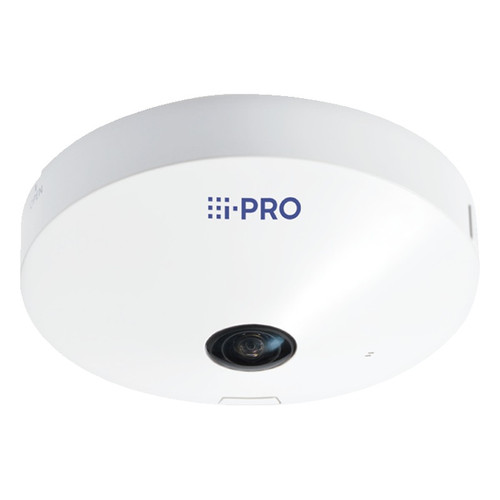
The WV-S4176A pairs an approximately 1/2-inch 12MP CMOS sensor with a 1.4 mm f/1.9 lens, covering 183° horizontally and vertically at a fisheye resolution of 2992×2992 pixels. Its wider aperture (f/1.9 vs. f/2.2) and lower minimum illumination—0.3 lux color / 0.2 lux black-and-white—give it a measurable low-light advantage. WDR is rated at up to 84 dB. DORI detection reach is 29.9 m, shorter than the QNF-9010, with identification at 3.0 m. The QNF-9010's longer DORI distances reflect the wider FOV and higher pixel-per-degree density despite the smaller sensor.
What about installation and environment?
The QNF-9010 is rated IP42, weighs 370 g, and measures Ø99×49 mm. It operates from −10°C to +40°C and draws a maximum of 7.7 W via IEEE 802.3af PoE Class 3. No IK impact rating is published in the provided specs. It also provides a CVBS composite video output (720×480/576) for installation-time alignment without a laptop. DC 12V input is not listed as an option.
The WV-S4176A is larger at Ø150×49.5 mm and heavier at approximately 420 g. It operates to a higher maximum temperature of +50°C, which may matter in warm equipment rooms. It accepts both IEEE 802.3af PoE (Class 0) and DC 12V at 680 mA, providing a redundant power path. No IP or IK ratings are stated in the provided specifications. A ±5° fixing-angle adjustment is built in.
Which fits your VMS and analytics better?
Both cameras support ONVIF Profiles S, G, and T. The WV-S4176A additionally supports ONVIF Profile M, which covers metadata streaming for AI-tagged objects—relevant for VMS platforms that consume standardized analytics metadata. The QNF-9010 supports Hanwha's SUNAPI and the Wisenet open platform alongside ONVIF, providing deeper integration with Wisenet VMS. The WV-S4176A supports up to 14 concurrent unicast streams; the QNF-9010 supports 6 unicast users plus multicast.
On-camera analytics differ significantly. The QNF-9010 offers people counting, heatmap, defocus detection, and tampering. The WV-S4176A adds AI-VMD, AI Privacy Guard, AI Scene Change Detection, and AI Sound Classification (gunshot, yell, vehicle horn, glass break), all executed on its Ambarella CV22 SoC. The WV-S4176A includes a built-in nondirectional microphone, a 3.5 mm audio output, and G.711/G.726 compression; the QNF-9010 does not specify audio capability. Edge storage on the QNF-9010 supports microSD/SDXC up to 256 GB explicitly; the WV-S4176A supports microSD but maximum capacity is not stated in the provided specs. The WV-S4176A also exposes three alarm I/O terminals plus one AUX output; the QNF-9010 does not list hardware I/O terminals.
Which should you choose: the QNF-9010 or the S4176A?
Our take: The WV-S4176A is the stronger choice when the deployment requires on-camera AI analytics, audio detection, alarm I/O terminals, or integration with a VMS that consumes ONVIF Profile M metadata. Its f/1.9 aperture and 0.2 lux black-and-white sensitivity outperform the QNF-9010's f/2.2 / 0.39 lux color minimum in dim environments, and its 50°C operating ceiling versus the QNF-9010's 40°C provides headroom in warmer spaces. The dual PoE/DC 12V power input adds installation flexibility. The QNF-9010 holds concrete advantages in WDR headroom (120 dB vs. 84 dB), DORI detection reach (34.9 m vs. 29.9 m), confirmed IP42 ingress protection, an explicit 256 GB edge-storage ceiling, a smaller footprint (Ø99 mm vs. Ø150 mm), and deeper native Wisenet VMS integration via SUNAPI. Choose the QNF-9010 for Wisenet-centric deployments with high-contrast lighting challenges; choose the WV-S4176A where AI sound classification, audio I/O, hardware alarm terminals, or ONVIF Profile M are required.
Side-by-Side Comparison
Spec-for-spec, from manufacturer data.
| Specification | Hanwha QNF-9010 | i-PRO S4176A |
|---|---|---|
| Resolution (fisheye) | 3008×3008 (12MP) | 2992×2992 (12MP) |
| Image Sensor | 1/2.3" 12MP CMOS | Approx. 1/2" 12MP CMOS |
| Lens Focal Length | 1.08 mm | 1.4 mm |
| Max Aperture | F2.2 | F1.9 |
| Angular FOV (H × V) | 187° × 187° | 183° × 183° |
| Min Illumination (color) | 0.39 lux | 0.30 lux |
| Min Illumination (B&W) | — | 0.20 lux |
| WDR | 120 dB | Max 84 dB |
| DORI Detect / Identify | 34.9 m / 3.5 m | 29.9 m / 3.0 m |
| Max Frame Rate | 30 fps | Not specified in provided specs |
| Video Compression | H.265, H.264, MJPEG | H.265, H.264, JPEG |
| ONVIF Profiles | S, G, T | S, G, T, M |
| IP Rating | IP42 | Not specified |
| Operating Temperature | −10°C to +40°C | −10°C to +50°C |
| Power Input / PoE Class | PoE 802.3af Class 3 (max 7.7 W) | PoE 802.3af Class 0 or DC 12V 680 mA |
| Edge Storage | microSD/SDXC up to 256 GB | microSD (max capacity not specified) |
| Audio | Not specified | Built-in mic; 3.5 mm output; G.711/G.726 |
| Alarm I/O | Not specified | 3× alarm input, 1× AUX output |
| Dimensions | Ø99 × 49 mm | Ø150 × 49.5 mm |
| Weight | 370 g (0.82 lb) | Approx. 420 g (0.93 lb) |
| Warranty | 3 years | 5 years |
Frequently Asked Questions
Which should you choose: the QNF-9010 or the S4176A?
The WV-S4176A is the stronger choice when the deployment requires on-camera AI analytics, audio detection, alarm I/O terminals, or integration with a VMS that consumes ONVIF Profile M metadata. Its f/1.9 aperture and 0.2 lux black-and-white sensitivity outperform the QNF-9010's f/2.2 / 0.39 lux color minimum in dim environments, and its 50°C operating ceiling versus the QNF-9010's 40°C provides headroom in warmer spaces. The dual PoE/DC 12V power input adds installation flexibility. The QNF-9010 holds concrete advantages in WDR headroom (120 dB vs. 84 dB), DORI detection reach (34.9 m vs. 29.9 m), confirmed IP42 ingress protection, an explicit 256 GB edge-storage ceiling, a smaller footprint (Ø99 mm vs. Ø150 mm), and deeper native Wisenet VMS integration via SUNAPI. Choose the QNF-9010 for Wisenet-centric deployments with high-contrast lighting challenges; choose the WV-S4176A where AI sound classification, audio I/O, hardware alarm terminals, or ONVIF Profile M are required.
Is the QNF-9010 or WV-S4176A better for low-light performance?
Based on published specs, the WV-S4176A has the advantage: its aperture is f/1.9 versus f/2.2 on the QNF-9010, and its minimum illumination is rated at 0.3 lux color / 0.2 lux B&W versus 0.39 lux color (color only specified) for the QNF-9010. Neither camera includes IR illumination, so both depend entirely on ambient light.
Which camera offers better on-camera analytics?
The WV-S4176A offers a broader AI analytics suite powered by its Ambarella CV22 SoC, including AI-VMD, AI People Counting, AI Privacy Guard, AI Scene Change Detection, and AI Sound Classification (gunshot, yell, vehicle horn, glass break). The QNF-9010 provides people counting, heatmap, defocus detection, and tampering detection but does not include sound classification or a published AI-processing chip specification.
Can either camera be used with third-party VMS platforms?
Yes. Both cameras support ONVIF Profiles S, G, and T, which cover live streaming, recording, and PTZ/analytics metadata and are accepted by most major VMS platforms. The WV-S4176A additionally supports ONVIF Profile M for standardized AI metadata streaming. The QNF-9010 also supports Hanwha's proprietary SUNAPI for deeper integration with Wisenet VMS.
Get a Second Opinion on Your Camera Choice
Share your site layout, coverage goals, and budget. Our team will validate the camera selection, flag anything we would change, and recommend products that match the use case.