
Axis A1610 vs Hanwha P200: Specification Comparison
Both the Axis A1610 and Hanwha NHP-P200 are IP-based, two-door network access controllers designed for enterprise physical-security deployments. Each unit supports Wiegand and OSDP reader protocols, draws power over Ethernet, and is managed via network-connected software. Installers and IT buyers evaluating a mid-size door-control solution will find both products occupy the same product class and price tier, making them legitimate cross-shop candidates. The comparison below examines reader and door capacity, power and environmental specs, and security/integration features.
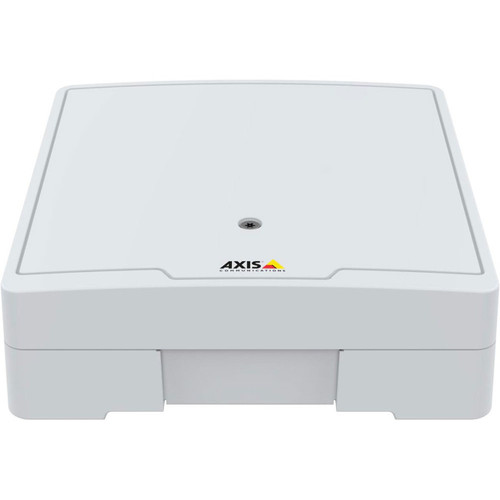
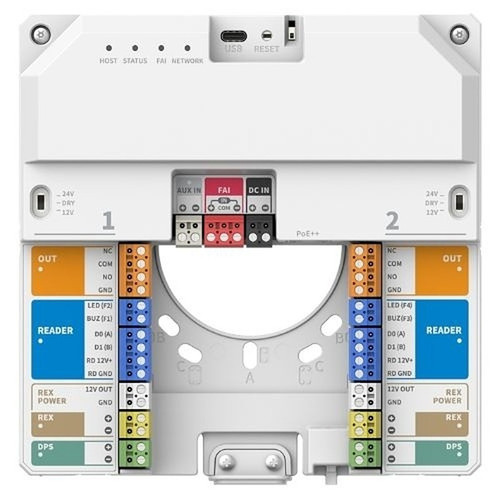
In This Guide
- How do the A1610 and NHP-P200 differ in reader capacity, cardholder storage, and door scalability?
- What are the power input options and operating environment limits for each controller?
- How do the A1610 and NHP-P200 compare on cybersecurity posture, standards compliance, and ecosystem integration?
- Which should you choose: the A1610 or the P200?
- Side-by-Side Specs
- FAQ
How do the A1610 and NHP-P200 differ in reader capacity, cardholder storage, and door scalability?
The Axis A1610 supports 1–2 wired doors and up to four OSDP (Secure Channel) readers or two Wiegand readers. It provides six configurable auxiliary I/O ports and two relays for local device integration. Cardholder database size and offline event cache capacity are not stated in the provided specifications.
The Hanwha NHP-P200 is rated for two doors and includes dual Wiegand/OSDP ports, five supervised inputs, and four OSDP Flex inputs, with a stated expansion path to four OSDP readers per port. It publishes a 50,000-cardholder database and a 250,000-event offline cache—both figures absent from the A1610 spec set.
For deployments where offline resilience and known cardholder capacity are procurement requirements, the NHP-P200 supplies those figures directly. The A1610 offers a higher raw OSDP reader count (up to 4) on a 1–2 door footprint, while the NHP-P200's supervised inputs (5) and OSDP Flex inputs (4) provide a denser supervised-wiring option.
What are the power input options and operating environment limits for each controller?
The Axis A1610 accepts PoE Class 4 (802.3at / PoE+) or a 10–28 V DC input, with a maximum DC output of 24 V. Its operating temperature range is specified as −40°C to 70°C in the product listing and −40°C to 55°C in the datasheet fields—buyers should verify which figure applies to their installation. The unit carries a UL 2043 plenum rating and UL 294 access-control listing, making it eligible for above-ceiling installation in plenum air spaces.
The Hanwha NHP-P200 accepts PoE++ (802.3bt) or 12–24 V DC, with a stated current draw of 780 mA on PoE+. Its operating temperature range is −20°C to +60°C. No plenum rating is stated in the provided specifications.
The A1610's lower cold-temperature floor (−40°C vs −20°C) and UL 2043 plenum listing give it a clear advantage in harsh-environment and above-ceiling installations. The NHP-P200's PoE++ (802.3bt) input budget is larger than the A1610's PoE+ (802.3at), which may be relevant when powering additional downstream devices through the controller.
How do the A1610 and NHP-P200 compare on cybersecurity posture, standards compliance, and ecosystem integration?
The Axis A1610 lists OSDP Secure Channel as its primary reader-side security mechanism. It carries UL 294 access-control certification and a five-year warranty. Memory is documented at 512 MB RAM and 2,048 MB Flash. Software platform and VMS/ACS compatibility are not enumerated in the provided specifications.
The Hanwha NHP-P200 publishes explicit cybersecurity credentials: FIPS 140-3 Level 3, TLS 1.3, AES-256 encryption, and a hardware TPM. It is ONVIF-conformant (Device Test Tool 24.12 rev.270) and also carries a five-year warranty. Software ecosystem details beyond ONVIF are not stated in the provided specifications.
Buyers operating in regulated environments (government, healthcare, finance) where FIPS 140-3 and hardware-rooted trust (TPM) are mandated will find the NHP-P200's published certifications directly responsive. The A1610's cybersecurity posture relies on OSDP Secure Channel; additional platform-level encryption details are not available from the provided specs. ONVIF conformance on the NHP-P200 simplifies multi-vendor VMS integration where that standard is enforced.
Which should you choose: the A1610 or the P200?
Our take: The NHP-P200 is the stronger choice when cardholder capacity, offline resilience, and certified cybersecurity posture are primary procurement criteria. The Hanwha unit documents a 50,000-cardholder database and 250,000-event offline cache versus no published figures for the A1610, publishes FIPS 140-3 Level 3 and TPM hardware security versus the A1610's OSDP Secure Channel only, and supports PoE++ (802.3bt) versus the A1610's PoE+ (802.3at) for larger downstream power budgets. Conversely, the A1610 is the stronger choice for installations requiring plenum-rated above-ceiling mounting (UL 2043—not stated for the NHP-P200), operation in extreme cold (−40°C floor versus −20°C), or tighter Axis ecosystem integration. Both carry five-year warranties and two-door capacity. Platform lock-in—Axis ACAP/AXIS Camera Station versus Hanwha Wisenet WAVE or third-party ONVIF—will be the deciding factor for sites already invested in either ecosystem.
Side-by-Side Comparison
Spec-for-spec, from manufacturer data.
| Specification | Axis A1610 | Hanwha P200 |
|---|---|---|
| Device Type | Network Door Controller | IP Access Controller |
| Max Doors | 1–2 wired doors | 2 doors |
| Reader Protocols | OSDP (Secure Channel) / Wiegand | Wiegand / OSDP |
| Max Readers | 4× OSDP or 2× Wiegand | 4 OSDP readers per port (expandable) |
| Auxiliary / Supervised Inputs | 6 configurable I/O ports | 5 supervised inputs + 4 OSDP Flex inputs |
| Relays | 2 | — |
| Cardholder Capacity | — | 50,000 |
| Offline Event Cache | — | 250,000 events |
| PoE Standard | PoE+ (802.3at) Class 4 | PoE++ (802.3bt) |
| DC Input Voltage | 10–28 V DC | 12–24 V DC |
| Operating Temperature | −40°C to 55°C (datasheet) / 70°C (listing) | −20°C to +60°C |
| Plenum Rating | UL 2043 | — |
| Access Control Certification | UL 294 | — |
| Cybersecurity / Encryption | OSDP Secure Channel | FIPS 140-3 L3, TLS 1.3, AES-256, TPM |
| ONVIF | — | Yes (DTT 24.12 rev.270) |
| Warranty | 5-year | 5-year |
Frequently Asked Questions
Which should you choose: the A1610 or the P200?
The NHP-P200 is the stronger choice when cardholder capacity, offline resilience, and certified cybersecurity posture are primary procurement criteria. The Hanwha unit documents a 50,000-cardholder database and 250,000-event offline cache versus no published figures for the A1610, publishes FIPS 140-3 Level 3 and TPM hardware security versus the A1610's OSDP Secure Channel only, and supports PoE++ (802.3bt) versus the A1610's PoE+ (802.3at) for larger downstream power budgets. Conversely, the A1610 is the stronger choice for installations requiring plenum-rated above-ceiling mounting (UL 2043—not stated for the NHP-P200), operation in extreme cold (−40°C floor versus −20°C), or tighter Axis ecosystem integration. Both carry five-year warranties and two-door capacity. Platform lock-in—Axis ACAP/AXIS Camera Station versus Hanwha Wisenet WAVE or third-party ONVIF—will be the deciding factor for sites already invested in either ecosystem.
Is the A1610 or NHP-P200 better for larger deployments with many cardholders?
The NHP-P200 publishes a 50,000-cardholder database and 250,000-event offline cache, giving buyers a concrete sizing figure. The A1610 does not state cardholder or event-cache limits in the provided specifications, so the NHP-P200 is the verifiable choice for large-cardholder sites.
Which controller is safer to install above a drop ceiling in a plenum air space?
The Axis A1610 carries a UL 2043 plenum rating, which permits installation in plenum-rated air spaces. No plenum rating is stated for the Hanwha NHP-P200 in the provided specifications, so the A1610 is the confirmed option for above-ceiling plenum installations.
Does either controller meet FIPS or government cybersecurity requirements?
The Hanwha NHP-P200 explicitly lists FIPS 140-3 Level 3, TLS 1.3, AES-256, and a hardware TPM. The Axis A1610 lists OSDP Secure Channel support; no FIPS certification is stated in its provided specifications. For mandated FIPS compliance, the NHP-P200 is the only option with documented certification.
Get a Second Opinion on Your Camera Choice
Share your site layout, coverage goals, and budget. Our team will validate the camera selection, flag anything we would change, and recommend products that match the use case.