
ACTi E91 vs ACTi Q93: Specification Comparison
The ACTi E91 and Q93 are both 1MP fixed-lens indoor mini dome cameras powered by 802.3af PoE, targeting the same resolution class and general form factor. The comparison is meaningful for buyers evaluating a general-purpose surveillance dome against a purpose-built people-counting analytics camera. Key differentiators include built-in analytics capability, IR night vision, on-board storage, and lens specification—factors that can significantly influence deployment suitability in retail, office, or access-control environments.
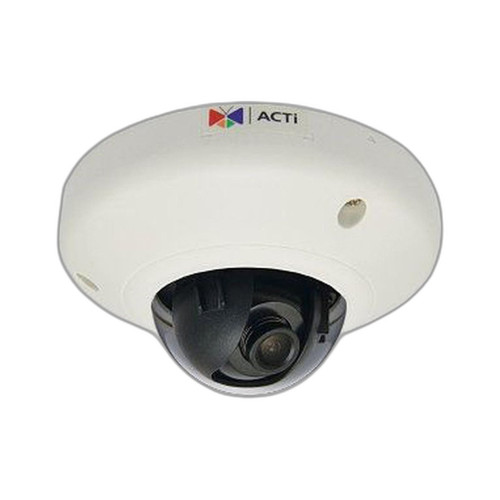
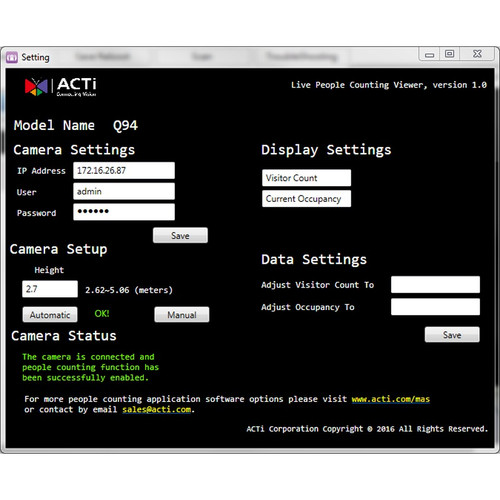
In This Guide
How do the imaging specs compare?
Both cameras deliver 1MP resolution at up to 30 fps and include WDR for high-contrast scene handling. The Q93 provides a specified fixed lens of 2.55mm f/2.2 with a 108.6° horizontal field of view—a wide-angle configuration deliberately chosen for overhead people-counting coverage. The E91 does not have a documented focal length or field-of-view figure in the provided specifications, making a direct optical comparison impossible from the available data.
The Q93 adds adaptive IR with Day/Night switching, providing low-light and no-light imaging capability. The E91 lists no IR or Day/Night spec, meaning it is specified only for illuminated environments. For deployments requiring 24-hour coverage without supplemental lighting, the Q93's IR capability is a documented differentiator; the E91's low-light performance cannot be assessed from the provided specs.
What about installation and environment?
Both cameras are powered by 802.3af PoE over a single Ethernet cable, eliminating dedicated power runs. The E91 carries a documented operating temperature range of -40°C to 60°C—a notably wide thermal envelope that may suit installations near unconditioned spaces or HVAC transitions. The Q93 has no operating temperature range listed in the provided specifications.
Both units support ceiling and wall mounting in a mini dome form factor. The Q93 adds microSDHC/microSDXC on-board storage as a documented option, which may simplify wiring by reducing reliance on continuous network recording. Neither camera lists an IP or IK rating in the provided specs, so ingress protection and impact resistance cannot be compared.
Which fits your VMS and analytics better?
Both cameras declare ONVIF compliance. The Q93 further specifies ONVIF Profile S and compatibility with mainstream VMS platforms, and it explicitly supports on-board people counting analytics—occupancy data processed at the edge with no additional server required. The E91 lists ONVIF without a profile designation; no analytics capability is documented for it.
The Q93 includes H.264 compression in its spec sheet; the E91 does not list a compression standard in the provided data. The Q93 also references a downloadable datasheet (Q93.pdf) while the E91 does not. Neither camera lists audio input or output in the provided specifications.
Which should you choose: the E91 or the Q93?
Our take: The Q93 is the stronger choice when the deployment goal includes occupancy measurement or traffic analytics, because it adds three capabilities the E91 does not document: built-in people counting analytics, adaptive IR Day/Night imaging, and on-board microSDHC/microSDXC storage. The Q93 also specifies its lens precisely at 2.55mm f/2.2 / 108.6° HOV, enabling accurate coverage planning, whereas the E91 provides no focal length or FOV data. Conversely, the E91's documented operating range of -40°C to 60°C is a concrete advantage for thermally challenging spaces, as no equivalent temperature rating is available for the Q93. Buyers who need a straightforward general-purpose dome for a well-lit, conditioned interior and already have server-side analytics can consider the E91; those requiring edge analytics, IR night vision, or local storage redundancy should specify the Q93.
Side-by-Side Comparison
Spec-for-spec, from manufacturer data.
| Specification | ACTi E91 | ACTi Q93 |
|---|---|---|
| Resolution | 1 MP | 1 MP |
| Camera Type | Mini Dome | Mini Dome (People Counting) |
| Lens / Focal Length | Fixed (focal length not specified) | Fixed 2.55mm f/2.2 |
| Horizontal FOV | — | 108.6° |
| Max Frame Rate | 30 fps | 30 fps |
| WDR | Yes | Yes |
| IR / Low-Light | — | Adaptive IR; Day/Night |
| Video Compression | — | H.264 |
| Edge Analytics | — | People Counting |
| ONVIF | Yes | Yes — Profile S |
| On-Board Storage | — | microSDHC / microSDXC |
| Power Input | PoE 802.3af | PoE 802.3af |
| Operating Temperature | -40°C to 60°C | — |
| Mount Type | Ceiling / Wall | Ceiling / Wall |
Frequently Asked Questions
Which should you choose: the E91 or the Q93?
The Q93 is the stronger choice when the deployment goal includes occupancy measurement or traffic analytics, because it adds three capabilities the E91 does not document: built-in people counting analytics, adaptive IR Day/Night imaging, and on-board microSDHC/microSDXC storage. The Q93 also specifies its lens precisely at 2.55mm f/2.2 / 108.6° HOV, enabling accurate coverage planning, whereas the E91 provides no focal length or FOV data. Conversely, the E91's documented operating range of -40°C to 60°C is a concrete advantage for thermally challenging spaces, as no equivalent temperature rating is available for the Q93. Buyers who need a straightforward general-purpose dome for a well-lit, conditioned interior and already have server-side analytics can consider the E91; those requiring edge analytics, IR night vision, or local storage redundancy should specify the Q93.
Is the E91 or Q93 better for low-light or night-time coverage?
Based on the provided specifications, the Q93 is the documented choice. It lists adaptive IR and Day/Night switching, which enable imaging in low or zero ambient light. The E91 has no IR or Day/Night spec listed, so its low-light capability cannot be confirmed from available data.
Can either camera work without a network video recorder?
The Q93 supports microSDHC/microSDXC on-board storage, allowing local recording independent of a continuous NVR connection. The E91 lists no on-board storage in the provided specifications, so it requires network-attached recording.
Do both cameras integrate with standard VMS software like Milestone or Genetec?
Both cameras declare ONVIF compliance, which provides baseline interoperability with ONVIF-compatible VMS platforms. The Q93 additionally specifies ONVIF Profile S. The E91 lists ONVIF without a profile designation. Neither profile guarantees full feature parity across every VMS; buyers should verify specific feature support with their VMS vendor.
Get a Second Opinion on Your Camera Choice
Share your site layout, coverage goals, and budget. Our team will validate the camera selection, flag anything we would change, and recommend products that match the use case.