Comelit UT2090 4MP Video Entrance Station
Overview
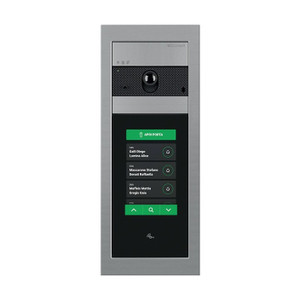
The Comelit UT2090 is a wall-mounted video entrance station designed for commercial and residential access control deployments where visitor identification and two-way audio communication are required at entry points. This device combines 4MP video capture with integrated audio, eliminating the need for separate intercom or door station hardware at the entrance. Power delivery via PoE+ (802.3at) removes the complexity of running dedicated 12V or 24V circuits to the door frame, simplifying installation and reducing jobsite labor.
Key Features
- 4MP Video Resolution (2688 x 1520): Delivers sufficient detail for facial recognition and visitor identification at typical entrance distances (6–15 feet). This resolution sits above 2MP/3MP baseline entrance stations but below 8MP specialty variants—a practical middle ground for most access control integrations where you need to distinguish features clearly without over-provisioning storage or bandwidth.
- PoE+ Power (802.3at, up to 95W): Eliminates separate low-voltage power infrastructure. You'll need a PoE+ switch or injector rated for 95W delivery; standard 802.3af PoE switches will not suffice. This single cable approach (power + video over Ethernet) cuts installation time and reduces points of failure at the entrance.
- Integrated Microphone and Two-Way Audio: Supports live audio communication between entrance and monitoring station or tenant unit. Built-in mic handles ambient noise at entry vestibules without requiring external audio modules, though acoustic conditions (busy lobbies, wind, rain noise) will affect clarity.
- Wall-Mount Form Factor: Surface or recess mounting on standard door frames. Compact footprint accommodates existing entrance architectures without requiring frame replacement or structural modification.
- Touchscreen Interface: Provides on-device control for call routing, volume, and basic configuration. Useful for standalone deployments or as a fallback when network connectivity is interrupted; however, full feature configuration typically requires integration with a video management system (VMS) or access control platform.
Integration & Compatibility
The UT2090 integrates with IP camera infrastructure and network video recorders via standard Ethernet. Audio and video streams follow ONVIF conventions, supporting integration with major VMS platforms and access control systems that consume ONVIF feeds. Verify compatibility with your specific VMS or access control controller before procurement—some legacy or closed-loop systems may require adapter firmware or third-party middleware.
PoE+ power planning is essential: each UT2090 draws up to 95W, so calculate total power budget across all PoE devices on your switch. A single PoE+ switch port supports one UT2090; if deploying multiple entrance stations, confirm your switch has sufficient PoE+ capacity (a typical managed PoE+ switch offers 2–4 dedicated high-power ports). Reference PoE power planning guides for detailed budget calculations.
When to Choose a Different Model
If your entrance environment requires IP67 submersion rating (e.g., underground parking, water-feature proximity) or extreme temperature swings beyond standard office/lobby conditions, consider higher-rated variants in the Comelit entrance station line. If 4MP resolution proves insufficient for facial detail or your deployment spans 20+ feet entrance depth, evaluate higher-megapixel models. If audio is not a requirement and you're seeking cost reduction, assess Comelit's video-only entrance stations or standard IP camera + call station combinations.
Frequently Asked Questions
Q: Does the UT2090 require a separate access control system to operate?
A: The UT2090 includes on-device call routing and local touchscreen control. However, full integration with tenant units, security monitoring, or gate/door strike relays typically requires a networked VMS or access control platform. Standalone operation (intercom only) is possible but limits logging and remote monitoring.
Q: What PoE+ switch should I use with the UT2090?
A: Any managed PoE+ switch rated for 802.3at (30W minimum per port, though 95W is required for the UT2090). Verify the switch datasheet specifies PoE+ availability on the port you plan to use. Budget-grade unmanaged PoE+ switches may underdeliver power under load—test before full deployment.
Q: Can I use standard 802.3af PoE to power the UT2090?
A: No. Standard PoE (802.3af) delivers maximum 15.4W; the UT2090 requires PoE+ (802.3at) which supplies up to 30W per port. Using 802.3af will cause the device to reset or fail to boot.
Q: What video codecs does the UT2090 support?
A: The UT2090 supports H.264 and H.265 (HEVC) compression. H.265 will reduce storage requirements by roughly 40–50% compared to H.264 at equivalent quality—a meaningful saving if you're recording 24/7 and archiving weeks or months of entrance footage.
Q: Is the microphone suitable for noisy entrance areas (lobbies, parking decks)?
A: The built-in microphone is omnidirectional and will pick up ambient noise. If your entrance is extremely loud or requires noise suppression, confirm VMS software supports audio filtering, or consider mounting a directional external microphone if the VMS supports auxiliary audio input.
Q: What is the typical field of view and lens specification?
A: Specific lens focal length and field of view are not detailed in available documentation. Contact the manufacturer or your integrator to confirm the exact lens spec and whether it matches your entrance coverage requirements.
Ted PerryPerspective based on aggregated IP Security Depot and affiliated engineering team experience.
The Comelit UT2090 occupies a practical niche: wall-mounted, single-cable power, 4MP video, and built-in intercom audio in one unit. That combination reduces bill-of-material count and labor on mid-market multifamily and commercial access control jobs. The 95W PoE+ power draw is the real constraint—you cannot pair this casually on a standard managed switch alongside a dozen other PoE cameras. Plan for it.
Technical Highlights:
- 4MP (2688 x 1520) Sensor: Delivers facial recognition clarity at typical entrance distances (6–15 feet). Sufficient for identity verification without the bandwidth or storage overhead of 8MP variants. H.265 codec support cuts recorded stream size by 40–50% versus H.264, meaningful over weeks of 24/7 recording.
- PoE+ 95W Peak Draw: Single cable installation (power and video over Ethernet) simplifies rough-in. Mandatory 802.3at switch or injector—standard PoE will not power this device. Budget your switch's PoE+ capacity explicitly; do not assume headroom.
- Integrated Two-Way Audio and Microphone: Eliminates separate call station or intercom module at the entrance. Built-in mic is omnidirectional and will pick up ambient noise in busy lobbies or parking areas—acceptable for most deployments, but not ideal for high-noise environments.
Deployment Considerations:
- Confirm your VMS or access control platform supports ONVIF video and audio streams from the UT2090 before final selection. Some legacy systems require middleware or firmware updates.
- The 95W draw is substantial—if you're deploying multiple UT2090 units, map your PoE+ budget ruthlessly. A typical managed PoE+ switch offers only 2–4 dedicated high-power ports. Oversubscription will cause brownouts or device resets during peak power demand.
The UT2090 fits cleanly into multifamily access control jobs, building lobbies, and commercial property entrances where you need reliable video-plus-audio in a single wall-mounted unit and network infrastructure already supports PoE+. Skip this if your entrance environment requires IP67 submersion or if budget is the primary constraint—simpler video-only entrance solutions exist at lower cost.