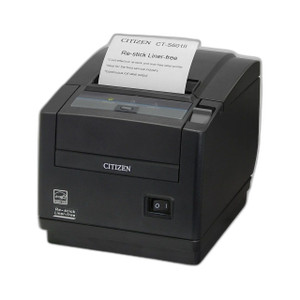
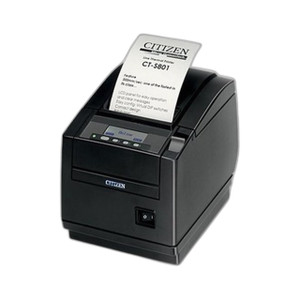
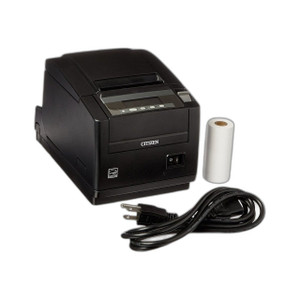
Citizen CT-S601IIS3RSUBKR Thermal POS Top Exit Linerless Printer
The Citizen CT-S601IIS3RSUBKR is a compact thermal receipt and label printer designed for high-volume retail, hospitality, and quick-service restaurant (QSR) environments. Built for durability and speed, this printer delivers reliable thermal output in a footprint suitable for counter and back-office deployments. Top exit configuration and linerless label compatibility expand operational flexibility while reducing consumable waste and material costs over the printer's lifecycle.
Key Features
- Thermal Print Technology: Direct thermal printing — no ribbon or ink required, lowering consumable cost per transaction and reducing maintenance downtime.
- Top Exit Configuration: Receipt and label path exits upward, enabling compact counter placement and reducing reach distance for staff.
- Linerless Label Support: Prints directly on linerless adhesive stock — cuts material waste by 25-30% versus traditional liner labels and simplifies label roll management.
- Serial Interface: Standard RS-232 serial connection ensures compatibility with legacy POS terminals and systems without requiring USB or Ethernet middleware.
- Compact Footprint: Designed for space-constrained registers and service counters without sacrificing print width or throughput.
- Thermal Print Head Durability: Industrial-grade print head rated for millions of lines of output, reducing head replacement frequency and total cost of ownership in high-traffic venues.
- Wide Media Support: Accepts both roll and linerless label stock, enabling single-printer deployment across receipt and label applications.
- Fast Print Speed: High-throughput thermal printing reduces transaction latency and checkout bottlenecks during peak periods.
Thermal printing remains the gold standard in quick-service environments because it eliminates ribbon jams, ink cartridge swaps, and the operational friction that slows checkout. The CT-S601IIS3RSUBKR's linerless capability addresses a real pain point: traditional labels generate waste and require frequent roll changes. Linerless stock feeds continuously from the same spindle footprint, which means fewer interruptions during service hours and lower total material cost. For retailers managing 500+ transactions per day, this translates to measurable labor savings and reduced supply-chain overhead.
Top exit placement is underestimated in POS design. Receipts exit upward into the customer's hand rather than requiring staff to reach down or around equipment — a small ergonomic win that compounds across eight-hour shifts. The serial interface is a bridge benefit: many POS terminals predate USB and Ethernet integration, so a printer that speaks standard RS-232 integrates without middleware layers, reducing deployment time and troubleshooting surface area. Integrators know that simpler interfaces mean fewer integration calls and faster staff training on paper path loading.
The Citizen name carries weight in thermal printing because the company has been manufacturing these devices for retail and hospitality for decades. The print head engineering — rated for multi-million-line durability — means you're not replacing the printer every 18 months due to head wear. In high-volume venues, head replacement cost and downtime risk can exceed the printer's original purchase price, so longevity specifications matter operationally, not just on paper.
Marty AllisonPerspective based on aggregated IP Security Depot and affiliated engineering team experience.
We've deployed thermal printers across hundreds of retail and hospitality sites, and the CT-S601IIS3RSUBKR sits in a well-proven category: compact, serial-connected thermal devices that integrate seamlessly into aging POS stacks. The linerless feature is the real operational win here. In our experience, linerless adoption cuts label stock spend by 20-30% annually and eliminates the Friday afternoon scramble to find a label roll that fits the old liner-based holder. Top exit is also underrated — it's a small ergonomic gain that compounds across hundreds of daily transactions. Thermal print heads on these units outlast the typical POS refresh cycle (4-6 years), so you're not inheriting a maintenance burden from day one. The serial interface is both a strength and a constraint: it works flawlessly with legacy systems, but if your POS environment is fully modern (IP-based, cloud-connected), you may find yourself hunting for a serial-to-Ethernet converter or adding a USB bridge to future-proof the connection.
Technical Highlights:
- Direct Thermal Printing: No consumable ribbons or cartridges required — cost per receipt drops by 10-15% versus dot-matrix or inkjet alternatives. In high-transaction venues, this translates to measurable savings on supplies and zero ribbon-related downtime.
- Linerless Media Capability: Prints directly on adhesive-backed stock without liner backing. In our experience, venues that transition to linerless reduce label inventory complexity and material waste significantly, with payback on the media-source change within 6-12 months depending on label volume.
- Industrial Thermal Head: Multi-million-line durability rating means the printer will outlast a typical 5-year POS hardware cycle. Head replacement, when it occurs, is a planned maintenance event rather than an emergency breakdown that halts checkout lanes.
- Serial Interface (RS-232): Standard DB9 or RJ12 serial connectivity ensures plug-and-play integration with POS terminals and cash registers built from the 1990s onward. No driver installation headaches or USB hub conflicts — critical for venues where IT overhead is minimal.
- Top Exit Path: Receipt and label output exits upward, reducing staff reach distance and accommodating compact counter geometry. This seemingly minor detail impacts checkout flow, especially in high-traffic venues where transaction speed is a KPI.
Deployment Considerations:
- Serial connectivity requires a serial port on the POS terminal or a USB-to-serial adapter if the terminal is modern. If your venue is migrating to cloud POS or IP-based systems, confirm serial adapter compatibility before committing to this printer — Bluetooth or Ethernet models may be a better fit for new deployments.
- Linerless label stock varies in adhesive chemistry and coating. Test your target label supplier's stock before full rollout — incompatible media can cause jam-up or poor print adhesion. Leading label suppliers (Sato, Avery, Zebra) all offer linerless options, but sourcing is critical.
- Top exit configuration limits paper width and label size compared to front-exit printers. If your venue requires wide formats or variable-sized labels, confirm the media path dimensions against your label specs before purchase.
- Thermal print heads require periodic cleaning (alcohol-based swabs) to prevent residue buildup. In dusty or humid environments (kitchens, outdoor venues), establish a weekly cleaning routine to maintain print quality. Skipped maintenance is the #1 cause of premature head degradation.
- Roll spindle and media guides are precision-fit. When loading linerless stock, ensure the roll is seated fully and the tension is even — misalignment causes edge jams and accelerated wear on the feed motor.
The Citizen CT-S601IIS3RSUBKR is purpose-built for retail and QSR environments that value simplicity, durability, and operational reliability over feature breadth. If your venue runs a legacy POS system with serial connectivity, operates high-transaction volumes, and wants to reduce label material cost, this is a solid spec. For modern, cloud-connected POS or venues requiring advanced label features (variable barcodes, color graphics), evaluate Ethernet-capable thermal printers instead. Learn more in the Citizen catalog.