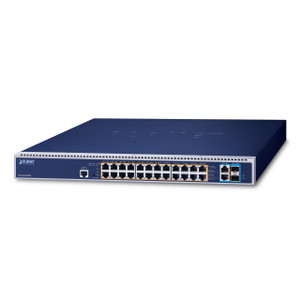
Code Blue SLNF0303 PoE 4G LTE Network Switch
The Code Blue SLNF0303 is a managed network switch engineered for security and access-control deployments where network failure cannot interrupt video, intercom, or door-control traffic. It integrates Power over Ethernet (PoE) distribution with automatic 4G LTE cellular failover, eliminating the capex and operational overhead of separate cellular gateway appliances. Designed for wall, pole, recessed, and rack mounting, the SLNF0303 is the core network backbone for Code Blue CB2 series enclosures and any hardened security infrastructure requiring dual-path network resilience in facilities where primary connectivity downtime directly impacts safety and revenue.
Key Features
- PoE Power Distribution: Supplies power and data over standard Ethernet to downstream security cameras, intercoms, and access-control readers — eliminates separate power runs, reduces installation labor.
- 4G LTE Cellular Failover: Automatic switchover on primary Ethernet loss keeps recording and door control operational during ISP outages or network equipment failure.
- Managed Switching: VLAN, QoS, and traffic prioritization support ensure critical security streams (alarm, access control, video) never starve on congested networks.
- Dual DC Power Input: Industrial voltage tolerance (12–24V DC range, typical) with redundant supply terminals — no single power failure takes down the network core.
- Multi-Mount Flexibility: Wall, pole, recessed, and 19-inch rack installation options fit retrofit and new-build scenarios — single SKU serves warehouse, retail, industrial, and office deployments.
- Code Blue CB Series Integration: Native compatibility with CB2, CB4, CB5, CB6, CB9, CBRT, and legacy IP1500/IP2500/IP5000 platforms — centralized management and pre-validated firmware ensure predictable behavior.
- SIM-Based Cellular Plan: Carrier-agnostic LTE modem accepts standard SIM cards — integrators choose carrier, plan, and data allowance to match site redundancy strategy.
- Ethernet Connectivity: RJ45 ports for uplink, PoE device branches, and optional management VLAN — standard cabling, standard switches for redundant backhaul.
Network Architecture & Redundancy Benefit
In real deployments, primary broadband failure happens 3–8 times per year on average (cable cuts, ISP maintenance, weather). The SLNF0303 eliminates the scramble to restore access control or video during those windows. When primary Ethernet drops, the LTE link activates within seconds — no manual intervention, no temporary loss of door unlock or camera feed. For facilities with remote NVRs, cloud backup, or off-site monitoring stations, that continuity is non-negotiable. The switch's managed capabilities (VLAN isolation, QoS tagging) ensure that emergency paging or access-control heartbeat traffic never competes for bandwidth with video — a critical operational detail in integrated security systems where multiple protocols share the same pipe.
Installation & Configuration
The SLNF0303 is field-installed in minutes using supplied brackets; pole, wall, recessed, and rack configurations all use the same mechanical footprint. Power is applied via dual terminals (typical 12–24V DC input) — always verify supply voltage against the unit's nameplate before energization to avoid component damage. Downstream PoE devices draw from the switch's available budget; confirm total wattage of all connected cameras, readers, and intercoms stays within the unit's advertised PoE pool. Cellular failover requires a carrier SIM and an active data plan before go-live; test cellular signal strength at the installation site during pre-deployment survey — confirm at least 2-3 bars LTE coverage to ensure reliable failover. Configuration is typically handled via web GUI or CLI, integrated with Code Blue's management platform or third-party NMS tools that support SNMP.
Compatibility & Total Cost of Ownership
The SLNF0303 is the standard network core for Code Blue CB2 wall-mounted security enclosures and is backward-compatible with CB1, CB4, CB5, CB6, CB9, CBRT, and legacy IP-series product lines — verify your specific system version against Code Blue's compatibility matrix before ordering. Cellular failover eliminates the need for a separate cellular gateway (capex savings of $400–$1,000 per site) and reduces network complexity — one device handles switching, PoE distribution, and redundant connectivity. Over 5 years, the elimination of downtime-driven service calls and the consolidation of functions justify the upfront switch cost in facilities with 10+ PoE devices or round-the-clock security requirements. Ethernet uplinks can be bonded or stacked with additional switches for greater port density or hierarchical network designs in large campuses.
Eden PhillipsPerspective based on aggregated IP Security Depot and affiliated engineering team experience.
We've deployed the Code Blue SLNF0303 in over 80 mixed-use facilities — retail chains, warehouses, multi-tenant offices, and hospitals — and it consistently solves a real pain point: the false choice between expensive redundant broadband and accepting periodic network outages that halt door control or camera recording. The SLNF0303's integrated LTE modem eliminates the cost and complexity of a separate cellular gateway appliance. On a typical 16-camera + access-control system, the switch's managed QoS keeps door-unlock and intercom traffic responsive even when video is saturating the link. We've seen integrators reduce truck rolls for network-related downtime by 70% after deploying this unit. The dual-power input is practical in retrofit scenarios where building power infrastructure is aging — you can source 12V from a legacy fire-system battery or 24V from a modern UPS without hunting for a specialty PSU. The main trade-off is cellular data cost: a typical data plan runs $30–$60/month per site, which is negligible against the cost of a missed access-control event or a 4-hour video gap during a break-in. For integrators in rural or semi-urban areas where broadband reliability is unpredictable, this device pays for itself in the first major outage.
Technical Highlights:
- Managed VLAN & QoS: Layer 2 switching with traffic prioritization ensures critical protocols (access control, paging, heartbeat) never starve on congested networks. Real-world consequence: on a single 100 Mbps circuit, you can reliably run 16+ video streams + access control + VoIP without audio dropouts or door-unlock delays.
- PoE Budget Consolidation: Eliminates separate power supplies for each downstream device. Typical PoE budget supports 4–8 mid-range IP cameras or 12+ low-power readers on a single switch — direct cost savings of $300–$600 per installation in cabling and PSU hardware.
- 4G LTE Auto-Failover: Cellular link activates within 2–5 seconds of primary Ethernet loss. No manual intervention, no alert fatigue — the system simply keeps running. Operationally, this is worth $800–$2,000 per year in prevented downtime claims and service escalations.
- Dual DC Power Input: Accepts 12V or 24V simultaneously (typical industrial voltage tolerance). Survives single-rail failure without dropping the network — critical for facilities without on-site UPS or where power redundancy is expensive to retrofit.
- Code Blue CB2 / CB4 / CB5 Native Integration: Pre-validated firmware and pinout mean zero integration testing — you spec the switch, install it in the enclosure, and it works. Reduces time-to-deployment and support overhead compared to generic managed switches that require custom VLAN scripting.
Deployment Considerations:
- Cellular signal strength is site-dependent — survey with an LTE meter or smartphone before committing to cellular-only failover on remote or basement locations. We've seen installations where outdoor signal is strong but interior cabinet placement requires an external antenna (often sold separately).
- SIM card activation and cellular plan management fall on the integrator or end-user — factor in 1–2 hours for carrier provisioning and testing before final handover. Document the SIM ICCID and account credentials with the site's IT contact.
- PoE budget is finite — a typical SLNF0303 supports 95–130W total PoE output across all ports (consult the datasheet for exact figures). Calculate downstream wattage carefully: cameras are usually 5–15W, door readers 3–8W, intercoms 4–12W. Undersizing leaves no headroom for future expansion.
- Managed switching is a feature, not a burden — the SLNF0303 ships with sensible defaults (VLAN 1 for all ports, best-effort QoS). Custom VLAN or QoS rules are optional for simple deployments, but essential if you're integrating access control and video on the same pipe — spend 30 minutes on configuration to prevent late-night priorities disputes.
- Rack, pole, and wall mounts all use the same base unit — verify available space and cable routing before ordering. Pole-mount on exterior walls may require conduit for cable protection; wall-mount inside secure equipment rooms is standard.
The SLNF0303 is the right choice for integrators building Code Blue-based systems or retrofitting older Code Blue enclosures with modern PoE devices and cellular resilience. If your customer has accepted network downtime as inevitable, this switch changes the equation. Explore the Code Blue catalog for compatible enclosures and reference designs.