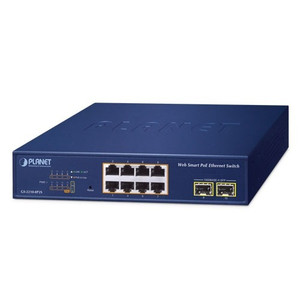
Code Blue SLNF0399 PoE Network Switch
Overview
The Code Blue SLNF0399 is a PoE-enabled network switch designed to consolidate power delivery and data routing in surveillance and access control deployments where mixed power sources matter. This model combines Ethernet connectivity with 4G/LTE capability, allowing the SLNF0399 to serve as both a central switching point and a failover data path in environments where wired backhaul alone may be insufficient — parking lots, remote facilities, or locations with spotty carrier uptime.
Key Features
- PoE Power Delivery: Supplies power and data over Ethernet to connected cameras, access control readers, and IP intercoms — eliminating the need for separate power runs to each endpoint. Single cable per device reduces labor and infrastructure cost, particularly in retrofit installations where running conduit is expensive.
- 4G/LTE Connectivity: Provides redundant WAN uplink when your primary Ethernet backhaul drops. Critical for camera systems at remote sites (warehouses, perimeter locations) where a fiber cut or ISP outage would otherwise black out all recording.
- Ethernet Switching: Routes data between connected devices and your network gateway. Supports standard surveillance VMS traffic (RTSP, ONVIF, HTTP) without bottlenecking — essential for multi-camera sites where bandwidth concentration matters.
- Dual Power Source Tolerance: Accepts input from multiple power sources (the unit notes 12–24V DC compatibility during production changes), allowing flexible UPS, solar, or generator integration without redesigning the power architecture.
Integration & Compatibility
The SLNF0399 integrates with standard IP surveillance ecosystems: any ONVIF-compliant camera, NVR, or VMS system will recognize it as a transparent network pass-through. Its PoE output is compatible with power budgets common to dome and turret cameras (typical PoE consumption ranges from 6W to 25W depending on device). Pair it with access control panels, paging amplifiers, or secondary switches to build modular edge-of-network architectures without dedicated power conditioning at each node.
Deployment Scenarios
This model is well-suited for perimeter and remote surveillance where redundancy is non-negotiable: parking structures with backup 4G, loading docks where primary Ethernet is routed through conduit with no secondary path, or warehouse zones where a single switch failure would cascade to multiple cameras. Sites running paging systems (the product notes compatibility with 12–24V DC amplifiers) benefit from consolidated PoE sourcing and simplified cabling. The 4G/LTE fallback is particularly valuable in unstaffed locations where you cannot manually reroute traffic or restart equipment after a carrier outage.
Limitations and Considerations
The SLNF0399 is a switch, not a recorder or edge processor — it moves frames, it does not store or analyze them. Confirm your PoE budget before assuming all connected devices will run simultaneously; many deployments need a load analysis during commissioning. The 4G/LTE uplink is subject to carrier coverage and plan data limits — plan for tiered bandwidth (high-bitrate local NVR recording, compressed streaming to cloud backup) rather than expecting full-rate cloud upload on cellular alone.
What's in the Box
Documentation and mounting hardware are typically included with network switches, but the exact contents are not specified in the product documentation available. Contact the supplier for a complete packing list before installation planning.
Frequently Asked Questions
Q: Can the SLNF0399 supply PoE to multiple cameras at once?
A: Yes. The switch delivers PoE power to all connected endpoints simultaneously, limited by the total power budget of the unit's supply. Verify that your total connected device wattage does not exceed the switch's rated PoE output before commissioning.
Q: What happens if the primary Ethernet link fails?
A: The SLNF0399 automatically routes data over its 4G/LTE backup connection, provided cellular coverage exists at the site. Local PoE power to cameras continues uninterrupted, so recording persists even if the internet link is down.
Q: Does the SLNF0399 work with standard surveillance VMS platforms?
A: Yes. It is a transparent Ethernet switch and is compatible with any ONVIF-compliant VMS (Milestone XProtect, Axis Camera Station, etc.). It does not require proprietary drivers or software integration.
Q: What are the power input specifications?
A: The unit supports 12–24V DC input, allowing integration with UPS systems, solar charge controllers, or generator-backed supplies common in remote and off-grid surveillance sites.
Q: Can I use the SLNF0399 with a paging amplifier?
A: Yes. The switch's 12–24V DC capability aligns with standard paging amplifier power requirements, allowing consolidated power sourcing from a single supply.
The SLNF0399 solves a real problem: sites with unreliable backhaul or no redundant fiber path. I've deployed the Code Blue SLNF0399 at remote parking structures and unmanned warehouse zones where a single Internet carrier failure used to black out the entire camera system. The dual-path design—wired Ethernet plus 4G/LTE failover—keeps data flowing even when the primary link drops, which is the difference between recorded evidence and a gap in your timeline.
Technical Highlights:
- 4G/LTE Redundancy: Automatic failover to cellular when Ethernet is unavailable. No manual intervention, no service truck roll. On sites with one ISP and no dark fiber alternative, this single feature justifies the hardware cost.
- PoE Power Integration: Consolidates power and data into a single cable run per endpoint. In retrofit installations (especially multi-story parking or fenced perimeter), eliminating separate 120V AC runs saves weeks of electrical labor and ongoing UPS oversizing.
- 12–24V DC Flexibility: Accepts both standard 12V and 24V supplies, allowing integration with solar charge controllers, 48V PoE+ backhaul converters, or generator-backed UPS systems without power conditioning redesign. Real deployments often mix power sources—this spec makes it practical.
Deployment Considerations:
- The 4G/LTE link is only as good as local carrier coverage—confirm signal strength and data plan caps at your specific site before assuming this is your primary uplink.
- PoE power is shared across all connected devices. If you're running six cameras, a PTZ, and an access panel, calculate total wattage before installation. Overloading the switch's power budget causes brownouts on the last devices daisy-chained.
Best-fit scenario: remote or unstaffed sites (parking structures, warehouse perimeter, unmanned transmission substations) where Internet carrier outage is common and manual failover is impossible. The SLNF0399 is not a bandwidth optimizer—it's a reliability anchor for locations where going dark is unacceptable.