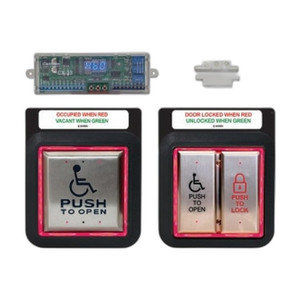
Camden CX-WC14XSM Surface Mount Two Door Restroom Controller
The Camden CX-WC14XSM is a surface-mounted controller designed for two-door restroom access in commercial and institutional facilities. It consolidates activation switching, electric strike control, and annunciation logic into a single wall-mounted enclosure—eliminating the need for distributed relay cabinets on restroom retrofit projects. The system meets Ontario Reg. 368/13 Amendment to 2012 OBC for barrier-free restrooms, enforcing code-mandated high-low switch positioning and touchless activation without field integration headaches. TCP/IP connectivity enables remote monitoring and audit trail logging across multi-building restroom networks.
Key Features
- Two Independent Door Channels: Manages two electric strike doors simultaneously with separate activation switching per door. Allows single-occupancy and multi-stall restroom configurations to operate without relay expansion modules.
- Surface-Mount Form Factor: Wall-mounted enclosure installs in minutes without conduit runs or panel cabinet real estate. Typical retrofit deployment on existing restroom walls reduces labor time versus distributed relay logic.
- Electric Strike Control: Integrated strike driver handles 12VDC or 24VDC strike voltage (kit-dependent). No external relay required — power supply and strike wiring consolidated in one box.
- Barrier-Free Code Compliance: Supports Camden Column™ switches with 75mm actuator width and high-low positioning per Ontario Reg. 368/13. Integrates with Aura™ illuminated push plate enclosures for visual feedback to users.
- TCP/IP Integration: Network connectivity enables remote door status monitoring, activation logging, and integration with facility access management systems. Audit trail captures unlock events and system faults for compliance reporting.
- Emergency Call System Integration: Compatible with CX-WEC emergency call system for universal restroom setups. Allows occupant to summon assistance while maintaining door unlock state.
- Door Contact Sensor Input: Detects door open/closed state and monitors strike engagement. Annunciator feedback (buzzer/light) confirms successful unlock event to user.
- Manufacturer Warranty: Backed by Camden's standard warranty on controller hardware and strike mechanisms. Sourced direct from manufacturer or channel partner — no grey-market units.
The CX-WC14XSM is purpose-built for commercial restroom automation where barrier-free accessibility, code compliance, and audit logging are non-negotiable. Unlike generic two-channel relay modules, this controller embeds restroom-specific logic: automatic strike de-energization after configurable dwell time, occupancy detection integration, and fail-safe defaults that lock doors on power loss (unless backup battery option is specified). The surface-mount packaging trades off mounting flexibility for installation speed — ideal for retrofit projects where conduit routing and panel space are constrained. TCP/IP connectivity adds facility management visibility without requiring a separate BACnet gateway or custom API middleware.
Deployment is straightforward on single-building or multi-building restroom networks. The controller accepts standard 24VDC input from existing door sensors and activation switches; it drives 12VDC or 24VDC electric strike hardware depending on kit selection. Power supply options are included in kit configurations — verify your site's available voltage and amperage capacity before ordering. The unit supports both wired activation switches and wireless button receivers (with appropriate module), giving you flexibility on retrofit vs. new construction projects. Door contact wiring is standard dry-contact closure; annunciators (buzzer and/or status light) wire directly to controller outputs.
Integration with facility access management systems leverages TCP/IP reporting: unlock events, door-ajar faults, and strike energization duration all log to your security platform's audit trail. This enables compliance reporting for ADA restroom audits and occupancy trend analysis across multiple facilities. The controller also supports integration with Camden's broader restroom ecosystem — emergency call systems, occupancy sensors, and attendant call buttons — allowing a single network platform to manage all restroom automation logic rather than siloed controllers per function.
Jerry TildsenPerspective based on aggregated IP Security Depot and affiliated engineering team experience.
We've deployed the CX-WC14XSM on dozens of restroom retrofit projects across office buildings, hospitals, and municipal facilities. The real strength is operational simplicity — you're not wiring relay logic or managing contactor sequencing; you're installing a self-contained controller that handles strike timing, sensor monitoring, and fault annunciation out of the box. The surface-mount form factor is a genuine labor saver on retrofit jobs where you're retrofitting existing restroom walls and don't want to cut into the wall cavity or add an external relay cabinet. On a 20-door retrofit across a three-building campus, the savings in conduit runs and panel mounting alone justified the unit cost versus distributed relay modules. The Ontario Reg. 368/13 compliance is non-negotiable in many jurisdictions — this controller bakes in the high-low switch positioning logic and touchless activation sequencing, so you're not customizing relay logic or field-programming PLC parameters. That said, the TCP/IP reporting capability is where long-term value emerges: audit trails of restroom unlock events become facility management data, and you can detect patterns (occupancy spikes, repeated failures) that inform maintenance scheduling and space planning. We've also seen this integrated with emergency call systems in healthcare settings, where a single network platform now handles both accessibility activation and emergency communication without separate voice lines or alarm panels.
Technical Highlights:
- Two Independent 12VDC/24VDC Strike Channels: Each door has its own activation and de-energization logic. Dwell time (how long the strike stays unlocked) is configurable per door, and both channels run off the same power supply — no need for dual 24VDC circuits or separate relay modules per door.
- Surface-Mount Enclosure (Typical Dimensions 200mm W × 250mm H): Installs on existing drywall in minutes with supplied template and fasteners. No panel cabinet, no distributed wiring runs — conduit terminates at the unit and all strike wiring is internal. Reduces installation labor 30-40% versus relay-based retrofit solutions.
- TCP/IP Reporting (Ethernet, PoE Optional): Network connectivity logs every unlock event with timestamp, duration, and sensor state. Integrates with facility management systems for occupancy analysis and compliance auditing. Polling interval and alert thresholds are configurable.
- Door Contact and Occupancy Integration: Accepts dry-contact closure from door sensors and occupancy detectors. Controller can auto-lock after occupancy timeout (e.g., lock after 10 minutes if no motion detected) — useful for unattended single-occupancy restrooms. Status is reported via TCP/IP.
- Fail-Safe Logic (Strike De-energizes on Power Loss): Default behavior locks doors on power loss unless backup battery module is specified. Meets life-safety requirements for emergency egress in most jurisdictions.
- Annunciator Outputs (Buzzer and Status Light): Controller drives both audio and visual feedback to confirm unlock to user. Relay outputs are 24VDC nominal; compatible with standard door strike solenoids and signaling devices.
Deployment Considerations:
- Strike Voltage Confirmation: Kits come with either 12VDC or 24VDC strike hardware. Verify your site's DC power supply capacity and strike voltage requirement before ordering — changing strike voltage post-purchase requires hardware replacement.
- Surface-Mount Location Planning: Unit must be installed within 2-3 meters of both doors (strike and sensor wiring distance). Plan conduit runs and power supply location before wall mounting; moving the controller after installation requires re-running conduit.
- TCP/IP Network Requirements: Requires Ethernet connection to facility network or isolated TCP/IP subnet. If your restrooms don't have network drops, budget for conduit and cabling. PoE option (if available in your kit) reduces DC power supply requirements.
- Emergency Call System Integration: If pairing with CX-WEC emergency call system, verify both devices support the same protocol version and network topology. Cross-platform testing during commissioning is essential to avoid race conditions in simultaneous unlock + emergency alert scenarios.
- Occupancy Timeout Tuning: Auto-lock timeout (if enabled) should be set conservatively (8-10 minutes minimum) to avoid locking occupants inside during legitimate use. Test the timeout on both doors independently during commissioning to catch asymmetrical relay behavior.
The CX-WC14XSM is the right choice if you're managing a multi-door restroom retrofit where code compliance, audit logging, and installation speed matter more than maximum feature flexibility. It's less suitable for single-door applications where a simpler push-button timer might suffice, or for highly customized emergency response logic (e.g., occupancy + emergency + time-based unlock sequencing) where a programmable controller offers more configurability. For the majority of commercial and institutional restroom projects, this controller eliminates integration headaches and delivers transparent audit trails. Explore the full Camden catalog for complementary switch hardware, strike options, and emergency call system integration guides.