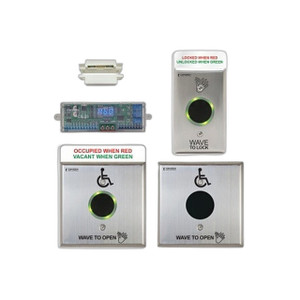
Camden CX-WC14XFM Flush Mount Two Door Restroom Controller
The Camden CX-WC14XFM is a flush-mount access controller engineered for two-door restroom installations where centralized strike coordination and networked activation are required. This device consolidates electric strike logic, relay control, and door sequencing into a single wall-mounted enclosure, eliminating distributed relay boxes and simplifying both installation and future modifications. TCP/IP connectivity enables integration with facility management systems, emergency protocols, and multi-site access logging — essential in healthcare, education, and commercial environments where restroom occupancy and accessibility compliance must be audited and tracked.
Key Features
- Dual Electric Strike Control: Coordinates activation across two independent door strikes with isolated relay outputs. Prevents simultaneous unlocking and enforces entry/exit sequencing logic in high-traffic restroom scenarios.
- Flush Mount Form Factor: Standard electrical box installation with no surface-mounted hardware — maintains clean aesthetic and complies with ADA accessibility guidelines for unobstructed maneuvering space.
- TCP/IP Networked Integration: Direct IP connectivity enables remote activation, real-time occupancy monitoring, and event logging via facility management platforms. No dedicated serial lines or analog circuits required.
- Electric Strike Compatibility: Relay outputs sized for standard electromagnetic strikes (voltage/current matched to common 12VDC or 24VDC strike models). Isolated circuits prevent cross-contamination of door lock states.
- Modular Kit Configuration: Available as complete system kits including power supply, activation switches (Column™ and Aura™ touchless options), door contact sensors, and audible/visual annunciators. Mix-and-match components for site-specific layouts.
- Barrier-Free & Code Compliance: Designed to Ontario Regulation 368/13 and 2012 OBC Amendment standards for accessible restroom controls. CSA certification and North American electrical approvals included.
- Emergency Call System Integration: Compatible with Camden CX-WEC emergency call infrastructure — unifies restroom assistance requests with access control events in a single monitoring platform.
- Flexible Activation Options: Works with traditional mechanical push-button switches, illuminated Aura™ plates, and touchless sensor inputs for ADA and infection-control compliance.
Restroom access control often spans regulatory, operational, and occupant-safety dimensions that general-purpose door controllers handle poorly. The CX-WC14XFM is purpose-built for this complexity. Barrier-free regulations mandate specific switch mounting heights, force requirements, and visual feedback — the Camden ecosystem pre-configures these. TCP/IP connectivity solves the audit problem: facility managers can log occupancy duration, track door-open events for maintenance alerts, and integrate with nurse-call or building automation systems without retrofitting serial lines or adding standalone gateways.
Two-door restroom layouts (e.g., entry vestibule + stall access, or single-gender + family/accessible stalls) require coordinated strike sequencing to prevent tailgating and ensure proper occupancy control. The CX-WC14XFM enforces logic — for instance, entry door unlocks only when the interior door is confirmed closed via a magnetic contact, and a configurable timer re-locks both on timeout. This eliminates the operational overhead of manual monitoring or resident complaints about stuck doors.
Installation is standard electrical box depth; no external conduit or surface raceways. The controller ships with all mounting hardware and is designed for retrofit into existing restroom door frames or new construction. Available as standalone unit or as part of a complete kit (power supply, switches, contacts, annunciators, and strikes) — reducing component sourcing and ensuring compatibility out of the box. Warranty coverage includes manufacturer support and replacement availability through authorized distribution channels.
For healthcare facilities, universities, and multi-tenant commercial properties where restroom access must be both accessible and auditable, the CX-WC14XFM eliminates the integration burden of bolting together separate controllers, gateways, and monitoring systems. TCP/IP logging integrates directly into existing Ethernet infrastructure, and the modular kit approach means you spec exactly what you need without paying for unnecessary components.
Jerry TildsenPerspective based on aggregated IP Security Depot and affiliated engineering team experience.
We've installed the Camden CX-WC series across healthcare, university, and corporate office restrooms — and the CX-WC14XFM specifically shines in environments where two distinct access points must be coordinated without complexity. The flush-mount design is critical: surface-mounted relay boxes stand out and create snag hazards in high-volume facilities, while the embedded form factor disappears into standard electrical infrastructure. What differentiates this controller from generic access boards is the purpose-built compliance alignment. Ontario Regulation 368/13 compliance isn't a checkbox afterthought — the system is engineered around CSA 75mm actuator spacing and force profiles, eliminating the guesswork of retrofitting generic access control into barrier-free installations. TCP/IP integration is straightforward — you bind it to your facility network, and it logs occupancy events natively. No proprietary gateway, no serial server, no middleware licensing. On a 200-restroom university campus, that translates to unified event reporting across all facilities without parallel network infrastructure.
Technical Highlights:
- Dual Isolated Relay Outputs: Each door strike has its own relay — prevents cross-talk and allows independent failure modes. If one strike fails mechanically, the other door remains operable under controller logic. Critical in healthcare where emergency egress must not depend on a single relay path.
- TCP/IP Native Connectivity: No serial-to-Ethernet bridge or gateway required. Event logging, remote unlock requests, and occupancy queries flow directly over standard Ethernet. Reduces capex and eliminates single points of failure from external gateways.
- Flush Mount in Standard Electrical Box: Installs into 2-gang or larger electrical boxes using standard trim ring — no custom framing or surface raceway work. Retrofit-friendly and meets ADA maneuvering clearance requirements without special architectural changes.
- Electric Strike Relay Sizing: Relay outputs are rated for 12VDC or 24VDC electromagnetic strikes (confirm with site strike inventory). Isolated circuits mean you don't sacrifice control of one door if the other strike draws unexpected inrush current during lock-down scenarios.
- Door Contact Integration: Magnetic switch inputs on both door positions allow the controller to enforce sequencing logic — e.g., vestibule door unlock only if interior door is confirmed closed. Eliminates tailgating and reduces manual supervision.
Deployment Considerations:
- Verify strike voltage and coil resistance before installation — 12VDC vs. 24VDC relay outputs are not field-swappable. Check the datasheet against your strike inventory; mismatched voltage will cause nuisance lockouts or relay chatter.
- Plan network topology: the controller requires powered Ethernet access near the restroom electrical panel. PoE is not mentioned in the evidence — confirm 120VAC or 24VDC power supply availability in the restroom electrical room or adjacent corridor. Kit options include power supply; standalone unit may require external supply sourcing.
- Door contact placement matters — install magnetic contacts on both doors at the same height and close to the controller signal path to minimize noise. Loose or corroded contacts cause false 'door open' events and can trigger unintended relay cycling.
- Multi-site restroom networks: if you're deploying across 10+ restrooms, consider a centralized access server or building automation integration (via SNMP or Modbus if supported). Event consolidation at the server level beats polling individual TCP/IP endpoints.
- Emergency egress compliance: verify with local Authority Having Jurisdiction (AHJ) that two-door restroom configuration doesn't trigger additional panic-hardware requirements. Some jurisdictions require manual override buttons inside the restroom — factor this into the activation switch spec and electrical layout.
- Touchless option for infection control: the CX-WC Series supports infrared or proximity sensors in place of traditional push buttons. If COVID-era touchless protocols are part of your facility standard, specify Aura™ touchless plates or external sensor modules upfront.
The CX-WC14XFM is the right fit for mid-to-large commercial facilities, healthcare networks, and educational institutions where restroom access must be both barrier-free and auditable, and where two-door configurations are standard. It's not the choice for single-door restrooms or retrofit installations into very tight electrical spaces — but in its intended context (barrier-free two-door commercial restrooms with TCP/IP logging), it eliminates a lot of integration work. Explore the Camden catalog for complete CX-WC system components and single-door variants.