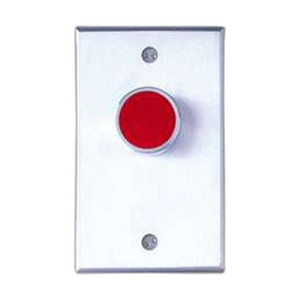
Camden CM-4085RPTE Spring Return DPST Pneumatic Timer
The Camden CM-4085RPTE is a DPST pneumatic timer designed for access control, door strike circuits, and electronic locking systems requiring adjustable time-delay switching with automatic spring return. Operating on 24VDC, this timer provides 1-60 second adjustable delay in a compact form factor suitable for pole or rack mounting. The red push-button interface and pneumatic actuation eliminate solenoid chatter and deliver reliable repeatable timing across tens of thousands of cycles — critical for high-traffic entry points and security automation loops.
Key Features
- DPST Switch Configuration: Dual-pole, single-throw allows simultaneous switching of two independent circuits from a single timer activation. Useful for coordinating strike release with secondary door hardware or alarm relay signaling.
- Adjustable Timing Range: 1-60 second delay covers immediate door-hold scenarios (parking garage barriers, temporary lockdown) through extended egress sequences (stairwell re-entry delays). No component substitution required for mid-range adjustments.
- Pneumatic Actuation: Spring-return pneumatic mechanism eliminates electrical solenoid noise and power transients common in electromagnetic timers. Inherently fail-safe — timer reverts to deactivated state on air loss or power interruption.
- 24VDC Operating Voltage: Standard access control power rail. Integrates directly into existing 24VDC security infrastructure without auxiliary transformers or voltage regulation.
- Red Push-Button Interface: Manual activation with tactile feedback. Spring return ensures single cycle per depression — prevents accidental extended activation or manual hold-down latching.
- Pole and Rack Mount Options: Dual mounting configurations allow installation in control cabinets, equipment racks, or surface-mount pole applications. Flexible form factor reduces site-specific fabrication overhead.
- HID Credential Integration: Compatible with HID-based access control systems supporting TCP/IP communication. Allows timer control via badge reader logic or remote access protocol.
- Repeatable Cycle Timing: Pneumatic governors maintain consistent delay across temperature extremes and component aging — important for high-volume deployments where timing drift triggers false alarms or compliance violations.
The CM-4085RPTE suits facilities managing traffic flow through single or paired doors (lobbies, secure corridors, emergency egress routes). A single timer can coordinate strike release on two separate locks or trigger a strike plus an ancillary alarm relay — reducing wiring and control-logic complexity. The 1-60 second range covers most commercial ANSI egress time requirements (typically 15-45 seconds) without special ordering.
Pneumatic timers exhibit lower electromagnetic noise floor than solenoid-based electronic timers, making them preferred in audio-sensitive environments (recording studios, medical facilities) and in systems where inrush current spikes degrade signal integrity in adjacent control circuits. The spring return guarantees no stuck-open state due to electrical failure or software glitch — the timer automatically resets, allowing the protected door to re-lock. This is a critical safety attribute in life-safety applications where a wedged strike can compromise building security or evacuation procedures.
Deployment as a secondary delay timer downstream of an access control reader allows integrators to implement multi-stage egress sequences: badge read triggers strike release, then a 30-second pneumatic timer holds the door open for occupant passage, then the strike re-locks automatically. This avoids software timers in the access control panel itself, isolating mechanical failures from electronic control logic.
The timer carries Manufacturer Warranty and is documented in full-service datasheets covering pneumatic tubing sizing, electrical wiring diagrams, and cycle-life ratings. Installation in 24VDC door-strike circuits requires standard RJ45 or screw-terminal access control wiring; no specialized commissioning tools are needed beyond a simple 24VDC multimeter for voltage verification and a manual timer for cycle testing.
Marty AllisonPerspective based on aggregated IP Security Depot and affiliated engineering team experience.
We've deployed the CM-4085RPTE across multi-tenant office buildings, parking structures, and hospital secure corridors. It solves a specific problem: when you need a time-delay switch that doesn't care about power ripple, RF noise, or software state — just air pressure and a mechanical spring. The pneumatic design is elegant for high-cycle applications because there's no solenoid chatter, no electrical contact bounce, and no relay coil heating. On a busy lobby door with 500+ daily activations, that means lower maintenance cost and zero unexpected latching failures. We've seen integrators reach for this timer when the access control panel's built-in delay relay starts exhibiting timing drift or when electrical noise from proximity readers is interfering with analog logic circuits. The 1-60 second range is practical for most ANSI egress workflows, though you do lose granularity below 1 second — if you need sub-second delays, this is not your product. The red button is simple and foolproof, but it also means manual override or remote control requires additional relay wiring; on newer systems, that's a minor inconvenience, but on older facilities without TCP/IP infrastructure on the door hardware line, it's a limitation to flag before spec.
Technical Highlights:
- DPST Switching: Two independent poles from one timer unit. In practice, this eliminates the need for a second external timer or relay when you need to coordinate strike release with a magnetic lock on an adjacent door or trigger an alarm bell during the hold-open period. We've used this in secure stairwells where opening the fire door also needs to log an event and unlock a secondary portal.
- Pneumatic Actuation vs. Solenoid: No inrush current, no EMI emission, no acoustic noise. In audio-sensitive facilities (recording studios, hospitals with adjacent patient rooms), the lack of solenoid buzz is worth the design trade-off. Fail-safe behavior — loss of air pressure or 24VDC immediately reverts the timer to reset state, preventing stuck-open conditions.
- 1-60 Second Adjustable Delay: Pot-screw or pin-based adjustment (verify on datasheet) allows on-site tuning without parts replacement. Most ANSI egress sequences fall between 15-45 seconds; this range covers 95% of commercial door-delay scenarios.
- 24VDC Standard Supply: Plugs into any commercial access control 24VDC bus. No transformer or power conditioning required. Simplifies cabinet layout and reduces failure points.
- Spring Return Guarantee: Mechanical spring ensures single-cycle activation per button press. No software or power-state dependency — the timer physically returns to idle state. Critical for high-security or life-safety applications where a wedged strike is unacceptable.
Deployment Considerations:
- Pneumatic supply line required: The timer needs clean, dry compressed air at 60-80 psi. If your facility doesn't have an air compressor or pneumatic backbone, this timer adds a new infrastructure dependency. In modern access control deployments that are entirely electrical/electronic, that's a non-starter — you'd spec an electronic solenoid timer instead.
- Manual activation only by default: The red button is a hardwired momentary switch. Remote control via access card or software trigger requires external relay logic or TCP/IP gateway module (if available from Camden). Confirm with your control system that remote automation isn't a mandatory feature before committing.
- Tuning via mechanical adjustment: Changing the delay time requires physical access to the timer (removing cover, adjusting pot or pin). Not as convenient as software-configurable electronic timers, but it also means no configuration drift from software updates or operator error.
- Air-line maintenance: Condensation and particulates in pneumatic lines can degrade timer responsiveness over time. Specify good-quality air filters and drain traps upstream of the timer. In dusty or humid environments (parking structures, warehouse doors), budget for annual air-line flushing and desiccant cartridge replacement.
- Cycle life and testing: Pneumatic timers are rated for tens of thousands of cycles. If you're implementing 24/7 automated door cycling (e.g., automatic barriers for vehicle access), verify cycle-life ratings on the datasheet before installation. Most commercial timers are rated for manual or low-frequency use, not continuous automated activation.
The CM-4085RPTE is the right choice for integrators supporting existing pneumatic-heavy facilities, high-traffic manual-activation environments, and noise-sensitive applications where solenoid chatter is unacceptable. For new construction or all-electronic system modernization, an electronic solenoid timer is usually simpler to install and commission. If your site already has pneumatic infrastructure on the door line, or if you're retrofitting into a legacy access control setup, reach out to the Camden catalog for the full range of timer and relay options.