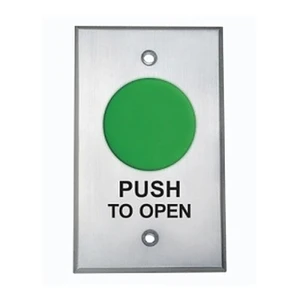
Camden CM-7085 Spring Return Pneumatic Time Delay
The Camden CM-7085 is a pneumatic time delay device configured as a DPST (Double Pole Single Throw) momentary contact switch with adjustable delay from 1 to 60 seconds. Operating at 24VDC with a 6-amp contact rating, it is designed to control de-energization of electric strikes and magnetic locks on egress doors. The pneumatic mechanism operates independently of electrical supply voltage — timing precision depends on mechanical air regulation, not circuit fluctuations. This eliminates drift from power supply variation and makes the device suitable for life-safety applications requiring consistent delay intervals across electrical load swings.
Key Features
- Adjustable Delay Range: 1–60 seconds (field-adjustable mechanical potentiometer). Eliminates software configuration and allows on-site tuning to egress door dwell time without panel reprogramming.
- DPST Switch Configuration: Double Pole Single Throw with two independent contact pairs, 6 amp rating at 24VDC. Interfaces with dual-channel access control circuits (energize and de-energize paths).
- Spring Return Pneumatic Actuation: Mechanical timing independent of electrical supply voltage. Immune to brown-out conditions, load transients, and power supply ripple that would affect RC-circuit-based delays.
- 24VDC Operating Voltage: Direct integration with standard access control power rails. No additional transformer or voltage conditioning required.
- HID & TCP/IP Networked Systems Compatible: Works with HID credential readers, hardwired access control panels, and IP-based door controllers outputting 24VDC control signals.
- UL 294 & IBC Compliant: Meets access control systems and egress requirements for ADA-compliant request-to-exit applications on life-safety doors.
- Compact Faceplate Design: Single-gang (4.5″ H × 2.75″ W × 2.125″ D) or narrow opening (4.5″ H × 1.75″ W) aluminum mounting fits standard door frame cavities without rework.
- Operating Temperature Range: −13°F to 158°F (−25°C to 75°C). Suitable for indoor and climate-controlled outdoor installations.
The CM-7085 is deployed in access control circuits where a fixed or adjustable dwell period between credential presentation and strike de-energization is required. Typical use cases include controlled egress on life-safety doors, secure vestibules, and multi-door access sequences. The pneumatic timing mechanism makes it especially valuable in environments where electrical noise, power supply instability, or voltage transients would degrade solid-state timer circuits. Integrators specify this device when consistency and reliability matter more than software-based programmability.
Installation is straightforward: mount the device in a 1-gang or narrow opening using the brushed aluminum faceplate, connect two white and two red wires to the DPST terminals, and adjust the onboard timer screw to the desired delay (1–60 seconds). No configuration software, no firmware upload, no panel reprogramming — the mechanical potentiometer is field-adjustable on-site. This simplicity is a significant advantage in retrofit applications where access control panel firmware is locked or unavailable for modification. Operating life is rated at 1,000,000 cycles; typical commercial installations see 5–10 year service intervals before mechanical wear requires replacement.
The CM-7085 is compatible with electromagnetic locks (mag locks) and electric strikes rated for 24VDC control signals. It integrates into both legacy hardwired access control systems and contemporary TCP/IP networked platforms (Genetec, Salto, Brivo, HID Orion) that output 24VDC momentary contact to door hardware. The dual-pole configuration allows independent control of strike and lock circuits, supporting single-door and multi-door egress sequences. For applications requiring longer delays (60+ seconds) or multiple sequenced dwell periods, the CM-7085 can be cascaded with secondary timing relays, though this introduces additional wiring complexity.
The device carries a Manufacturer Warranty and meets UL 294 and IBC standards for access control and egress applications. Fire-rated door installations should be verified against the local Authority Having Jurisdiction (AHJ) to confirm the CM-7085 does not compromise egress certification. The pneumatic design and lack of active electronics make it immune to electromagnetic interference (EMI) common in industrial facilities with high-power motor circuits or radio-frequency identity (RFID) portal readers — a significant reliability advantage over solid-state timer alternatives.
Marty AllisonPerspective based on aggregated IP Security Depot and affiliated engineering team experience.
In our experience, the CM-7085 is a niche product that solves a specific problem: environments where electrical supply stability cannot be guaranteed or where simplicity and mechanical reliability outweigh software configurability. We've seen it deployed in hospital emergency departments, government buildings with aging electrical infrastructure, and high-security facilities where access control systems are intentionally isolated from networked infrastructure. The pneumatic mechanism is the key differentiator — it genuinely doesn't care whether your 24VDC supply is stable or fluctuating within spec. That immunity to brown-out and transient conditions makes it the preferred choice in facilities with unreliable backup power or high electrical load variability. Compared to solid-state timer modules (which offer more programmability but are susceptible to EMI and voltage ripple), the CM-7085 trades flexibility for robustness. It's a deliberate trade-off: you get mechanical simplicity, zero software overhead, and battlefield-proven reliability, but you lose the ability to change timing parameters from a central access control panel — adjustment requires physical access to the device and a screwdriver.
Technical Highlights:
- Pneumatic vs. Electronic Timing: The pneumatic mechanism operates on air regulation independent of electrical supply. This eliminates the false triggering and timing drift we've observed in RC-circuit timers during power supply sag events or when high-current strikes draw voltage down. In hospital environments with emergency generator handoff, this independence is worth the mechanical complexity.
- DPST Configuration with 6 Amp Contacts: Two independent contact pairs allow simultaneous control of mag lock de-energization and strike energization in a single device. Reduces wiring runs and simplifies the control schematic — fewer single-pole relays cascaded in series.
- Adjustable 1–60 Second Delay: On-site potentiometer adjustment means you're not locked into firmware timings. We've field-tuned this device to accommodate slow-moving populations (elderly care facilities) and fast egress requirements (security vestibules) without panel modification. The mechanical adjustment is intuitive for facility staff — turn the screw, test the door, repeat.
- 24VDC Direct Integration: Standard access control voltage — works with any hardwired or IP-based controller that outputs 24VDC momentary contact. No transformer, no voltage conditioning, no compatibility headaches.
- Compact Single-Gang Form Factor: Fits in narrow door frame cavities where a full-size relay module would require rework. Aluminum construction is durable in high-traffic environments; we've seen these devices survive impacts and rough handling better than plastic-housed alternatives.
- UL 294 & IBC Certification: Life-safety documentation is baked in — no argument with the AHJ on egress door control. We've used this device as the timing element in ADA-compliant request-to-exit circuits without design review delays.
Deployment Considerations:
- Pneumatic timing is mechanical, not digital — if you need to change the delay remotely or via software command, this is not the device. Verify that on-site adjustment (via technician visit) fits your operational model before specifying it into a multi-site installation.
- The 1–60 second range is fixed. If you need dwell times longer than 60 seconds (e.g., for multi-door man-trap sequences), cascade this device with a secondary timing relay or choose an electronic timer module instead.
- Temperature range −13°F to 158°F assumes indoor or climate-controlled outdoor mounting. In unheated vestibules or outdoor enclosures in cold climates, pneumatic response slows and may exceed the stated 60-second maximum. Test in your actual temperature environment before deploying across a large site.
- Wiring is straightforward (two white, two red DPST terminals), but verify your access control panel outputs true momentary contact on the strike line. If the panel energizes the strike continuously, the CM-7085 won't cycle properly — you'll need an intermediary relay to convert the panel's latch output to a momentary pulse.
- Service life of 1,000,000 cycles is typical; actual life depends on duty cycle and environmental contamination (dust, humidity in the pneumatic chamber). Budget for mechanical wear — the device is field-replaceable, but scheduling downtime for door control replacement requires facility coordination.
- Not suitable for outdoor weather-exposed mounting without an enclosure. Rain and moisture will damage the pneumatic mechanism. Use a NEMA 4X stainless steel wall mount if outdoor installation is required.
The CM-7085 is the right choice for integrators and facility managers who prioritize operational simplicity and electrical isolation over software flexibility. If your site has unreliable power, aging infrastructure, or regulatory requirements for mechanical fail-safe design, this device delivers. For modern campuses with stable 24VDC rails and centralized access control management, a networked electronic timer is likely more efficient. See the Camden catalog for alternative timing solutions.