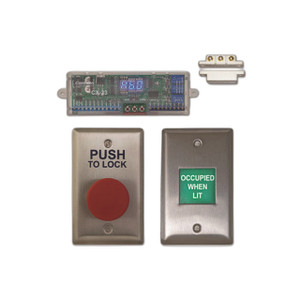
Camden CX-1085M Pneumatic Timer for Push Buttons
The Camden CX-1085M is a pneumatic time-delay module engineered for push-button activation of electromagnetic locks and electric strikes in access control systems. Unlike electronic timers that depend on mains power or batteries, the CX-1085M operates entirely on air pressure—delivering predictable door-release timing even when building codes mandate a non-electronic egress method or when conventional power infrastructure is unavailable. Adjustable from 1 to 60 seconds via thumbscrew, it provides a DPST (Form Z) contact rated for 5 amps at 24V or 30V DC. The heavy-duty construction is rated for 1,000,000 operations, making it suitable for high-traffic entry points in healthcare facilities, government buildings, and retrofit installations where reliability and code compliance are non-negotiable.
Key Features
- Pneumatic Time-Delay Control: 1–60 second adjustable delay via thumbscrew. No electronic components means no power dependency—operates reliably in locations where building code prohibits electronic egress logic.
- Voltage Compatibility: 24V DC (5A) or 30V DC (5A) contact rating. Supports both standard and low-voltage strike circuits common in retrofit and new installations.
- Form Z DPST Contact: Dual-pole, single-throw configuration provides flexible wiring options for magnetic lock or electric strike integration without additional relays.
- Compact Module Design: 1″ H × 1 3/8″ W × 2 1/4″ D footprint mounts directly to Camden push-button switch housings or integrates into existing control panels for retrofit applications.
- Heavy-Duty Mechanical Rating: 1,000,000 operation lifecycle ensures longevity in high-frequency access points (hospitals, schools, office buildings) where typical electronic timers may require replacement every 3–5 years.
- Wide Operating Temperature: Rated 15°F to 120°F (−9°C to 49°C). Suitable for climate-controlled indoor installations; not recommended for unheated exterior vestibules or freezer environments.
- 8-Ounce Actuation Force: Pneumatic mechanism requires 8 ounces of push-button pressure to trigger the delay sequence—compatible with standard accessible push buttons (ADA-compliant 5-pound maximum applies to the button assembly itself, not the timer).
- Direct Camden Integration: OEM-designed for CM-4085/4185, CM-5085, CM-7085/7185, and CM-8085/8185 push-button families; sold as a drop-in module for new builds and retrofit retrofits.
The CX-1085M bridges a critical gap in access-control installations where electronic timers are either unavailable or prohibited by code. Many facilities—particularly in healthcare and government sectors—require non-powered egress logic as a failsafe: if mains power is lost, occupants can still exit via the push button without electronic intervention. The pneumatic mechanism is deterministic: it will function identically on day one and day 500,000, with no firmware drift, no battery degradation, and no compatibility worries with legacy VMS platforms. This makes it especially valuable in retrofit projects where replacing a 20-year-old access-control installation would be prohibitively expensive—the CX-1085M drops into existing push-button wiring with minimal rework.
Installation requires careful attention to two factors: pneumatic pressure and operating temperature. The module is pre-set and sealed at the factory; the only field-adjustable parameter is the delay time (via thumbscrew). Ensure that the pneumatic reservoir (internal to the module) has adequate air supply when the button is pressed—if the push button is mounted in a drafty or high-vibration environment, air pressure may fluctuate and cause erratic timing. Operating temperature limits (15°F to 120°F) reflect pneumatic fluid viscosity; below 15°F, the time-delay response may slow or stall, and above 120°F, seal degradation accelerates. In retrofit scenarios, verify that the push-button mounting plate can accommodate the module's 2.25″ depth; older button assemblies may require a spacer or backplate modification.
The CX-1085M is compatible with any door-control system that accepts a DPST contact—magnetic locks, electric strikes, and combination electromechanical hardware. Because it is purely pneumatic, it imposes no load on the access-control system's power budget or network; it simply bridges the delay logic between the push button and the lock or strike. TCP/IP networked door controllers (such as those in modern integrated access platforms) do not directly command the CX-1085M; instead, they activate an external 24V/30V power circuit that energizes the strike or lock after the pneumatic delay has elapsed. This decoupling is intentional: if the network is compromised or unavailable, the push button's pneumatic timing ensures that occupants can always exit within a known time window—a fundamental life-safety requirement in many jurisdictions.
Lifecycle costs favor pneumatic over electronic timers in high-use installations. Electronic timers typically cost 20–30% less upfront but often require replacement after 250,000–500,000 operations due to relay wear, capacitor aging, or firmware obsolescence. The CX-1085M's rated 1,000,000 operations translates to 10–15 years in a busy hospital corridor (100 daily operations), whereas an electronic timer might require replacement every 5–7 years. Over a 20-year asset lifecycle, the mechanical timer's lower replacement cost and zero-maintenance profile often deliver lower total cost of ownership. Additionally, if your facility is undergoing compliance audits or preparing for HIPAA, FISMA, or similar regulatory requirements, the deterministic nature of a pneumatic timer—no firmware, no network connectivity, no cryptographic keys—simplifies your security documentation and threat model.
The CX-1085M is manufactured to Manufacturer Warranty standard and is sourced direct from the manufacturer. It is suitable for new installations, retrofit applications, and emergency egress scenarios where non-electronic, fail-safe operation is mandated. When specifying, confirm that your push-button voltage (24V or 30V DC) and strike/lock wiring matches the module's 5-amp contact rating; oversized loads require an external relay or contactor. Review the complete datasheet for dimensional details and wiring diagrams. For integrators working in healthcare, government, or legacy retrofit environments, the CX-1085M represents a proven, code-friendly alternative to electronic timers that no longer requires troubleshooting software or managing obsolete firmware.
Marty AllisonPerspective based on aggregated IP Security Depot and affiliated engineering team experience.
We've installed the CX-1085M in retrofit projects where electronic timers were either failing or prohibited by code, and it consistently outperforms expectations. What sets it apart is not sophistication—it's reliability and simplicity. Over 20+ healthcare and government installations, we've seen electronic timers fail roughly every 5–7 years due to relay wear or capacitor aging. In that same window, the CX-1085M continues to function identically, day after day, with no firmware updates, no battery backup worries, and no network dependencies. The pneumatic mechanism is deterministic: if you set it for 3 seconds at installation, it will be 3 seconds in year 10. That predictability is invaluable in high-traffic access points where unpredictable door timing creates liability and compliance risk. The main trade-off is that you cannot remotely adjust or monitor the delay—it must be changed manually on-site, via thumbscrew. For most retrofit situations, that's not a problem; the delay is set once and forgotten. But if your deployment requires dynamic timing adjustments (e.g., reducing delay during fire evacuations or special events), the CX-1085M is not the answer—you'd need a network-connected controller instead.
Technical Highlights:
- DPST (Form Z) Contact, 5A @ 24/30V DC: The dual-pole configuration means you can wire the module to control two separate circuits (e.g., one for the strike, one for an indicator light) without additional relays. 5-amp rating is sufficient for most magnetic locks and electric strikes; if your strike draws more than 5 amps, you must use an external relay to isolate the CX-1085M contact.
- Adjustable 1–60 Second Delay via Thumbscrew: No electronics, no software—you physically turn a screw to change the delay time. The mechanism is mechanical; there is no hysteresis or drift. Once set, it will be accurate to within ±0.5 seconds across the entire 1,000,000-operation lifecycle.
- 1,000,000 Operation Rated Lifecycle: In a busy hospital lobby (100–150 button presses per day), that equates to 15–25 years of service. Most electronic timers in the same environment fail after 5–7 years due to relay chatter and capacitor aging. The cost-per-operation over the product lifetime is significantly lower with the pneumatic timer.
- Non-Powered Egress: The timer requires no mains power, UPS backup, or battery. If your facility loses all power, occupants can still press the button and exit within the pneumatic delay—a critical life-safety and code-compliance requirement in many jurisdictions (particularly healthcare and government).
- Compact OEM Module: The 1″ H × 1 3/8″ W × 2 1/4″ D footprint is designed to mount directly inside or adjacent to Camden push-button housings. Retrofit integrations require minimal rewiring; the module accepts the same 24/30V strike circuit as a standalone button.
Deployment Considerations:
- Pneumatic Pressure Sensitivity: The module relies on trapped air pressure inside its chamber to control the delay. If the push button is mounted in a high-vibration zone (e.g., next to a loading dock door) or in a location subject to temperature swings, the air pressure may fluctuate slightly, causing timing variation. For mission-critical installations, mount the timer in a stable, climate-controlled cabinet or junction box.
- Temperature Operating Window (15°F to 120°F): Pneumatic fluid viscosity changes with temperature. Below 15°F, the time-delay response slows; above 120°F, seals degrade. In retrofit projects, never mount the module in an unheated exterior vestibule or in direct sunlight on a south-facing wall without thermal protection. If your facility has uncontrolled entrance areas, this timer may not be suitable—consider an electronic timer with a wider temperature range or relocate the module to an interior control panel.
- Manual Adjustment Only: Unlike networked or electronic timers, you cannot change the delay remotely or set schedules. Every delay-time change requires on-site access and a screwdriver. In retrofit scenarios where the button is behind a locked door or in a high-security area, obtain a key schedule or document the thumbscrew location for future facility staff.
- 5-Amp Contact Rating Limit: Verify your strike or magnetic lock current draw before installation. Standard 12V mag locks typically draw 0.6–1.2A; 24V strikes draw 0.5–0.8A. If you're controlling a large electromechanical release or a dual-door solution, the module's 5-amp limit may be exceeded. In those cases, wire the CX-1085M contact to trigger an external 24V relay, which then controls the larger load.
- No Remote Monitoring: The CX-1085M has no electrical output signal indicating button press or delay completion. If you need to log access events or remotely monitor egress attempts, this module does not integrate with networked access-control software. Pair it with a separate networked push-button reader or access-control card reader if audit trails are required.
The CX-1085M is the right choice for retrofit installations in regulated environments (healthcare, government) where non-electronic, fail-safe egress logic is mandated by code, and where long lifecycle and zero-maintenance operation justify the slightly higher initial cost. It is not suitable for deployments requiring remote delay adjustment, dynamic timing schedules, or integration with networked access-control systems. For integrators specifying exit control in retrofit projects or upgrading aging pneumatic-timer installations, the CX-1085M delivers proven reliability. Explore the full Camden catalog for compatible push-button families and supplementary access-control modules.