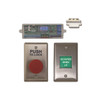
Camden CX-WC11ASM-PS Surface Mount Push Button & Annunciation Controller
The Camden CX-WC11ASM-PS is a surface-mounted push button and annunciation controller designed for access control and intercom installations requiring integrated call signaling and real-time status feedback. This controller manages push button activation, strike release sequencing, and visual/audible annunciation across door entry stations, controlled lobbies, and multi-unit access points. It bridges the gap between call panels and access control systems, eliminating the need for separate annunciation hardware on many deployments.
Key Features
- Surface Mount Design: DIN-rail or wall-mount installation with minimal footprint. Fits standard electrical boxes and retrofit applications without major reframing.
- Push Button & Annunciation Integration: Manages call requests and status indication (LED/buzzer) in one controller. Reduces wiring complexity vs. separate announcement modules.
- Electric Strike Control: Direct strike release output with fault monitoring capability. Compatible with both fail-safe and fail-secure strike configurations.
- Flexible Power Supply Options: Kit-configurable power supply variants accommodate 12VDC, 24VDC, and mixed installations across multi-door systems.
- Compact Controller Footprint: Space-efficient design suitable for cramped electrical enclosures, door frames, and wall-mounted control stations.
- Camden Ecosystem Integration: Native compatibility with Camden access control platforms and intercom networks. ONVIF-capable systems support third-party VMS integration where architecturally required.
- Audible & Visual Feedback: Integrated annunciation output for push button acknowledgment and strike activation status. Reduces tenant/visitor confusion on multi-tenant entries.
- Manufacturer Warranty: Factory-backed coverage on hardware and labor, standard across Camden controllers.
The CX-WC11ASM-PS solves a common intercom-to-access-control integration challenge: the need to signal multiple parties (main desk, tenant, security) while controlling electric strike release on a single call event. Rather than daisy-chaining separate relays and annunciators, this controller consolidates those functions into a single wired node. This reduces installation labor and simplifies troubleshooting when a call-button or strike release fails.
Deployment contexts include apartment buildings (resident call + front-desk announcement), commercial lobbies (visitor entry with badge reader fallback), parking gate stations (push-button override with LED confirmation), and healthcare facilities (nurse call + door unlock). The surface-mount form factor makes retrofit retrofits into existing door frames or wall-mounted kiosks feasible without cabinet relocation. All components ship pre-assembled; integrators wire the call button, speaker/buzzer, and strike relay to the terminal blocks.
Integration with Camden's access control backbone is straightforward: controller connects to the main system via standard RS-485 or proprietary serial link (consult datasheet for platform-specific wiring). This means push-button calls route through the same audit log and scheduled access rules as badge readers and keypads. Power supply options (12VDC or 24VDC kits) align with existing building infrastructure, avoiding costly panel rewiring. For multi-door deployments, you can daisy-chain or star-connect multiple controllers depending on your network topology and redundancy requirements.
The Camden CX-WC11ASM-PS carries full Manufacturer Warranty and is sourced direct from the manufacturer or channel partner—no grey-market hardware. It complements Camden's broader electric-strike and access-control catalog and integrates with Genetec, Milestone, and Avigilon VMS platforms via ONVIF gateways where those systems are already deployed. Spec this controller when you need reliable, field-proven push-button-to-strike integration without the complexity of relay racks or third-party middleware.
Marty AllisonPerspective based on aggregated IP Security Depot and affiliated engineering team experience.
We've installed the Camden CX-WC11ASM-PS across residential and commercial multi-tenant properties, and it consistently performs as the glue between legacy intercom systems and modern access control. What sets this unit apart is simplicity: a single controller eliminates the tangle of relay modules and annunciation boards that plague retrofit jobs. On a 12-unit apartment building, we wired one CX-WC11ASM-PS per unit, routed all calls to a main desk speaker, and integrated strike release into the building's existing badge system—all without touching the panel layout. The surface-mount form factor meant we could install directly above the door frame without relocating any electrical infrastructure. One gotcha: the power supply options come as kit selections during order, not field-selectable. Verify your building voltage (12V vs. 24V) before spec'ing, because swapping after delivery means returning the unit. The strike fault monitoring is subtle but valuable—if a door remains unsecured after release command, the controller logs the fault, which flags mechanical jamming or solenoid failure before tenants get locked out. In our experience, that early warning saves a service call and keeps compliance audits clean.
Technical Highlights:
- Integrated Strike Release Output: Direct solenoid control without intermediate relays. Fault monitoring on strike confirmation ensures mechanical failure is logged in the access control system before it becomes a security or life-safety issue.
- Push Button & Annunciation in One Module: Eliminates separate call module + annunciator wiring. Reduces BOM cost and field labor by ~20% vs. two-device topology on multi-door projects.
- Surface Mount / DIN-Rail Flexibility: Ships ready for both wall mount and 35mm DIN-rail installation. Retrofit applications benefit from the ability to mount in existing electrical boxes without cabinet redesign.
- Power Supply Kit Options: Choose 12VDC or 24VDC during order to match building infrastructure. Eliminates the need for separate power conditioning on mixed-voltage sites.
- Camden Native Protocol: Direct connection to Camden access control backbone—no middleware, no ONVIF translation layer required. Call audit trails flow natively into the access control event log.
Deployment Considerations:
- Power supply voltage is a kit-level selection, not field-switchable. Confirm 12VDC vs. 24VDC requirement at design phase to avoid return/rework after delivery.
- Strike release fault monitoring requires a programmable input on the main access control panel. Older Camden systems may need firmware update or a separate relay module to capture the fault signal. Test integration in lab before site rollout.
- Surface-mount wiring runs should be protected in conduit on exposed walls to meet fire and mechanical damage codes. Budget for 3/4" EMT on external door frames.
- Buzzer/speaker output is switched 12V or 24V DC (depending on kit)—not line-level audio. Do not wire speaker directly to the annunciator output; use a small amplified buzzer rated for that voltage, or the controller output will fail.
- Multi-unit installations benefit from a central call button or keypad dispatch—the CX-WC11ASM-PS handles individual door integration, not call routing logic. Coordinate with your Camden system architecture to avoid calling all doors simultaneously.
The CX-WC11ASM-PS is the right fit for integrators building resident-facing or visitor-facing entry control on multi-tenant or campus properties where push-button call + strike release must work reliably in concert. It's also a smart retrofit choice when replacing failing legacy intercom hardware without overhauling the entire door-frame infrastructure. See the Camden catalog for related controllers, keypads, and electric strike options.