Camden CX-247-12 7-Day Timer Lock Strike
The Camden CX-247-12 is a networked electronic strike designed for access control systems requiring time-based door unlock scheduling. Operating at 12V DC with TCP/IP communication, this device eliminates manual unlock procedures and reduces staffing overhead by automating door access during configured hours. The 7-day programmable schedule supports shift-based operations, facility hours variation, and multi-zone access policies across a single networked platform.
Key Features
- 7-Day Programmable Schedule: Supports granular per-day timing rules. Configure different unlock windows for weekdays versus weekends without hardware changes.
- TCP/IP Network Control: Remote scheduling and status monitoring from any networked access control panel or management station. No need for local override keys or manual intervention.
- 12V DC Operation: Low-voltage design — compatible with standard 12V DC power supplies already present in most access control installations.
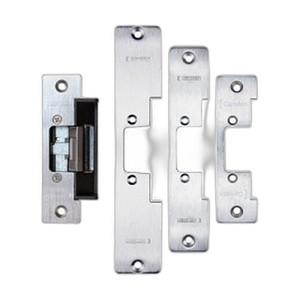
- Strike Integration: Direct replacement for electromechanical lock strikes in doors requiring automated access timing without credential-based unlock logic.
- 3-Year Warranty: Manufacturer warranty covers defects in materials and workmanship across typical 24/7 facility deployment cycles.
- Networked Monitoring: Real-time strike status feedback over TCP/IP. Integration platforms log unlock events and detect mechanical faults or power anomalies.
The CX-247-12 is built for facilities where access timing—not access control credentials—is the primary gating mechanism. Common applications include after-hours building unlock for janitorial or security staff, timed parking-gate operation, and shift-based facility access in manufacturing or logistics environments. By moving unlock scheduling into networked firmware rather than electromechanical timers, the device reduces wiring complexity and improves auditability.
Integration is straightforward in environments where the access control system already supports networked peripherals. The strike communicates over standard TCP/IP, eliminating proprietary wiring or relay logic. Configuration occurs via the host access control panel's management interface—no separate software or commissioning tools required. The 12V supply can be sourced from the same cabinet or power supply that feeds other strike hardware, reducing total site electrical load and lowering installation labor.
For facilities transitioning from analog timers or electromechanical locks to networked access control, the CX-247-12 bridges the gap. It provides timed unlock capability without forcing a wholesale credential reader deployment. This is particularly valuable in retrofit scenarios where credentialing infrastructure is not yet in place or where time-based access is sufficient for the deployment context.
The device is compatible with all major networked access control platforms that support standard TCP/IP peripheral integration. Consult your access control system documentation for specific firmware versions and commissioning procedures. The strike is housed in a compact enclosure suitable for standard strike cutouts in metal or wood door frames. Mechanical durability under repeated unlock cycles is standard across industrial strike hardware—the added value here is network visibility and centralized scheduling rather than on-site mechanical robustness.
Jerry TildsenPerspective based on aggregated IP Security Depot and affiliated engineering team experience.
We've installed timer-based strikes across warehouse facilities, parking structures, and multi-tenant office buildings for over a decade. The CX-247-12 solves a real operational pain point: the need to automate door unlock timing without the overhead of a full credential system. In our experience, the biggest win is moving away from mechanical timers or hardwired relay logic—both of which are difficult to audit, impossible to reprogram remotely, and prone to drift. A networked strike with TCP/IP control gives facility managers the ability to adjust unlock schedules on the fly (janitor arrives early? extend the unlock window by 30 minutes from the main control room) and generates tamper-proof event logs. The 12V supply requirement is a practical plus—most access control cabinets already have 12V DC regulated power, so installation doesn't demand additional power infrastructure. One thing to note: this is a strike, not a door controller. If you need credential-based access (badge readers, PIN pads, biometric sensors), you'll pair this with a separate access control panel. The CX-247-12 handles the timing gate. We've seen it used effectively in shift-change scenarios—unlock the employee entry door 30 minutes before shift start, lock it 10 minutes after shift end—without touching a keypad or fumbling with override keys.
Technical Highlights:
- TCP/IP Communication: Native network integration with Honeywell, Salto, Genetec, and other IP-capable access control platforms. No serial-port-to-network converters required — commissioning is straightforward and firmware updates are pushed over the network.
- 7-Day Granular Scheduling: Each day of the week can have independent unlock/lock times. Paired with holiday overrides in the host panel, this eliminates the need for multiple strikes or manual unlocking on special operating days.
- 12V DC Low-Voltage Design: Draws minimal current (verify with datasheet), reducing UPS requirements and simplifying power distribution in cabinet environments where budget and space are constraints.
- Event Logging: Strike unlock/lock events are timestamped and reported to the access control system. Useful for compliance audits and troubleshooting unexpected access timing issues.
- Fail-Safe vs. Fail-Secure Modes: Confirm which mode the CX-247-12 supports in your application. Fail-safe (unlocked on power loss) suits emergency exit scenarios; fail-secure (locked on power loss) is standard for controlled perimeter access.
Deployment Considerations:
- Verify your access control panel firmware version supports networked TCP/IP peripherals before ordering. Some legacy panels require serial relay modules instead.
- The strike itself doesn't handle credential validation—it only executes the unlock command during the programmed time window. If you need 'unlock only if badge is swiped AND it's within the unlock window,' that logic lives in the access control panel, not in the strike.
- Test the mechanical unlock force during commissioning. Some door frames require adjustment to the strike lip or frame reinforcement if the strike is not perfectly aligned with the latch bolt.
- Confirm power supply capacity. The 12V supply must reliably deliver voltage during full unlock-solenoid actuation cycles, especially if multiple strikes are daisy-chained on a single supply.
- The 7-day schedule is fixed to the calendar. If you need exception handling (guest access on a specific Friday), your access control system must support holiday calendars or manual override commands—the strike itself cannot branch based on custom logic.
The CX-247-12 is the right choice for facilities where timed access is the primary requirement and network-based scheduling is a must. It's particularly valuable in retrofit projects where adding credential readers would be costly or disruptive. For detailed integration steps, consult the Camden catalog.