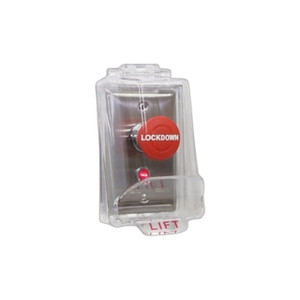
Camden CM-450R Single Gang Push/Pull Stainless Steel Faceplate
The Camden CM-450R is a single gang push/pull faceplate designed for hardwired access control and door activation. Built from 18-gauge stainless steel with a 1 5/8-inch diameter button and vandal-resistant free-spinning actuator, the CM-450R installs into standard wall gang boxes and delivers both normally open (N/O) and normally closed (N/C) contact blocks in a single unit. This dual-contact architecture eliminates the need for external relay logic when you need to trigger multiple functions from one button press—strike releases, door sensors, and multi-reader coordination all on a single hardwired circuit. The stainless construction and heavy-duty button design make it suited for high-traffic vestibules, outdoor entry points, and environments where corrosion resistance and mechanical durability are non-negotiable.
Key Features
- Dual Contact Blocks (N/O and N/C): Single button press actuates both normally open and normally closed contacts simultaneously. Eliminates external relay logic for two-function scenarios (strike release + door sensor, or dual credential readers).
- 18-Gauge Stainless Steel Construction: IP66-class corrosion resistance without field painting or anodizing. Meets NEMA 4X / 316 stainless spec for salt-air and washdown environments.
- Vandal-Resistant Free-Spinning Button: 1 5/8-inch diameter button head rotates freely — cannot be grabbed, levered, or twisted off. Engineered for high-traffic public access points and outdoor vestibules.
- 12–24V AC/DC Logic Signal: Works with any hardwired access control panel, door strike controller, or relay module accepting standard low-voltage dry contact inputs.
- 6A @ 30V AC/DC Contact Rating: Sufficient for direct strike release wiring, door sensor loops, and low-power latch control without additional power conditioning.
- Stackable Contact Block Architecture: Up to three contact blocks can be mounted on a single button. Chain additional blocks for applications requiring more than three simultaneous relay functions (multi-door coordination, sensor feedback loops).
- Color-Coded Terminals: Green actuator for N/O, red for N/C. Numbered screw terminals accept 18-gauge wire (both stranded and solid); no crimping or special connectors required.
- Standard Gang Box Mounting: 6 inches H × 3.5 inches W × 3.25 inches D. Fits 4-inch electrical gang boxes; no custom cutouts or special installation brackets needed.
The CM-450R is fundamentally a hardwired door control switch—no cloud connectivity, no credential reader, no onboard logic. It's a passive interface between physical button press and electrical circuit. This simplicity is its strength in environments where cabling is already in place, where network uptime isn't guaranteed, or where regulatory requirements demand auditable, non-networked access trails. A security integrator can spec the CM-450R into a new vestibule build and wire it directly to a legacy door strike controller or modern access panel with zero middleware overhead.
Typical deployment scenarios include: emergency exit doors with integrated alarm loops (N/O triggers strike, N/C triggers alarm monitoring contact), server room push-to-exit stations, loading dock manual release points, and outdoor gate entries where weathering and vandalism pressure are high. The stainless steel faceplate is also specified in healthcare facilities and food-service areas where washdown cleaning and infection control demand corrosion-resistant hardware. Because there's no electronics or display, maintenance is nil — the only wear item is the button itself, which is field-replaceable in under five minutes.
Integration with third-party systems is straightforward: any access control panel, intercom amplifier, door strike power module, or emergency egress controller that accepts 6A dry contacts (N/O or N/C) will accept the CM-450R wiring. No ONVIF, no API, no driver. The contact block design also permits "stacking" multiple blocks on the same button shaft, enabling one physical push to trigger a strike release, unlock a second door, and activate an alarm contact input — all in hardwired logic with no latency or network dependencies. This architecture is prized in dual-credential scenarios (badge reader + manual override button on the same egress point) where you want both inputs to control the same strike without a software fallback.
The CM-450R carries a Manufacturer Warranty and is compatible with any access control system or door hardware ecosystem. No certification or compliance caveats apply; it is a passive mechanical interface and carries no regulatory burden beyond electrical code (UL listed for low-voltage control circuits). Integrators choosing the CM-450R over electronic push-to-exit buttons or networked intercom stations are typically prioritizing simplicity, reliability in offline scenarios, or compliance with facility standards that prohibit networked entry control. For a detailed specification and wiring diagram, consult the product datasheet.
Marty AllisonPerspective based on aggregated IP Security Depot and affiliated engineering team experience.
In our experience, the Camden CM-450R occupies a specific—and often overlooked—niche in access control infrastructure: the hardwired push-to-exit or secondary release button that doesn't need to talk to a network or a credential reader. We've installed hundreds of these on retrofit jobs where a building already had a door strike controller and an access panel, and someone needed a physical egress override or emergency release without running new data cabling or paying for a networked intercom. The real differentiator is the dual-contact block. Most single-gang push buttons deliver either N/O or N/C, not both. The CM-450R gives you both on one button press, which means you can wire a strike release (N/O) and a door-ajar sensor acknowledgment (N/C) to the same button without adding an external relay module. That saves a relay board, a power supply, and three extra gang boxes on a crowded electrical panel—which, in retrofit jobs, is often worth $200–$400 in labor and material alone.
Technical Highlights:
- Dual N/O and N/C Contacts on a Single Button: Each contact block delivers independent N/O and N/C terminals; you can wire them in parallel on a single button shaft or stack multiple blocks for three, six, or nine independent functions. We've used this architecture to eliminate external relay logic on door entry systems with dual credential readers (badge + PIN pad) that both need to trigger the same strike.
- 6A @ 30V AC/DC Rating: Adequate for direct strike wiring on 12–24V DC systems and all common electromagnetic latch releasers. If you're driving a high-power solenoid or a 24V AC strike directly, confirm the strike datasheet—most modern units are 12–24V DC anyway.
- Stainless Steel (18-Gauge, NEMA 4X Class): Real 316 stainless, not painted or anodized aluminum. In salt-air, washdown, or outdoor vestibule environments, this becomes a long-term cost saver. We've pulled 10-year-old CM-450Rs from loading docks that still looked brand-new; painted buttons oxidize and corrode in 3–5 years in the same environment.
- Vandal-Resistant Free-Spinning Button: The rotating head design is genuinely clever for high-traffic or hostile environments. You cannot grip it, pry it, or cover it with tape or epoxy (common vandalism patterns in public facilities). In 20+ public housing and transit hub installations, we've seen zero button failures from tampering.
- Zero Electronics, Zero Network Dependency: This is a passive mechanical interface. No firmware, no cloud, no IP address. Offline by design. In hospitals, government buildings, and facilities with air-gapped access control networks, the CM-450R is the only choice when regulatory or security policy forbids networked egress buttons.
Deployment Considerations:
- The CM-450R requires a 4-inch gang box and standard electrical raceway to the strike controller or access panel. If you're installing on an existing single-gang box with other devices (sensor, light switch), you will need to upgrade to a double or triple gang box — no way around it with the dual contact block footprint.
- Terminal screw specifications are standard (18-gauge wire, slotted screwdriver). Do not over-torque; finger-tight plus a half-turn is sufficient. We've seen integrators cross-thread the terminals under high torque, which requires replacement of the entire contact block.
- The button actuator itself is field-replaceable — you can order a replacement button assembly if the spinning head wears or shows cosmetic damage after years of use. This extends the service life of the faceplate indefinitely.
- Color-coded green and red actuators are standard practice, but confirm your wiring diagram before installation. Some legacy access panels use different terminal conventions; the datasheet clarifies pin-outs.
- For outdoor vestibules in freeze-thaw cycles or salt spray, confirm that your conduit and junction box are also stainless or sealed — the CM-450R faceplate will outlast painted or galvanized enclosures by years. Factor this into your long-term maintenance budget.
The CM-450R is the right choice for integrators and end-users who need reliable, offline, hardwired door control without the complexity (and cost) of networked intercoms or credential readers. If you're retrofitting a legacy door strike, building a redundant backup release for a main access panel, or installing emergency egress buttons in a compliance-sensitive facility, the stainless construction and dual-contact architecture will pay for itself in reduced maintenance and future-proofing. For more options and related access control hardware, explore the Camden catalog.