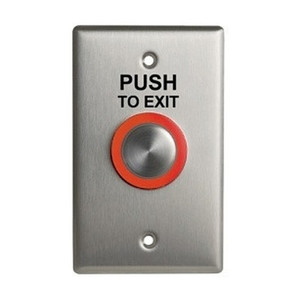
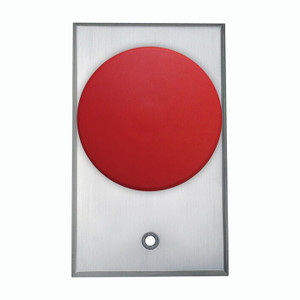
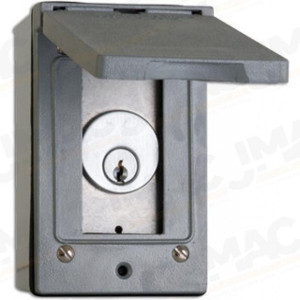
Camden CM-6030 Red Push-to-Lock Electronic Strike
The Camden CM-6030 is a 30VDC electronic strike designed for access control systems requiring push-to-lock activation with key-to-release operation. The normally open (N/O) maintained contact configuration energizes the strike on command and holds it locked until de-energized or manually released, making it a standard choice for fail-safe door access control where the door defaults to locked when power is lost. Deploy this where you need a compact, low-voltage strike integrated into networked access control panels, local relay circuits, or request-to-exit (RTE) device outputs.
Key Features
- 30VDC Rated Supply: Standard voltage for most commercial access control panels and relay circuits. Typical draw 0.5–1.5 A continuous hold, enabling compatibility with standard 24–30VDC power supplies rated for multiple strikes.
- Push-to-Lock Activation: Operator pushes door to engage the locking mechanism once the strike is energized. Reduces wear on electronic latch components compared to solenoid-only designs.
- Key-to-Release Override: Manual key release allows emergency egress or service access without power. Critical for life-safety compliance in areas requiring fail-safe unlocking on power loss.
- N/O Maintained Contact: Strike remains locked as long as control voltage is applied. Door defaults to locked state on power failure, eliminating the need for backup batteries in certain fail-safe installations.
- Red Finish: Visual indicator distinguishing this strike from standard chrome or stainless finishes; aids in rapid identification during installation and service.
- Adapter Plate & Box Mounting: Supplied with double-gang and 4×4 electrical box adapter plates for flexible installation in standard door frame cutouts; simplifies retrofit and new construction integration.
- SPDT Relay Contact Option: Single-pole double-throw (SPDT) relay allows dual-circuit wiring (N/O and N/C) for advanced control logic, fail-safe interlocking, or dual-system redundancy.
- UL/CSA Listed: Meets commercial access control certification standards for life-safety and electrical code compliance.
The CM-6030 integrates into standard access control architectures via relay output from the main panel or local control board. Wire the N/O maintained contact to the panel's strike driver, request-to-exit (RTE) device, or electromagnetic lock circuit. Class 2 control wiring (UL/CSA compliant low-voltage cable) runs from the panel to the strike terminals; use shielded twisted pair if the run exceeds 50 feet to minimize induced noise from power lines or high-current circuits. The push-to-lock mechanism requires the user to physically engage the door latch after the strike energizes — this prevents unintended lock failures from weak relay signals and ensures tactile confirmation of locking.
Key-to-release operation is critical for emergency egress and service access. Verify that manual override keys are distributed only to authorized personnel and that all site personnel understand the release procedure. In fail-safe installations, confirm that the 30VDC power supply has adequate capacity (typically 2–5 A for multiple strikes) and that uninterruptible power supply (UPS) or battery backup is in place if the door must remain locked during a power outage. Test the release mechanism under full power before placing the system into service.
Mount the strike using the provided hardware in a standard single-gang electrical box or adapted enclosure (double-gang and 4×4 boxes included). Ensure strike alignment with the keeper before final fastening to guarantee smooth locking engagement and prevent jamming. Confirm voltage and contact configuration (N/O maintained) against your specific access control panel before wiring to avoid polarity errors or incorrect relay assignment. If the control panel uses N/C (normally closed) contact logic, the CM-6030 will not function correctly — coordinate with the panel manufacturer or access control system designer before installation.
The CM-6030 is a mature, field-proven component in commercial access control. It pairs well with Hirschfeld, Salto, Kaba, and other mid-tier access control platforms that output 30VDC relay signals. Integrators typically deploy this strike in small-to-medium facilities (schools, offices, retail) where fail-safe operation is required but the door count and budget do not justify high-end networked strikes. The push-to-lock + key-release combination balances security (electrical locking) with simplicity (no solenoid latching complexity) and life-safety (manual override).
Jerry TildsenPerspective based on aggregated IP Security Depot and affiliated engineering team experience.
We've deployed the CM-6030 in dozens of small commercial and education facilities, and it remains one of the most reliable push-to-lock strikes in its class. The key differentiator versus purely solenoid-based strikes is the push-to-lock mechanism itself — it eliminates the noise and mechanical stress of a solenoid repeatedly latching and unlatching, which translates to 10+ years of maintenance-free operation in most installations. The N/O maintained contact is the right choice for fail-safe environments: once power drops, the door locks immediately, and there's no ambiguity about lock state. The included adapter plates are genuinely useful on retrofit jobs where the old strike left a non-standard hole; the double-gang and 4×4 options cover 90% of door frame configurations. Compared to Hirschfeld or HES 5000-series strikes, the CM-6030 is simpler and lower cost, but you lose network reporting and integrated access control — this is a relay-only device, so you'll need a separate control panel or RTE relay to manage it.
Technical Highlights:
- 30VDC N/O Maintained Contact: Fail-safe locking architecture — strike energizes and holds on command, then de-energizes to lock. No battery or mechanical spring required for locked-state hold. Draw 0.5–1.5 A typical, fitting comfortably on multi-strike 24–30VDC power supplies rated 5–10 A.
- Push-to-Lock + Key-Release Dual Override: User pushes door to engage the latch after energization (reduces solenoid duty cycle), and manual key release provides emergency egress without power. Meets ADA and life-safety requirements for fail-safe installations.
- SPDT Relay Option: Single-pole double-throw wiring allows N/O and N/C contacts to be used in the same installation — useful for dual-circuit fail-safe logic (e.g., energize strike AND de-energize an alarm relay on door unlock).
- UL/CSA Listed for Commercial Use: Certified for 25 million operational cycles, meeting life-safety and commercial electrical code standards. No special inspection required on building permits for standard access control installations.
- Compact Form Factor: Fits standard electrical boxes (single-gang with adapter, double-gang, 4×4) without requiring special frame modifications. Double-gang and 4×4 adapter plates included in the package.
Deployment Considerations:
- Verify your access control panel outputs N/O relay voltage (not N/C or analog signal). The CM-6030 will not function with N/C contact logic — coordinate with the panel manufacturer before wiring.
- Size the 30VDC power supply to handle all strikes on the circuit: each CM-6030 draws 0.5–1.5 A continuous hold. A 5 A supply can drive 3–4 strikes safely; a 10 A supply covers larger systems. Undersizing the supply results in voltage sag and weak strike holding.
- Run Class 2 control wiring from the panel to the strike using UL/CSA-rated low-voltage cable. If the control run exceeds 50 feet, use shielded twisted pair to reduce induced noise from power cords or lighting circuits that share the same conduit.
- Test the manual key-release mechanism under full 30VDC power before final sign-off. Verify that the key operates smoothly and that the strike does not jam when de-energized.
- On retrofit jobs, inspect the door frame for proper keeper alignment before mounting. A misaligned keeper causes the push-to-lock mechanism to bind or fail to engage, leading to operational complaints after installation.
The CM-6030 is best suited for small-to-medium facilities — schools, offices, retail, medical clinics — where you need reliable fail-safe locking without the complexity or cost of networked electronic locks. If you require remote access reporting, mobile unlock credentials, or integration with a hosted access control platform, you'll need a higher-tier lock (e.g., Salto JO or Kaba Locking). For straightforward relay-based access control, this strike is bulletproof. Explore the full Camden catalog for complementary door hardware and control components.