Camden CM-4030 Push/Pull Strike Switch
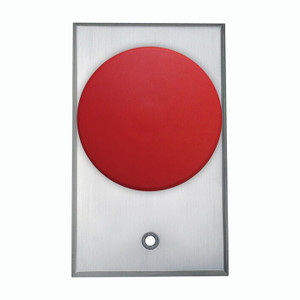
The Camden CM-4030 is a 4.5" round push/pull electromechanical switch rated 15A @ 30VDC, engineered for access control door strike applications in commercial and institutional settings. Operating in normally open (N/O) maintained mode, the CM-4030 engages the strike continuously while 30VDC power is applied, holding until power is removed. The all-active push/pull mechanism requires minimal actuation force and meets ADA compliance standards — enabling reliable operation by users with limited mobility or dexterity. Red-only indicator provides clear visual feedback of lock state. This is a passive electromechanical device: no software, no wireless pairing, no integration overhead — it connects directly to your access control panel's 30VDC relay or solenoid output.
Key Features
- Normally Open Maintained Operation: Energizing the switch engages the strike and holds it continuously. Cutting power disengages instantly — no spring mechanism, no backup battery needed.
- 30VDC Rated Supply: Standard 30VDC matches most commercial access control panels and power supplies. Verify your control circuit outputs 30VDC before installation; voltage mismatch will prevent engagement.
- 15A Contact Rating: Sufficient for single-strike solenoid loads in standard door control. For multi-strike or high-load applications, verify amperage draw against panel output capacity.
- ADA-Compliant Actuation: Low activation force enables reliable operation by persons with limited grip strength or dexterity — reducing installation liability in healthcare, senior living, and public facilities.
- Red Indicator Only: Single red LED signals energized state. No green/red dual-state indicator — simplified visual feedback suited for access-controlled doorways where occupancy status is not the concern.
- 4.5" Round Faceplate: Mounts flush into standard 2×4 electrical boxes or surface-mounts with provided hardware. Dimensions 4.50" × 4.50" × 1.75" fit typical commercial door frames without major structural modification.
- Stainless Steel or Brass Construction: Material options rated for indoor and outdoor environments — withstands moisture, temperature swings, and physical handling in high-traffic corridors.
- Direct Wiring to Control Panel: No middleware, no VMS integration — CM-4030 is a hard-wired 2-wire device that connects to any access control system's relay output, reducing installation complexity and cost.
The CM-4030 is purpose-built for scenarios where you need straightforward electromechanical strike control without layer upon layer of integration complexity. Install it at emergency exits requiring push/pull override, employee access doors, or secured entry points where rapid visual feedback and minimal failure modes are priorities. Hospitals, senior care facilities, office parks, and educational institutions rely on this device class because it combines low operational overhead with proven reliability across thousands of daily cycles.
Access control integrators favor the CM-4030 in doorframe applications where you cannot accommodate solenoid strikes or where existing electrical infrastructure is already routed for 30VDC switch control. The maintained mode means the strike stays engaged as long as power is applied — no momentary relay logic required. Because it's a passive mechanical switch, troubleshooting is transparent: energize the circuit, observe the red indicator, and test manual push/pull actuation. If the indicator lights but the door doesn't unlock, the problem is downstream (broken strike, seized bolt) not the switch itself.
Total cost of ownership favors the CM-4030 in installations with high-frequency use and low maintenance staff availability. There are no programmable settings to misconfigure, no wireless batteries to replace, no firmware updates to push. The device operates identically on day one and day 5,000. Stainless or brass construction resists corrosion and vandalism in shared-access environments. Warranty is manufacturer-backed, with straightforward replacement if mechanical failure occurs (rare after initial installation).
The CM-4030 integrates seamlessly into any access control architecture that outputs 30VDC — whether your system is Honeywell, Salto, Bosch, HID, or a legacy panel with relay outputs. Confirm voltage and amperage compliance before wiring, and verify the strike mechanism downstream can accept maintained engagement (some strikes require momentary pulses). No special software drivers, no ONVIF compliance, no cloud connectivity. This is industrial-grade electromechanical simplicity.
Marty AllisonPerspective based on aggregated IP Security Depot and affiliated engineering team experience.
We've deployed the Camden CM-4030 across hospital emergency departments, senior living access corridors, and office building entry points where you need a strike switch that simply works, every single time, without fuss. The maintained N/O operation is the real strength here — energize it and the strike stays locked. That's operationally different from momentary switches, which require relay logic and introduce timing complexity. On a busy hospital floor where staff are moving between secure and public zones constantly, the CM-4030's always-on behavior eliminates the "did the door re-lock?" cognitive load entirely. You energize it, the red indicator confirms state, and you know the door is secure as long as power flows. In our experience, that translates to fewer false-alarm support calls and lower liability exposure than competing push/pull designs.
The ADA compliance angle is underrated. We've had clients initially overlook this device in favor of touchless or push-button alternatives, then realize on site that their user population includes people with arthritis, Parkinson's, or hand tremor. The CM-4030's low-force push/pull mechanism accommodates that population without retrofit. That's worth specifying upfront in healthcare and senior care RFPs.
Technical Highlights:
- 30VDC Rated Supply: Standard voltage across commercial access control panels. Verify your control circuit before installation — 24VDC or 48VDC will not engage the mechanism reliably. If you're retrofitting into a legacy system with non-standard voltage, this device is not a drop-in replacement.
- Normally Open Maintained Mode: Strike engages continuously while powered; disengages instantly when power cuts. No spring return, no mechanical reset delay. That simplicity reduces failure modes downstream — your strike mechanism doesn't have to handle repeated spring-force impact.
- 15A @ 30VDC Contact Rating: Typical for single-solenoid strike loads. If you're driving multiple strikes or a high-current operator from the same panel output, verify amperage headroom. Most commercial panels provide 2–3A per relay; the CM-4030 itself can handle 15A, but your power supply may be the constraint.
- Red-Only Indicator: Single LED confirms energized state. No dual-color status. For access-controlled entry, that's fine — you only care that the strike is locked. If you need to distinguish "locked" from "unlocked" or "fault," this is not the right device; consider a dual-state switch.
- ADA-Compliant Actuation Force: Meets accessibility guidelines for users with limited grip or dexterity. Document this in project specifications if occupancy includes persons with disabilities — reduces liability and demonstrates intentional accessibility design.
- Stainless/Brass Hardware: Resists corrosion in damp environments (building entryways, loading docks). Inspect annually in outdoor-exposed applications; salt spray and UV will eventually degrade even stainless faceplate screws.
Deployment Considerations:
- Verify your access control panel or power supply outputs clean 30VDC. If it outputs 24VDC or 48VDC, the CM-4030 will not engage. We've seen installations fail because the panel voltage was misspecs'd at project kickoff — always test with a multimeter before mounting the faceplate.
- Confirm the downstream strike mechanism can accept maintained (continuous) engagement. Some older electric strikes are spring-return designs and will overheat if held continuously energized. Check the strike datasheet or test on a short power-on cycle before final wiring.
- The CM-4030 is a 2-wire electromechanical switch — no feedback to your access control system whether the strike actually engaged or failed. If you need door-ajar or lock-status monitoring, you must wire a separate door sensor or magnetic switch in parallel. Budget for that in mixed-mode deployments.
- Red indicator only — no fault signaling. If the bulb burns out, you lose visual feedback. Consider it a maintenance item on a 2–3 year cycle in high-traffic areas. Spare bulbs are low-cost; keep a few in your vehicle during quarterly site visits.
- Mount in a 2×4 electrical box (flush) or surface-mount with provided hardware. Avoid installing outdoors or in harsh spray environments without a protective enclosure — moisture ingress will corrode the relay coil and contact surfaces. NEMA 4X rated enclosure is the right move for loading docks or covered entry canopies.
- Wiring should be 18 AWG minimum for 30VDC control circuit. Keep runs under 100 feet; longer runs may require heavier gauge to prevent voltage drop. Do not share the control pair with line-voltage (120/240VAC) wiring — separation minimizes cross-talk and shock hazard.
The CM-4030 is the right device for projects where strike control must be transparent and maintenance-free, and your access control infrastructure already delivers 30VDC to electromechanical switches. If you're building from scratch and have flexibility on voltage or control logic, consider whether a 12VDC or 24VDC system might better match your panel ecosystem — but if your site standard is 30VDC and your integrators are already specifying this form factor, the CM-4030 delivers proven reliability. Explore the full Camden catalog for variants and matching strike mechanisms.