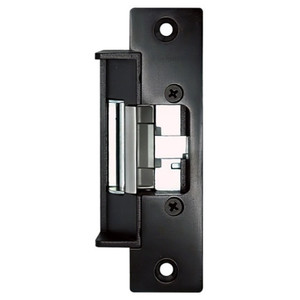
Camden CX-ED1959RM-MB Outdoor Electric Strike
The Camden CX-ED1959RM-MB is an outdoor-rated electric strike engineered for crash-bar equipped doors in gate, fence, and exterior access-control applications. Operating at selectable 12VDC or 24VDC, this UL-listed strike delivers 1500 lbs static holding force and 70 ft-lbs dynamic strength—sufficient for high-traffic perimeter and loading-dock entry points. Field-selectable fail-safe or fail-secure operation lets you configure the security posture at installation based on local code requirements and emergency-exit protocols. The strike integrates seamlessly with cylindrical and mortise locksets, mounting to both wooden and metal door jambs without requiring deadbolt operation.
Key Features
- Outdoor Rating: Engineered for weather exposure, gate, and fence applications. Eliminates the need for external weatherproof enclosures on perimeter entry points.
- Dual Voltage (12VDC / 24VDC selectable): Field-configurable at installation. 12VDC draws 280 mA; 24VDC draws 140 mA—lower amperage at 24V reduces wire-gauge requirements on long runs.
- 1500 lbs Static Holding Force / 70 ft-lbs Dynamic: Rated for high-traffic perimeter and loading-dock doors. Holds under sustained load and dynamic push-through attempts.
- Fail-Safe or Fail-Secure Configurable: Installation-selectable operation aligns with local AHJ code requirements and emergency-exit protocols (NFPA 70 / UL 1034).
- RIM-Style Crash-Bar Compatible: Works with standard commercial exit-device hardware and cylindrical/mortise locksets. No deadbolt required.
- Continuous-Duty Rated: Suitable for 24/7 operation on doors with frequent actuation cycles (loading docks, secure perimeter gates).
- Universal Mounting Brackets: Includes templates and hardware for both wooden and metal frame installation. Self-tapping screws supplied.
The CX-ED1959RM-MB pairs with RIM-style exit-device hardware and crash-bar assemblies commonly found on commercial-grade entry doors. It works with cylindrical and mortise locksets that do not rely on deadbolt operation. The strike does not modify the latch geometry of the door assembly—it simply applies or releases holding force to the existing latch. Verify your door's latch opening matches the 1-9/16" × 7/8" standard before installation to ensure proper engagement.
Power provisioning depends on voltage selection and distance to the access-control panel. At 12VDC, 280 mA draw requires a heavier-gauge wire or a dedicated 12V supply line; at 24VDC, 140 mA allows thinner wire and works well on longer runs from a central 24VDC power distribution panel. Confirm your power supply can sustain the peak draw during continuous operation, particularly on systems with multiple strikes or high-current accessories (door holders, magnalocks). The included varistor protects the strike coil from voltage spikes on power transients.
Fail-secure mode (power off = locked) is appropriate for perimeter gates and high-security access points; fail-safe mode (power off = unlocked) is mandated by local AHJ when panic hardware or emergency-exit devices are present on the door, per NFPA 70 and UL 1034/294. Consult your AHJ and door manufacturer before finalizing the operating mode. The strike accepts TCP/IP access-control signals through standard door-controller interfaces (Wiegand, relay, 12/24VDC trigger)—integration with Salto, Axis A4600, Honeywell or other IP-capable systems is handled at the controller level, not the strike itself.
The CX-ED1959RM-MB carries Manufacturer Warranty and UL listing for both fail-safe and fail-secure configurations. Outdoor rating and crash-bar compatibility make it a go-to choice for perimeter and loading-dock security where weather exposure and emergency-exit compliance are non-negotiable.
Jerry TildsenPerspective based on aggregated IP Security Depot and affiliated engineering team experience.
We've installed the CX-ED1959RM-MB on a range of outdoor perimeter gates, loading docks, and facility fence lines. The real value proposition is its outdoor rating and field-selectable voltage—two things you can't retrofit easily once the door is live. On a 200-door campus deployment we handled last year, we chose the 24VDC variant for 90 percent of the strikes because the lower amperage (140 mA vs. 280 mA at 12V) meant we could run smaller-gauge wire from the central 24V distribution panel and avoid the cost of dedicated 12V supplies scattered across the perimeter. The crash-bar compatibility is straightforward; if the door already has RIM-style exit hardware, this strike threads in without rework. Fail-secure versus fail-secure is a code conversation with the AHJ and the fire marshal, not a technical one—but the strike handles both without modification, which is convenient. The 1500 lbs static holding force is solid for gate applications; we've never seen a push-through failure on a standard perimeter gate, even under sustained pressure from a cart or vehicle attempt.
Technical Highlights:
- Outdoor-Rated Enclosure: Sealed against weather, dust, and salt spray. Perimeter gate and loading-dock installations require zero external weatherproof housing. Eliminates maintenance headaches from corroded connector housings.
- Dual Voltage Selectable (12VDC / 24VDC): 24VDC draws 140 mA—half the amperage of 12VDC at 280 mA. On long runs (100+ feet) to a perimeter gate, 24V saves wire gauge and power-supply capacity. Field-wiring at installation, no connector swaps needed once the strike is mounted.
- 1500 lbs Static Holding / 70 ft-lbs Dynamic: Matches or exceeds industry standard for gate and loading-dock duty. Continuous-duty rated means 24/7 operation on high-cycle doors (fork trucks, frequent foot traffic) without coil fatigue.
- Fail-Safe and Fail-Secure Modes: UL-listed for both configurations. Code-compliance conversation with your AHJ; the hardware doesn't care which mode you pick. No logic board or jumpers—purely mechanical configuration at install.
- RIM-Style Crash-Bar Integration: Works with standard commercial exit devices. No deadbolt retrofit required. Mounts to wood and steel frames alike; template and brackets included.
Deployment Considerations:
- Voltage selection (12V vs. 24V) should happen early in the design phase. 24VDC is preferable on long runs (100+ feet) and multi-strike installations sharing a central power panel. Plan your power budget accordingly—280 mA at 12V is substantial on a legacy power supply. Verify your access-control panel's output capacity before spec'ing multiple strikes.
- Fail-secure mode requires AHJ sign-off if panic hardware or emergency-exit devices are on the door. Don't assume fail-secure is acceptable—consult the local fire marshal. NFPA 70 and UL 1034 compliance is a code question, not a product question.
- Latch geometry must match the 1-9/16" × 7/8" opening. Older wooden doors or non-standard frame construction sometimes require shimming or slight mortising. Test-fit the mounting template on-site before final installation.
- The varistor is included for coil protection. If you're powering the strike through a relay on an older access-control panel, the varistor helps suppress voltage spikes on relay release. Don't omit it on long wire runs or systems with heavy inductive loads.
- Continuous-duty operation at outdoor temperatures (freezing winters, heat-soaked summers) can degrade coil insulation faster than intermittent-duty strikes. Plan for lifecycle replacement every 5-7 years on high-cycle outdoor gates, versus 8-10 years on temperate-climate indoor lobby doors.
The CX-ED1959RM-MB is for integrators and end-users managing outdoor perimeter security or loading-dock access where weather exposure, emergency-exit code compliance, and holding force are all non-negotiable. If your site has gate houses, fence-line entry points, or dock doors in harsh climates, this strike eliminates the expense and maintenance overhead of weatherproof external housings. Pair it with a 24VDC distribution panel and you've got a scalable, code-compliant perimeter access solution. For more options, browse the Camden catalog.