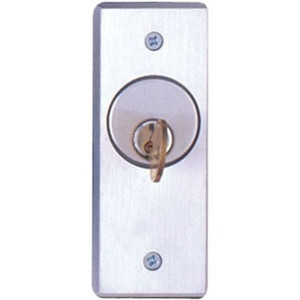
Camden CM-1205 SPST Momentary Key Switch
The Camden CM-1205 is an SPST momentary key switch designed for direct control of door strikes, electromagnetic locks, and electric locks in access control installations. Operating at 30VDC, it provides manual activation without requiring card readers, keypads, or networked controllers — ideal for emergency egress doors, maintenance areas, or secondary access points where staff need reliable electromechanical control. The momentary contact action closes the circuit only while the key is turned; release returns the switch to the de-energized state, preventing accidental or prolonged unlock conditions. Flush-mounted in a door frame, the CM-1205 integrates into any hardwired 30VDC strike controller or EM lock power supply as a passive wired input.
Key Features
- SPST Momentary Contact: Circuit closes only during key rotation, then springs back to open. Prevents accidental prolonged energization of strikes or locks.
- 30VDC Rating: Direct compatibility with standard hardwired strike controllers, EM lock power supplies, and legacy access control panels using low-voltage relay logic.
- Mortise Cylinder Mount: Accepts standard 1–1.25 inch mortise cylinders, matching existing lock hardware across multi-building facilities.
- Cast Assembly Construction: One-piece body with brass cylinder ring and tamperproof fasteners resist tampering and accidental disassembly.
- Flush Installation: Recessed into door frame (2¾ inch single-gang or 1¾ inch opening) for professional appearance and reduced projection.
- Wired Integration: No network dependency — operates as a passive 30VDC switching element on any control board with available auxiliary circuit and SPST momentary logic.
- Manual Override:** Eliminates dependency on electronic access control systems for emergency egress or maintenance unlock scenarios.
The CM-1205 is a straightforward electromechanical solution for facilities that require manual key-activated control over door hardware without introducing networked complexity or power-supply redundancy overhead. Common deployment scenarios include emergency egress corridors, equipment rooms, loading docks, and secondary entrances where authorized staff need reliable, zero-dependency unlock capability. Because the switch itself is passive, it inherits the availability and fail-safe characteristics of your hardwired strike controller — no wireless signal loss, no network latency, no battery drain on a networked node.
Wiring the CM-1205 is straightforward: connect the switch output terminals directly to your 30VDC strike or lock control circuit, observing polarity per your control board documentation. Most installations run the switch leads through conduit alongside power and ground lines to the strike controller mounted inside the door frame or in an adjacent equipment closet. Verify your control board has a 30VDC auxiliary output or relay input rated for momentary closure before ordering — legacy access panels and modern hardwired strike controllers both support this topology. If your facility is moving toward networked access control (Milestone, Genetec, or cloud-based platforms), the CM-1205 can coexist with card readers and keypads on the same door, serving as a manual override or secondary activation method on a separate circuit.
The CM-1205 carries a Manufacturer Warranty. Installation requires basic electrical knowledge and compliance with local electrical codes; most integrators complete a flush mortise installation in under 15 minutes. No batteries, no firmware updates, no cloud dependencies — a 20-year lifespan is realistic for this class of device in typical indoor environments. For high-traffic doors subject to repeated key insertion and rotation, the mortise cylinder itself will eventually wear; replacement cylinders are standard parts available from any locksmith supplier.
Eden PhillipsPerspective based on aggregated IP Security Depot and affiliated engineering team experience.
We've deployed the CM-1205 across dozens of facilities ranging from small office buildings to industrial campuses, and it consistently delivers what it promises: dumb-simple, zero-failure-rate manual door control. The appeal is precisely its lack of sophistication — there's no network stack to troubleshoot, no credential database to sync, no power-loss scenario that strands a door in an unsafe state. In our experience, the hardest decision isn't whether the CM-1205 works; it's deciding which doors actually need this kind of manual bypass. Most facilities assume every door needs electronic access control, but once you walk the site with an integrator who understands fail-safes and emergency egress, the CM-1205 slots naturally into secondary entrances, maintenance closets, and loading docks where staff turnover is high and manual unlock is the faster and safer alternative to cutting power to the entire access system. The only real limitation is that it offers zero audit trail — no log of who turned the key or when. If your compliance framework (HIPAA, SOX, PCI-DSS) requires accountability, you'll need to pair this switch with a separate card reader on the same door or document manual access separately.
Technical Highlights:
- 30VDC SPST Momentary Logic: Matches the output of hardwired strike controllers and EM lock power supplies without requiring intermediate relays or signal conditioning. Direct wiring reduces points of failure and field troubleshooting time.
- Mortise Cylinder Compatibility (1–1.25 inch): Most facilities already have spare mortise cylinders on hand from maintenance stock. No proprietary lock cores, no special ordering delays. A worn cylinder is a 10-dollar part replacement, not a device recall.
- Momentary Contact Return: Springs back to open automatically — prevents a user from walking away with the door struck. Safer than sustained-closure designs for high-traffic areas and reduces liability exposure from propped doors.
- Cast Brass Body: Corrosion-resistant assembly withstands humid/salt-air environments (parking garages, loading docks, coastal facilities) without active maintenance.
- Flush Mortise Installation: Sits nearly flush with the door frame — minimal projection means less risk of damage from carts, forklifts, or aggressive handling on industrial docks.
Deployment Considerations:
- Verify your strike controller or EM lock power supply has a 30VDC auxiliary output rated for SPST momentary closure before ordering. Older access panels sometimes use 24VDC or 12VDC — voltage mismatch will either prevent activation or damage the switch.
- Plan for key custody and rotation. Unlike card readers, a physical key can be copied or lost. Assign keys to specific staff roles and audit key inventory at hire/termination. Consider pairing high-sensitivity doors with a second authentication method (card reader + key requirement).
- No audit log — if regulatory requirements mandate access accountability (medical facilities, data centers), the CM-1205 alone is insufficient. Use it as a secondary override only, and document manual access separately in your security procedures.
- Mortise cylinder wear is the primary maintenance driver. Expect replacement every 5–10 years depending on frequency of use. Stock spare cylinders on site to avoid lockout situations during field replacement.
- Conduit routing matters: run switch wiring in separate conduit from AC power or high-voltage circuits to minimize EMI-induced noise on the control circuit. Most integrators use Cat.5e or shielded twisted pair for 30VDC control runs over long distances.
The CM-1205 is the right choice for integrators and facility managers who need reliable manual unlock at secondary points without adding networked complexity or points of failure. Site conditions favoring the CM-1205 include emergency egress corridors, equipment rooms requiring frequent access but low credential-tracking overhead, and retrofit projects where existing hardwired strike controllers are already in place. For primary access points or facilities pursuing full integration with a modern VMS or access control platform, pair the CM-1205 with card readers and networked controllers on higher-traffic doors, reserving the key switch for override and maintenance scenarios. Browse the full Camden catalog for additional lock and strike solutions.