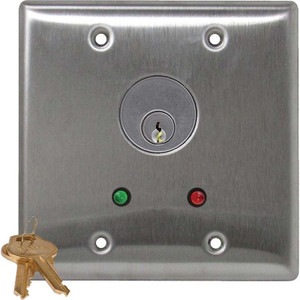
Camden CM-1150 Key Switch 2 SPDT Momentary
The Camden CM-1150 is a dual-contact key switch designed for 30VDC electric strike and access control applications. Built from die-cast aluminum in a one-piece body, it mounts flush into standard 1", 1 1/8", or 1 1/4" mortise cylinders — the retrofit standard for retrofit door frames. The two independent SPDT (Single Pole Double Throw) momentary contacts provide manual key-controlled activation of electric strikes, magnetic locks, or access control bypass circuits without requiring additional relay or circuit board logic. The momentary design ensures the strike energizes only while the key is turned; release immediately de-energizes, making it ideal for timed access scenarios and authorized personnel override workflows.
Key Features
- Dual SPDT Momentary Contacts: Two independent contacts rated for 30VDC. Enables control of two separate circuits — typical configurations are one primary strike + one auxiliary relay, or dual strikes in series/parallel.
- 30VDC Operating Voltage: Compatible with standard access control power supplies and HID credential systems. Momentary pulse activation integrates directly with strike panels and auxiliary inputs on modern access control boards.
- Die-Cast Aluminum Housing: One-piece construction resists corrosion in damp vestibules and indoor-adjacent alcoves. Vandal-resistant design suitable for high-traffic entry points.
- Flush Mortise Mount: Accepts standard 1", 1 1/8", or 1 1/4" cylinders. Retrofit-friendly installation on existing door frames without structural modification.
- Momentary-Contact Design: Strike energizes only during key turn — de-energizes on release. Eliminates accidental lock-down and simplifies credential verification workflows without latching logic.
- HID Access Control Ready: Integrates with HID-based systems and generic access control platforms that accept 30VDC momentary dry-contact inputs for door strike energizing, lock release, or bypass functions.
The CM-1150 fills a specific gap in hybrid access control deployments: you need a manual override that doesn't require supervised power or electronic latching, and your strike panel already expects momentary contacts. The two independent SPDT contacts give integrators flexibility — wire one for primary strike activation, the second for an auxiliary relay or secondary lock. Typical installations pair the CM-1150 with a credential reader upstream (card, badge, or biometric) and route its grant signal to the strike panel; the key switch then serves as a physical override for maintenance staff or emergency egress.
Installation is straightforward. The CM-1150 arrives with brass cylinder lock ring, socket/slotted mounting screws, and tamperproof fasteners with driver. Drill the mortise opening to match your cylinder bore, insert the cylinder, and secure the aluminum housing flush to the door frame. All-weather die-cast construction resists corrosion in damp vestibules; if the switch is exposed to direct rain or hose-down cleaning, verify supplementary weatherproofing on the electrical connections. The momentary contact design means no latching relay or holding coil is required — the strike panel simply sees a dry-contact pulse for the duration of the key turn. This simplicity reduces troubleshooting overhead and integrates cleanly into legacy access control wiring.
Compatibility is conditional: the CM-1150 requires a control panel that accepts 30VDC momentary dry-contact inputs. If your strike panel expects latching contacts, a different voltage, or only supports single-contact circuits, this model will not integrate correctly — verify your panel spec before ordering. The two SPDT contacts are rated for standard access control currents (typically <1A per contact); do not exceed the strike panel's maximum relay coil current, or use an intermediary relay for high-current loads (e.g., fail-safe magnetic locks drawing >2A).
Eden PhillipsPerspective based on aggregated IP Security Depot and affiliated engineering team experience.
We've deployed the Camden CM-1150 across dozens of door retrofit and upgrade projects where the requirement is a simple, unsupervised manual override. The appeal is straightforward: it's a mechanical key switch with two dry contacts — no solenoid logic, no electronic latching, no supervised circuit monitoring. In environments where the strike panel already handles momentary-contact logic (which most modern access control platforms do), the CM-1150 is bulletproof. The two independent SPDT contacts are the real differentiator — on a two-door vestibule install, you wire one contact to the inner door strike and the second to the outer door strike from a single key cylinder. No dual switches, no wall-mounted key cabinet. The die-cast aluminum body holds up in damp mechanical rooms and vestibules; we've seen units survive 5+ years of daily use in parking garage access points and basement utility entries without corrosion or contact degradation. Trade-offs: the momentary-only design means it's unsuitable for scenarios where you need the strike to remain energized after the key is released (you'd need an auxiliary relay for that). The 30VDC spec is standard, but if your panel runs 24VDC or higher voltages, this won't work — verify before retrofit. Contact ratings are modest (typically <1A), so high-current fail-safe magnetic locks need an intermediary relay.
Technical Highlights:
- Dual SPDT Momentary Contacts: Two independent contacts, each rated for 30VDC. Allows simultaneous control of two separate strike circuits (primary + secondary lock, or two doors from a single key). Momentary pulse means the strike de-energizes immediately on key release — no accidental lockout or supervisor override complexity.
- 30VDC Compatibility: Integrates directly with standard access control power supplies and HID credential panels. Verify your strike panel accepts momentary dry contacts; if it requires latching or supervised inputs, use an intermediary relay module.
- Die-Cast Aluminum, One-Piece Body: Resists corrosion in damp mechanical rooms and vestibules. Flush mortise mount requires no external hardware or pedestals — cleaner install, lower vandalism profile than surface-mounted overrides.
- Standard Mortise Cylinder Compatibility: Fits 1", 1 1/8", or 1 1/4" cylinders — the retrofit standard on most older/newer door frames. No frame modification required; drill, insert, secure with provided fasteners.
Deployment Considerations:
- Verify your strike panel explicitly accepts 30VDC momentary dry-contact inputs before ordering. Latching panels or different voltage specs require a relay intermediate or won't work at all.
- Contact ratings are modest (~<1A typical) — if you're driving high-current fail-safe magnetic locks (>2A draw), wire the contacts through an auxiliary relay coil rather than direct to the lock.
- The momentary-only design means the strike de-energizes on key release. If your workflow requires the strike to remain energized after the key is released, use a momentary relay with extended hold time as an intermediary.
- Die-cast aluminum resists indoor corrosion, but direct rain or hose-down requires additional weatherproofing on the electrical connections and cylinder. Avoid unprotected outdoor alcoves without an overhang or vestibule.
- Tamperproof fasteners are included, but consider upgrading to anti-rotation mounting screws if the install is in a high-vandalism zone (e.g., parking garage utility entry). Rotate the cylinder 180° periodically to detect pick attempts.
The CM-1150 is the right choice for integrators who need a mechanical, unsupervised override on retrofitted doors with existing momentary-contact strike panels. It simplifies design — no relay logic, no electronic latching — and the two independent SPDT contacts offer flexibility for multi-door vestibules or dual-strike configurations. See the Camden catalog for compatible strikes and access control interface modules.