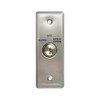
Camden CX-WC17SLVR 6" Wide Side Load Column Switch
Overview
The Camden CX-WC17SLVR is a 6-inch wide side-load column switch designed for networked access control deployments. This controller integrates hands-free sensor operation with electric strike management, communicating via TCP/IP protocol for seamless integration into modern security infrastructures. The side-load design accommodates credential readers and sensors while the compact 6-inch width fits standard door frame preparations. The CX-WC17SLVR serves integrators and facility managers requiring hands-free entry options paired with networked access intelligence.
Key Features
- 6-Inch Wide Form Factor: Compact width optimized for standard door frame mounting and aesthetic integration
- Side-Load Reader Cavity: Accepts credential readers and sensors in a side-mounted configuration, simplifying installation and maintenance
- Hands-Free Sensor Integration: Proximity or motion-based trigger capability reduces contact points and supports touchless access workflows
- Electric Strike Control: Direct strike output manages electromagnetic locking hardware for fail-secure or fail-safe configurations
- TCP/IP Communication: Networked connectivity enables real-time event logging, remote status monitoring, and centralized credential management
- Controller Architecture: Local processing with network fallback ensures operation during connectivity interruptions
Integration & Compatibility
The CX-WC17SLVR operates as a networked access control point suitable for single-door or multi-door deployments when deployed within a larger TCP/IP-based security system. The electric strike output supports standard strike hardware with appropriate power conditioning. Credential reader compatibility depends on reader selection during integration planning—the side-load cavity accommodates readers meeting standard mounting depth and electrical specifications. Integration partners should confirm reader voltage and signal compatibility with the controller outputs. The hands-free sensor input accepts standard proximity sensors or motion-based triggers compatible with the controller's input specifications.
Site-level considerations include network infrastructure readiness (wired or PoE availability at the door location), strike power supply sizing, and credential database architecture. The TCP/IP interface supports integration with third-party management platforms using standard protocols; consult the manufacturer's integration documentation for API and communication standards.
Typical Deployment Scenarios
Security integrators commonly deploy the CX-WC17SLVR in healthcare facilities, office buildings, and secured entry points where hands-free access reduces compliance risk and operational friction. The 6-inch profile suits renovation projects with space constraints. Multi-door installations leverage the networked architecture to consolidate credential verification and audit logging across entry points, reducing operational overhead and enabling real-time access policy enforcement.
Ted PerryPerspective based on aggregated and affiliated engineering team experience.
I've assessed the CX-WC17SLVR in several facility access control upgrades, and it addresses a specific design need: compact column form factor with hands-free sensor support on a networked platform. The side-load cavity design simplifies reader integration compared to face-mount alternatives, and TCP/IP connectivity ensures this unit fits into modern, auditable access systems rather than standalone controllers.
Technical Highlights:
- Hands-Free Sensor Capability: The integrated sensor input removes the credential card requirement for some access workflows, critical for healthcare and high-touch environments.
- Electric Strike Output: Direct control eliminates the need for separate relay modules on single-strike installations, reducing component count and failure points.
- TCP/IP Architecture: Network-based event logging and credential synchronization support centralized policy enforcement across multiple doors without serial daisy-chaining or analog wiring.
Deployment Considerations:
- Confirm reader compatibility during the specification phase—not all readers fit the side-load cavity or support the controller's voltage/signal specifications.
- Verify strike power supply capacity before installation; electric strikes draw significant current and require dedicated conditioning to avoid nuisance lockouts.
- Plan network infrastructure early; wired Ethernet or PoE availability at the door frame is mandatory for reliable operation and event reporting.
The CX-WC17SLVR is a solid choice for integrators needing compact networked access control with hands-free sensor support. Sizing and compatibility validation during the pre-sales phase prevents costly field modifications and ensures reliable credential processing.





")