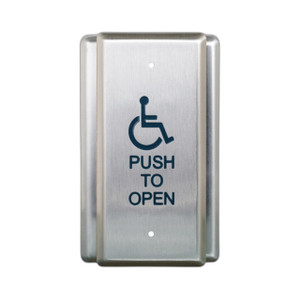
Camden CM-45/455SE1 Push Plate Switch, Wheelchair & Push to Open
Overview
The Camden CM-45/455SE1 is a 4-1/2" push plate access control switch designed for door release and push-to-open applications in networked security environments. This model integrates wheelchair-accessible activation with standard push-button operation, making it suitable for facilities requiring ADA compliance alongside conventional access patterns. The CM-45/455SE1 communicates via TCP/IP protocol and operates at 30VDC, enabling seamless integration into IP-based access control systems without dedicated hardwired control lines.
Key Features
- 4-1/2" Form Factor: Large push plate surface area accommodates wheelchair users and reduces activation force requirements for accessibility compliance.
- Dual-Mode Activation: Supports both wheelchair access operation and standard push-to-open door control from a single device.
- TCP/IP Communication: Network-connected architecture eliminates analog relay lines, reducing installation complexity and enabling remote monitoring and control through your IP access management platform.
- 30VDC Operating Voltage: Low-voltage design integrates with standard access control power supplies and strike systems commonly deployed in commercial security installations.
- Strike/Lock Interface: Functions as a lock/strike control device within access control topology, triggering door release mechanisms upon authorization.
- IP Network Integration: Direct TCP/IP connectivity allows the CM-45/455SE1 to report activation events, receive commands, and participate in networked access policies without intermediate relay controllers.
Integration & Compatibility
The CM-45/455SE1 (often searched as CM 45/455SE1) integrates directly into TCP/IP-based access control systems. Its network-native design allows security integrators to eliminate traditional hardwired strike circuits, reducing conduit runs and simplifying troubleshooting. The push plate connects to any access control panel or controller supporting TCP/IP device endpoints, with activation events logged as standard access transactions. The 30VDC requirement aligns with existing access control power infrastructure, allowing straightforward retrofit into established door release circuits or new deployment alongside modern IP intercoms and readers.
For facilities with mixed accessibility requirements, the dual-mode operation supports both ADA wheelchair-accessible activation and conventional foot-traffic push-to-open patterns, eliminating the need for separate devices. Integration with entry scheduling, vestibule control, and emergency unlock scenarios depends on your access control platform's capabilities—confirm TCP/IP device support and event logging with your system administrator before ordering.
Ted PerryPerspective based on aggregated and affiliated engineering team experience.
I've specified the CM-45/455SE1 in several multi-story office and healthcare deployments where wheelchair accessibility pairs with high-traffic push-button door release. The TCP/IP native architecture means no relay cabinets or hardwired strike circuits to troubleshoot—everything reports back to your access control system as standard network traffic. That simplicity saves installation time and reduces field wiring errors on larger projects.
Technical Highlights:
- TCP/IP Protocol: Direct network communication removes dependency on analog strike control lines, enabling centralized event logging and remote status monitoring.
- 30VDC Supply: Works with standard access control power supplies; no special PSU required if your infrastructure already powers networked strike solenoids.
- Dual-Mode Access: Wheelchair and push-to-open operation from a single 4.5" plate simplifies hardware density and reduces infrastructure complexity in common-use entries.
Deployment Considerations:
- Verify your access control platform supports TCP/IP-connected strike/lock endpoints; some legacy systems require relay modules for compatibility.
- Confirm strike wiring is 30VDC rated; mixing AC-powered strikes with this device will cause equipment damage.
- Test activation response time under your system's authorization policies—network latency can impact perceived responsiveness in high-throughput entries.
For facilities pursuing accessibility compliance without sacrificing standard push-release capability, the CM-45/455SE1 is a straightforward choice. Network integration keeps installation clean, and the large plate surface eliminates user frustration common with smaller button designs.




")

