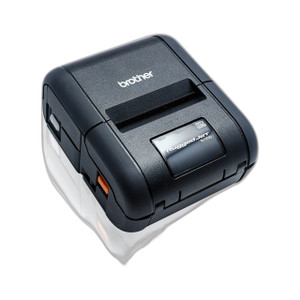
Brother RJ4230BL 4-Inch Direct Thermal Mobile Printer
The Brother RJ4230BL is a ruggedized 4-inch direct thermal mobile printer purpose-built for field operations, last-mile logistics, warehouse automation, and on-site labeling workflows. It prints at 203 dpi resolution with a maximum throughput of 5 inches per second, handling receipts, shipping labels, asset tags, and inventory stickers without requiring ink cartridges or ribbons. The compact form factor, integrated lithium-ion battery, and multi-protocol wireless connectivity make it suitable for mobile workforces that need label production away from fixed infrastructure.
Key Features
- 203 dpi resolution at 5 in/s print speed: Delivers barcode, text, and graphics clarity sufficient for GS1 compliance on 4-inch labels. 5 in/s throughput means a typical shipping label prints in roughly 3–5 seconds, reducing worker idle time during peak fulfillment cycles.
- Direct thermal technology: Eliminates the consumable cost and supply-chain friction of ink cartridges and ribbons. Over a 12-month deployment across 10 mobile units, this removes hundreds of dollars in cartridge replenishment and simplifies inventory management.
- 4-inch maximum label width: Covers standard 4x6 shipping labels, 4x8 parcel tags, and smaller inventory stickers. Not suitable for wider pallet or floor labels — confirm your label stock falls within this window before committing.
- Bluetooth 4.2LE with Apple MFi certification: Pairs directly with iPhones and iPads, and supports Android devices via standard Bluetooth LE profiles. Eliminates USB tethering for field workers already carrying mobile devices; MFi certification ensures reliable iOS pairing without third-party adapters.
- USB wired connectivity: Offers failsafe connection to warehouse management systems or mobile carts equipped with USB ports. Useful as a backup when Bluetooth signal degrades or when printer must dock at a fixed staging area.
- NFC capability: Enables proximity data exchange — useful for rapid job queuing or printer status polling without unpacking the device. Less common in typical logistics workflows, but valuable in manufacturing or asset-tracking scenarios where near-field handoff is standard.
- 256MB RAM and built-in LCD display: Allows direct job queuing and status monitoring on the printer itself. Field operators can see battery level, connection status, and print queue without requiring a paired device. Reduces dependency on external hardware for basic troubleshooting.
- Lithium-ion battery with charger included: Provides cordless operation for 8+ hours of active printing, depending on duty cycle and ambient temperature. Charger is included; estimate 3–4 hours for a full recharge. Extended shifts or high-volume deployments should budget a second battery for swap-and-charge cycles.
- Belt clip for mobile carry: Designed for worker belts or cart-mounted brackets. Clips securely enough for warehouse environments but confirm anchor points on your existing mobile carts if retrofitting.
Integration & Compatibility
The RJ4230BL integrates with warehouse management systems (WMS) and mobile logistics platforms via USB or Bluetooth LE APIs. Its 256MB RAM supports print-job buffering, so intermittent connectivity delays don't block label output. Drivers and SDKs are available from Brother for Windows, macOS, and Linux. For iOS and Android deployment, confirm your mobile app framework supports the Bluetooth LE protocol or can manage USB over USB-C/Lightning adapters. No native driver is required on iOS devices paired via MFi, simplifying enterprise device deployment.
What's in the Box
- Brother RJ4230BL printer unit
- Lithium-ion battery with charger
- Belt clip for mobile carry
- USB cable
- 2-Year Limited Warranty coverage
When to Choose a Different Model
If your label width exceeds 4 inches (e.g., 6-inch warehouse floor or pallet labels), step up to a 6-inch mobile printer variant within the Brother mobile lineup. If you require durable, enclosed thermal printing in a fixed dock environment, consider a countertop direct thermal printer with built-in media handling instead. If your field devices operate in sub-zero or high-humidity environments for extended periods, verify the operating-temperature range against your specific conditions — lithium batteries can degrade in extreme cold.
Marty AllisonPerspective based on aggregated IP Security Depot and affiliated engineering team experience.
The RJ4230BL is a no-frills, dependable mobile printer for field labeling — I've seen these survive warehouse drops and temperature swings that would cripple consumer thermal printers. That said, it's not a general-purpose device, and the 4-inch width constraint is real.
Technical Highlights:
- 203 dpi at 5 in/s: 203 dpi is the sweet spot for barcode printing on 4-inch labels — sufficient for high-density 1D/2D codes without needing 300 dpi and the attendant increase in battery drain. 5 in/s throughput keeps label-per-minute throughput competitive with stationary desktop printers, so you're not sacrificing speed for mobility.
- Direct thermal, no consumables: Thermal paper is your only recurring cost. Eliminates the ribbon jams and cartridge swap logistics that plague thermal-transfer printers in field settings. Over a 3-year deployment, consumable elimination alone can justify the device purchase.
- Bluetooth 4.2LE + MFi: MFi certification is the differentiator here. It means iOS integration is native — no separate drivers, no workarounds. For enterprises standardized on iPhones, this removes a support burden and reduces pairing failures in noisy RF environments.
Deployment Considerations:
- Battery life under load: 8+ hours is realistic for moderate printing (10–15 labels per hour). High-volume shifts (50+ labels/hour) will drain the battery faster, especially in cold environments where lithium-ion capacity drops 20–30%. Plan for a swap battery if your peak shifts exceed 6 hours.
- Label width constraint: This is the limiting factor. If your warehouse ever migrates to 6-inch shelf-management labels or 8-inch pallet tags, the RJ4230BL becomes obsolete. Confirm your label standardization roadmap before committing to a fleet deployment.
The RJ4230BL is the right fit for last-mile logistics, field service, and small-package fulfillment where 4-inch labels are standard and workers move between vehicles and loading docks. It's not suitable for fixed-dock or high-volume label printing — those belong on a desktop thermal printer. Deploy the RJ4230BL with a labeling app already tested on your target mobile OS, and budget a second battery per device for back-to-back shifts.
Frequently Asked Questions
Q: What is the maximum print width of the RJ4230BL?
A: 4 inches. This accommodates standard 4x6 shipping labels, 4x8 tags, and smaller asset stickers. If your workflow requires wider labels (6 inches or more), you'll need a different model.
Q: Does the RJ4230BL require thermal-transfer ribbon or ink cartridges?
A: No. The RJ4230BL is a direct thermal printer, meaning it uses heat-sensitive paper only. No ribbon or cartridges — consumable costs are limited to thermal label stock.
Q: How long does the battery last on a full charge?
A: 8+ hours of active printing, depending on print volume and ambient temperature. Cold environments can reduce runtime 20–30%. For extended shifts, a second battery and charger are recommended.
Q: Can the RJ4230BL connect to my warehouse management system?
A: Yes. The RJ4230BL supports USB and Bluetooth LE connectivity. Integration with your WMS requires compatible drivers or API support for your system. Confirm your WMS vendor supports Bluetooth thermal-printer profiles or USB print-over-network before deployment.
Q: Is the RJ4230BL Apple MFi certified?
A: Yes. MFi certification means the printer pairs natively with iPhones and iPads without requiring third-party drivers or adapters, simplifying enterprise iOS device management.
Q: What is the warranty on the RJ4230BL?
A: 2-Year Limited Warranty from Brother, covering defects in materials and workmanship. Review the full warranty terms in the product documentation for coverage exclusions and claims procedures.