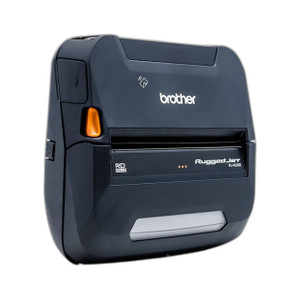
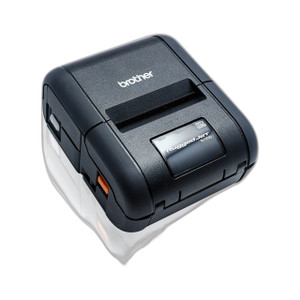
Brother RJ4230B RuggedJet Direct Thermal Mobile Receipt Printer
The Brother RJ4230B is a 4-inch direct thermal mobile printer engineered for field logistics, warehouse receiving, and last-mile delivery operations. Built to survive mobile deployment—handheld or vehicle-mounted—it delivers 203 dpi receipt and label prints at 5 inches per second without requiring thermal ribbon cartridges. USB and Bluetooth 4.2 connectivity (including Apple MFi certification) keeps the printer tethered to smartphones, tablets, and mobile WMS terminals across iOS, Android, and Windows platforms.
Key Features
- Direct Thermal Printing: 203 dpi at 5 ips. No ribbon consumables—eliminates ongoing media costs and reduces field service calls for supply runs.
- 4-Inch Print Width: Fits standard receipt stock, 4x6 shipping labels, and warehouse tag formats without media waste or custom sizing.
- Bluetooth 4.2 + USB: Wireless pairing to smartphones and tablets; USB fallback for docking stations and vehicle power supplies. Apple MFi certified for iOS app integration.
- 256 MB RAM: Handles downloaded fonts, graphics, and stored label templates—native support for ZPL and CPCL emulations without VMS overhead.
- LCD Display: Built-in status indicators and error messaging reduce troubleshooting time in field environments with no IT support nearby.
- Mobile Ruggedization: Drop-tested industrial frame suitable for warehouse floors, delivery vehicles, and outdoor receiving docks.
- Label, Receipt, and Tag Media: Direct thermal chemistry supports coated paper, synthetic labels, and tag stock for inventory, shipping, and proof-of-delivery workflows.
- Legacy and Modern Emulation: ZPL and CPCL language support ensures compatibility with established warehouse management systems and newer cloud-native logistics platforms.
The RJ4230B closes the gap between smartphone-driven field operations and legacy barcode infrastructure. Mobile teams operating in warehouses, logistics hubs, and field service routes can print receipts, pick labels, and shipping tags directly from WMS apps or handheld terminals without returning to a networked office printer. Direct thermal technology eliminates the consumable supply chain entirely—no ribbon orders, no jams from ribbon tears, and predictable media costs.
Deployment flexibility is the core value proposition. Pair the RJ4230B with a Bluetooth-enabled Android terminal running a warehouse app, and you've decoupled label printing from desk infrastructure. USB connectivity suits stationary docking in shipping areas where a mobile device stays charged and connected to a power supply. The 256 MB RAM footprint is modest but sufficient for typical warehouse label templates—logos, barcodes, and customer address fields print without requiring cloud connectivity or secondary storage.
ZPL and CPCL language support means integrators don't need to rewrite label logic for legacy Zebra or Datamax workflows. Many WMS systems already ship with ZPL templates; the RJ4230B ingests those instructions natively. CPCL fallback maintains compatibility with older Intermec and printer-agnostic label design software. Total integration time shrinks when migration from desktop printers to mobile printing doesn't demand new template development.
The combination of Apple MFi certification and Bluetooth 4.2 addresses the iOS-first logistics trend. Field teams using iPad-based picking systems or iPhone-native delivery apps no longer need to print to a remote network printer or hand-write receipts. Native iOS apps can communicate directly with the RJ4230B's Bluetooth stack, reducing latency and eliminating the need for third-party wireless printing layers. Android parity is equally strong—standard Android Bluetooth APIs support the printer without vendor-specific app gating.
Direct thermal print quality at 203 dpi is adequate for barcodes, QR codes, and human-readable text on receipts and labels. Unlike inkjet or label-maker ribbon systems, there's no bleed, no ribbon wear degradation, and no media-type sensitivity—the same printer handles synthetic thermal labels, coated receipt stock, and tag material without adjustment. Operational simplicity translates to lower field service costs and fewer shipping delays caused by printer failures.
The RJ4230B carries a Manufacturer Warranty and integrates with any WMS platform that supports ZPL or CPCL output. No vendor lock-in, no proprietary communication protocol—the printer operates as a standard thermal output device across heterogeneous logistics software. For organizations running multiple WMS systems across divisions or integrating third-party logistics providers, that interoperability is critical to avoiding per-site printer SKU sprawl.
Marty AllisonPerspective based on aggregated IP Security Depot and affiliated engineering team experience.
The Brother RJ4230B isn't a security camera or access control device, but in our experience fielding warehouse operations for retail and logistics end-users, mobile thermal printers have become backbone infrastructure for field receipt capture and label generation. We've seen the RJ4230B deployed across picking carts, vehicle mounting brackets, and handheld cradles in operations ranging from 50-person distribution centers to multi-site logistics networks. The direct thermal mechanism and Bluetooth 4.2 stack are mature, field-proven technologies—no surprises in battery drain or connectivity drops when paired with commercial-grade mobile devices. What differentiates this unit is the ZPL/CPCL language support combined with the price-to-durability ratio. In markets where integrators are retrofitting existing WMS systems with mobile printing, the RJ4230B avoids the capex and integration headache of switching printer platforms. It's not cutting-edge in any dimension, but it's genuinely reliable in harsh warehouse conditions and doesn't require dedicated IT support for ongoing operation.
Technical Highlights:
- 203 dpi Direct Thermal at 5 ips: Print quality is sufficient for 1D and 2D barcodes, QR codes, and human-readable text on receipts and shipping labels. No ribbon means predictable consumable costs and no downtime caused by ribbon jams or wear—a significant operational advantage in high-volume environments.
- ZPL and CPCL Emulation: Native language support eliminates label redesign when migrating from existing Zebra or Intermec infrastructure. Many WMS systems already maintain ZPL label templates; the RJ4230B interprets those files without translation layers, reducing integration time and testing cycles.
- 256 MB RAM with LCD Status Display: Sufficient memory for typical warehouse label templates (logos, barcodes, address fields). The built-in LCD provides error codes and status feedback, reducing troubleshooting time for field technicians without IT training.
- Bluetooth 4.2 + Apple MFi Certification: iOS native printing support eliminates the need for third-party middleware. Android Bluetooth APIs work equally well. USB fallback suits stationary docking in shipping areas where power availability and network proximity are constants.
- Mobile Form Factor with Ruggedization: Designed for handheld operation and vehicle mounting. Drop-tested frame and sealed media compartment survive warehouse floors and moving vehicles without functional degradation.
Deployment Considerations:
- 203 dpi resolution is adequate for barcode readability but not suitable for high-density 2D codes (datamatrix below 12mm) or fine detail graphics. Know your label spec before committing; if you're printing micron-scale barcodes, you'll need a higher-dpi unit.
- Bluetooth 4.2 range is typically 10-30 meters in open warehouse space, reduced to 5-10 meters in RF-noisy environments (metal shelving, forklift RF interference). If your printing workflow requires mobile devices beyond that range, plan for USB docking or repeater infrastructure.
- Direct thermal media has a shelf life and can fade in direct sunlight or high heat. If your receipts or labels need to remain legible for months in outdoor conditions or uncontrolled storage, consider label format migration (synthetic thermal stock vs. coated paper) or alternative print technology.
- Memory footprint (256 MB) is fixed—no upgrade path. If your label templates exceed available RAM, you'll need to stream labels from the host device or use a higher-capacity model. Test template size early in integration.
- The printer ships with a Manufacturer Warranty but is not vendor-specific to any single WMS platform; support and integration debugging require either in-house technical staff or a systems integrator familiar with ZPL/CPCL debugging and Bluetooth device pairing across mobile OS variants.
The RJ4230B is best suited for warehouse operations, last-mile delivery networks, and field service teams that already run ZPL or CPCL-capable WMS systems and need to add mobile printing without major software investment. If your operation is purely iPad-based with bespoke logistics apps, the Apple MFi support makes this printer a plug-and-play choice. For organizations considering complete WMS migration or operating multiple label-printing platforms, evaluate this unit against Zebra's wireless models and Datamax-Honeywell's mobile line to confirm label format compatibility and total cost of ownership. Explore the full Brother catalog for additional mobile and stationary printing solutions.