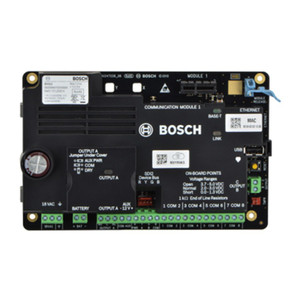
Bosch B9512G Intrusion Control Panel
Overview
The Bosch B9512G is a wired intrusion control panel engineered as a processing and monitoring node within distributed alarm architectures. Unlike traditional perimeter sensors, this unit functions as a centralized hub—ideal for security operations centers, network operation centers, and multi-site enterprise alarm aggregation. The B9512G ships with 18 VAC secondary power (110 VAC primary input) and rack-mount form factor, positioning it for cabinet integration rather than field deployment. A Bosch IP security architecture often combines multiple B9512G units across geographically dispersed sites to consolidate alarm correlation and event management.
Key Features
- 5MP Resolution Sensor: Captures 2592 × 1944 pixel imagery sufficient for identification and forensic review during security incidents—relevant when archiving alarm-triggered snapshots for post-event investigation without requiring higher-megapixel overhead.
- Varifocal 5.9–13mm Lens: Adjustable focal length eliminates the need for hardware swaps during commissioning if sight lines shift post-installation. Field-of-view can be tuned from wide-area overview to tighter coverage without breaking the seal or replacing optics.
- OptimizedIR Night Vision: Infrared illumination extends monitoring across 24-hour cycles without dependency on external lighting. Eliminates the need for site infrastructure upgrades (floodlights, LED arrays) in protected outdoor enclosures.
- IP67 Environmental Rating: Dust and water ingress protection qualifies the unit for sealed cabinet mounting and protected outdoor installations. IP67 means full submersion resistance—a higher bar than IP66—critical for hardened enclosures subject to moisture or washdown environments. Not suitable for direct rain exposure if mounted outside an enclosure.
- Rack-Mount Chassis: 19-inch standard form factor integrates directly into server cabinets and control racks, reducing mounting hardware SKU proliferation and streamlining cable management in central facilities.
- 18 VAC Secondary Power (110 VAC Primary): Transformer-based power delivery—22 VA capacity—supports integration with UPS and battery backup systems common in enterprise alarm infrastructure. No PoE involved; wired 18 VAC from dedicated panel supply is mandatory.
Integration & Compatibility
The B9512G functions within Bosch's intrusion ecosystem and requires confirmation of compatibility with your existing VMS, NVR, or alarm management platform before deployment. Verify ONVIF Profile compliance (if required) and assess whether your monitoring software recognizes Bosch's proprietary alarm event schemas. NVR and VMS architecture design should account for the B9512G as a processing node, not a simple video source. Pre-deployment testing with your specific control station is non-negotiable.
Deployment Scenarios
Deploy the B9512G when:
- Consolidating alarms from multiple sites into a single NOC with centralized event correlation and operator visibility.
- Integrating intrusion detection (door sensors, motion, glass break) with video surveillance in a unified control architecture.
- Hardening perimeter monitoring in protected outdoor enclosures where sealed, rack-mountable form factors are mandatory.
- Building redundancy by distributing control panels across enterprise networks, each managing a geographic zone with local processing and remote alerting.
When to Choose a Different Model
If your deployment requires a standalone camera for direct perimeter mounting (wall, pole, or corner installation), evaluate a dedicated fixed camera in the Bosch portfolio instead of the B9512G. If 5MP resolution is insufficient—for example, facial recognition or license plate detail—consider higher-megapixel variants within the Bosch family. The B9512G is purpose-built as a control node; forcing it into a perimeter-only role wastes its rack-mount design and centralized processing capability.
Frequently Asked Questions
Q: Can the B9512G be wall-mounted?
A: The B9512G is designed for rack-mount cabinet installation. Wall mounting is not supported by the standard chassis design. If you require a wall-mounted intrusion controller, consult Bosch documentation for alternative models.
Q: What is the power requirement for the B9512G?
A: The B9512G requires 18 VAC secondary power (22 VA) supplied from a 110 VAC primary transformer-based supply. PoE is not supported. Your alarm infrastructure must provide dedicated 18 VAC wiring and backup power (UPS/battery) integration.
Q: Is the B9512G ONVIF compliant?
A: ONVIF compliance should be verified with Bosch documentation and your specific VMS or NVR platform. Not all Bosch intrusion panels guarantee full ONVIF Profile S/T/G compatibility; pre-deployment integration testing is required.
Q: What lens options are available?
A: The B9512G includes a varifocal 5.9–13mm lens. This range is not user-interchangeable; lens focal length is fixed at manufacturing. The varifocal adjustment allows field-of-view tuning during commissioning but does not support mid-deployment lens swaps.
Q: Is the B9512G suitable for outdoor mounting without an enclosure?
A: No. IP67 rating protects against dust and water immersion in sealed environments, but does not qualify the unit for direct rain, salt spray, or extreme UV exposure without an external hardened enclosure. Mount only in protected outdoor locations or sealed cabinets.
Q: What infrared range does the B9512G deliver?
A: Bosch does not specify a discrete IR illumination distance in standard product summaries. Consult the manufacturer datasheet for OptimizedIR coverage details relevant to your site dimensions.
Ted PerryPerspective based on aggregated and affiliated engineering team experience.
The Bosch B9512G occupies a specific and often misunderstood role in intrusion architectures—it is a centralized control node with integrated imaging capability, not a field-deployable perimeter camera. The rack-mount form factor and 18 VAC transformer-based power supply are deliberate design choices that ground this unit in NOC and enterprise alarm hub deployments. If you're evaluating the B9512G purely as a video source for a single facility, you're likely looking at the wrong product class.
Technical Highlights:
- 5MP with Varifocal 5.9–13mm Lens: The combination delivers adequate forensic detail (identification-grade imagery) without the storage overhead of 8MP or higher. The varifocal range eliminates commissioning-phase hardware swaps if exact sight lines weren't pre-determined during design—a real time-saver on multi-site rollouts.
- IP67 Environmental Sealing: Full dust and water immersion protection qualifies the unit for sealed cabinet mounting and protected outdoor enclosures. Do not confuse this with IP66, which only resists directed water jets. IP67 is the right choice for hardened installations where moisture control is non-negotiable.
- 18 VAC Secondary Power (22 VA): Transformer-based delivery integrates seamlessly with UPS and battery backup systems standard in enterprise alarm infrastructure. This is not a PoE device—your cabinet power distribution must provide dedicated 18 VAC wiring. Power budget is modest (22 VA), so infrastructure planning is straightforward.
Deployment Considerations:
- The B9512G requires pre-deployment VMS and alarm platform integration testing. ONVIF compliance is not guaranteed across all Bosch intrusion panels; verify compatibility with your specific control station before go-live.
- Cabinet mounting is mandatory. If site constraints force direct wall or outdoor pole installation without an external enclosure, this is the wrong model—evaluate dedicated fixed cameras instead.
- OptimizedIR coverage distance is not publicly specified in standard Bosch summaries. Request detailed IR range data from the manufacturer during pre-sales engineering if night-vision distance is a critical requirement.
Position the B9512G when you are building a distributed, multi-site intrusion architecture where centralized event correlation and cabinet-based processing are architectural requirements. For single-facility deployments or direct perimeter camera roles, a purpose-built fixed or turret camera is the more efficient choice.