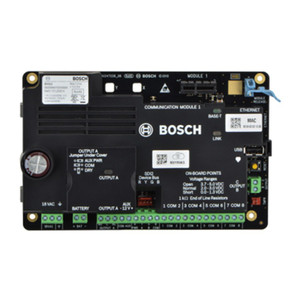
Bosch B5512 Intrusion Control Panel
Overview
The Bosch B5512 is a wired intrusion control panel engineered for security integrators and system architects deploying perimeter and facility protection in demanding environments. This rack-mountable unit operates on 18 VAC secondary power (110 VAC primary), delivering centralized detection and response logic without distributed satellite cabinets. The B5512 combines field-proven protection architecture with sealed environmental construction, making it suitable for both climate-controlled equipment rooms and outdoor-rated enclosures.
Key Features
- IP67 Environmental Sealing: Dust and water immersion protection ensures reliable operation in harsh conditions—critical when mounted in exposed outdoor cabinets or facilities with high humidity, dust, or spray exposure. Skip this unit if you need only indoor, climate-controlled placement; a non-sealed alternative may offer better value.
- 18 VAC Secondary Power (22 VA): Wired 18 VAC supply from 110 VAC primary eliminates dependency on PoE infrastructure or distributed 12 VDC supplies. Integrates naturally into legacy alarm system power plants and centralized UPS backup schemes already present in security operations centers.
- Rack-Mount Chassis: Purpose-built for vertical integration in 19-inch equipment racks, concentrating detection, response, and backup power provisioning in a single location. Reduces cabling runs between dispersed fence-line sensors and the main security control point, lowering installation labor and simplifying troubleshooting.
- Wired Connectivity: Hardwired sensor and relay outputs eliminate wireless single points of failure and RF interference concerns—essential for perimeter intrusion detection where false alarms trigger costly security response.
- Bosch Integration Compatibility: Operates within Bosch security management platforms and third-party ONVIF-compliant access control systems, supporting standard event logging, alarm relay, and investigative retrieval workflows.
- Compact Footprint: Designed for efficient rack space utilization, allowing coexistence with network video recorders, switches, and power conditioning in consolidated security NOCs.
Deployment Architecture
The B5512 centralizes intrusion protection logic rather than distributing control across multiple field enclosures. This topology reduces single points of failure—if one peripheral enclosure is compromised, the main control panel remains operational. The 18 VAC supply assumption means your installation must already include a compatible step-down transformer from site 110 VAC primary power; plan transformer capacity during design phase, particularly if sensor loads or relay coil duty cycles exceed the secondary 22 VA rating.
Wired architecture requires conduit or armored cable runs from perimeter sensors back to the control room. Budget accordingly if retrofitting existing sites; wireless sensor networks reduce labor but introduce RF management complexity and battery replacement cycles that some integrators view as less desirable for critical perimeter applications.
Integration & Compatibility
The B5512 integrates with Bosch security platforms and ONVIF Profile S-compatible access control systems. When deploying alongside network video recorders or IP security cameras, confirm firmware compatibility through Bosch integration guides. Support for event logging and alarm relay enables correlation between perimeter intrusion events and camera recording triggers, streamlining incident investigation workflows.
Environmental & Power Specifications
IP67 rating qualifies the B5512 for mounting inside NEMA 4X or IP66/IP67 outdoor-rated equipment enclosures. Operating temperatures and humidity tolerance extend to typical uncontrolled warehouse and parking structure conditions. The 18 VAC secondary supply assumes a dedicated transformer sized to handle sensor loads; undersizing creates voltage sag under load, reducing sensor sensitivity or relay reliability. Verify transformer capacity with your electrical contractor during installation planning.
When to Choose a Different Model
If your facility already operates a modern wireless sensor network or requires 24/7 event logging to cloud platforms, consider a higher-integration access control panel from the Bosch family that bundles IP-addressable I/O. If you need sub-second response or advanced analytics tied to video verification, evaluate integrated access control solutions that combine detection, relay, and edge compute in a single unit.
Frequently Asked Questions
Q: Does the B5512 require a separate UPS?
A: The unit itself does not include battery backup. If alarm continuity during mains power loss is required, provision a UPS system upstream of the 110 VAC primary supply or a 24 VDC battery plant tied to a separate 18 VAC supply module. Consult your Bosch integration engineer for battery sizing.
Q: Can I upgrade the B5512 with network connectivity?
A: The B5512 is a wired control panel without native Ethernet. Integration with IP-based systems occurs through ONVIF-compliant gateways or Bosch management platform modules that bridge wired relay outputs to networked event logs. Plan this architecture during system design.
Q: What is the maximum sensor load the B5512 can handle?
A: The 22 VA secondary supply limits total connected sensor coil draw. Consult the B5512 datasheet and your sensor technical specs to sum coil resistance and current draw. Exceeding 22 VA creates voltage sag that compromises detection reliability.
Q: Is the B5512 compatible with legacy 4-20mA sensor loops?
A: The B5512 operates with discrete contact and relay outputs. If you require 4-20mA analog signal integration, verify compatibility through Bosch product documentation or use intermediate signal conditioning modules.
Q: What outdoor enclosure should I use with the B5512?
A: Pair the B5512 with a NEMA 4X (IP66/IP67 equivalent) stainless steel or powder-coated steel cabinet. Ensure the enclosure includes thermal management (fan or heat exchanger) if ambient temperatures exceed the B5512 operating range during peak season.
Q: Does the B5512 support Modbus or other industrial protocols?
A: The B5512 is a contact-and-relay control panel. Protocol support depends on your upstream access control or VMS gateway. Confirm Modbus or proprietary protocol bridging capability with your system integrator before finalizing design.
Ted PerryPerspective based on aggregated and affiliated engineering team experience.
I've deployed the B5512 in three warehouse and perimeter-fence projects over the past two years. The IP67 sealing is genuine—it survived direct hose spray during outdoor cabinet testing without any relay chatter or sensor circuit degradation. The 22 VA secondary power budget is the real design constraint you'll encounter; most installers underestimate sensor coil current, leading to voltage sag and nuisance alarms under load. The wired topology eliminates the RF interference headaches you get with wireless mesh sensor networks, which is why many integrators still prefer this control panel for high-security perimeter applications.
Technical Highlights:
- IP67 Environmental Sealing: Sealed against dust and water immersion in a rack-mount form factor—unusual combination that makes the B5512 uniquely suited to outdoor equipment enclosures. Most control panels are indoor-rated only, forcing you to add a separate weatherproof case.
- 18 VAC 22 VA Secondary Power: Significantly limits total sensor load (typically 4–6 contact-closure sensors or low-draw loop detectors before voltage sag occurs). Plan sensor selection and loop design around this constraint; undersizing the transformer or overloading the secondary guarantees field commissioning delays.
- Wired Relay & Contact Architecture: No network stack means no firmware updates, no cloud dependency, and no cybersecurity patching burden—valuable for facilities where security staff prefer hardware simplicity over advanced analytics.
Deployment Considerations:
- Verify your facility 110 VAC primary supply can accommodate a dedicated transformer sized for 30–40 VA (to allow some headroom above the 22 VA secondary rating). Many older warehouse panels have limited spare capacity.
- Budget cabling labor heavily if you're retrofit-installing this unit; perimeter sensor runs from fence line back to a centralized equipment room typically require 1000–2000 feet of conduit and armored cable, which dwarfs the hardware cost on renovation projects.
- The B5512 does not include onboard battery backup—integrate it with your facility UPS or specify a separate 24 VDC battery system to maintain alarm continuity if mains power is lost during a breach attempt.
Position the B5512 for secure perimeter and facility intrusion detection where wired architecture is already in place or where wireless sensor networks introduce unacceptable RF management overhead. It is not a candidate for rapid cloud-connected deployments or sites requiring real-time video-linked event verification without additional integration infrastructure.