
Why Surveillance Systems Fail During Incidents
Posted by Marty Allison on Mar 02, 2026

Why Surveillance Systems Fail During Incidents — Not During Testing
Most surveillance systems get tested under calm conditions.
One operator. A few live views. Light playback. No exports. No pressure.
Then a real incident happens and everything feels unstable.
Deployment takeaway
Testing rarely simulates incident load.
Incidents create correlated spikes across recording
…
Why Your NVR Can’t Handle Its Rated Camera Count
Posted by Ted Perry on Mar 01, 2026

Why Your NVR Can’t Handle the Camera Count on the Spec Sheet
NVR spec sheets love big numbers.
64 channels. 128 channels. 256 channels.
But those numbers assume ideal lab conditions. In real deployments, performance collapses long before you hit the headline camera count.
Deployment takeaway
Channel count assumes specific bitrate and codec conditions.
Decoding limits ar
…
Why Surveillance Networks Collapse at the Core
Posted by Jerry Tildsen on Feb 27, 2026
Why Your Surveillance Network Collapses at the Core Switch (And It’s Not the Cameras)
Most surveillance problems get blamed on cameras. Or the recorder. Or the VMS.
But in larger deployments, the failure point is often the network.
Specifically: uplinks that were never sized for real aggregate video traffic.
Deployment takeaway
PoE port count is not network capacity. Up
…
Why Large Surveillance Systems Fail: Storage Throughput Reality
Posted by James Everett on Feb 26, 2026

Why Large Surveillance Systems Fail (And It’s Not the Terabytes)
Most storage conversations start with retention days. How many TB. How many days. How many cameras.
But the real failure point in larger deployments is usually simpler.
The recorder can’t write fast enough when motion spikes across dozens of cameras at once.
Deployment takeaway
Capacity answers how m
…
Why Surveillance Standards Collapse After the Third Location
Posted by Karl Wilson on Feb 24, 2026
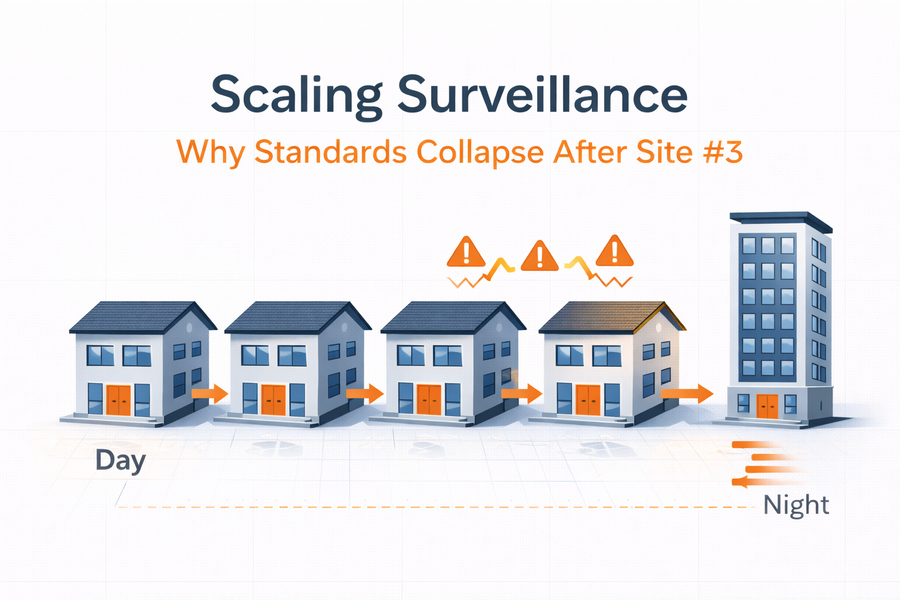
Why Surveillance Standards Collapse After the Third Location
Most surveillance programs scale like this:
Location 1: Designed carefully.
Location 2: Minor adjustments.
Location 3: “Just copy the last one.”
Location 4+: Everything starts drifting.
By location five, you don’t have a standard anymore. You have variations.
Deployment takeaway
A model list is n
…