Axis 01148-001 Outdoor PoE Network Extender
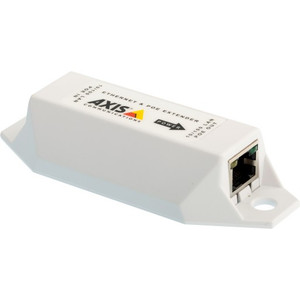
The Axis 01148-001 is a passive PoE extender purpose-built to overcome a stubborn deployment problem: standard Ethernet runs max out at 100 meters, but your outdoor perimeter, campus, or industrial site often demands cable runs of 150, 200, or more meters. This device bridges that gap by automatically forwarding in-line power to downstream PoE and High PoE devices without consuming configuration time or requiring intermediate power supplies. For security integrators and IT architects planning large-footprint surveillance or access control systems, the 01148-001 eliminates a costly workaround.
How It Works & Why It Matters
The T8129-E is a two-port inline extender — Ethernet in one end, Ethernet out the other. It detects incoming PoE power and automatically forwards it downstream. This passive forwarding approach means zero configuration: drop it in the cable run, and it works. For extended deployments, you can chain two units to reach 300 meters total (100m + 200m extender reach). The trade-off is straightforward: you lose one switch port per extender, and you cannot daisy-chain more than two units without re-injecting power, so plan your cabling topology accordingly.
Key Specifications & Deployment Benefits
- Extended Reach (200m single unit; 300m dual): Eliminates the need for expensive intermediate switches or power injectors in remote mounting scenarios. Plan for roughly 100 meters of standard cabling loss per extender unit. Dual-unit configurations turn into a real option for large industrial perimeters or campuses where running new conduit is not practical.
- IP66 Rating (PVC-free polycarbonate enclosure): Direct rain, hose spray, and heavy dust will not cause moisture ingress or component failure. Do not assume IP67 — full submersion is not supported. Suitable for wall-mount, pole-mount, or conduit installations in wet outdoor environments.
- Automatic PoE Forwarding (IEEE 802.3af/at + Axis High PoE): Works with standard 13W PoE (802.3af), higher-draw PoE+ devices up to 30W (802.3at), and Axis High PoE protocols. No manual power budget calculations or separate injectors; the device auto-negotiates and forwards.
- Temperature Range -40°C to 60°C (-40°F to 140°F): Operates reliably across arctic, desert, and tropical climates without environmental enclosure add-ons. A real factor for unheated outdoor cabinets or exposed wall mounts in northern or high-altitude deployments.
- 10/100 Mbps Duplex Ethernet: Standard Fast Ethernet performance — sufficient for a single or small cluster of IP cameras or access points. If you're pushing gigabit traffic (e.g., multi-stream 4K or mesh Wi-Fi aggregation), this extender is not the right tool; consider a full-size outdoor switch instead.
- Minimal Power Footprint (1.3W max): Nearly invisible to your PoE budget. A 30W PoE++ port can power this unit and still deliver ~28W to downstream devices.
- LED Diagnostics (Power + Link/Activity): Integrated into the RJ45 connectors themselves — green power status, yellow activity blink. Saves field time during troubleshooting on high poles or difficult-to-access runs.
- Compact Dimensions (182 × 49.8 × 30.2 mm; 180g): Small enough to mount directly onto a pole bracket or tuck into a shallow outdoor junction box. Weight is negligible for standard outdoor hardware.
Typical Integration Scenarios
Deploy the T8129-E (often searched as 01148 001) in perimeter surveillance systems where cameras sit 150–200m from the main switch, large-campus Wi-Fi access point extensions, remote building entrance card readers, or distributed IP speaker/intercom networks. Common use cases: parking lot monitoring with centralized NVR, warehouse perimeter scanning with cameras at distant fence lines, or multi-building access control without running new power infrastructure. Always verify downstream device power draw before chaining two extenders — the second unit's power budget shrinks slightly due to line loss.
When to Choose a Different Approach
If you need gigabit throughput or multi-camera aggregation with heavy codec traffic, deploy a full outdoor PoE switch instead. If cable runs exceed 300 meters, budget for an intermediate power closet or switch installation rather than cascading three or more extenders. If your environment is fully submerged or subject to sustained high-pressure wash-down, confirm IP67 requirements with Axis before purchase.
Certifications & Compliance
RoHS, WEEE, and CE marked. EMC compliance covers EN 55032/55024 (industrial) and FCC Part 15 Class B (conducted/radiated emissions). Safety rated to IEC/EN/UL 62368-1. 3-year manufacturer warranty.
Frequently Asked Questions
Q: Can I chain three or more T8129-E units to go beyond 300 meters?
A: No. Chaining more than two units without intermediate power re-injection will cause the third unit and downstream devices to lose power. The second extender's output voltage drops due to line loss; a third cascaded unit would drop further below the minimum 44V threshold for PoE operation.
Q: Does the 01148-001 support gigabit (1000 Mbps) Ethernet?
A: No. The T8129-E is a 10/100 Mbps device. It will negotiate and run at the slower speed even if connected to gigabit infrastructure. For high-throughput deployments, use an outdoor PoE switch.
Q: Will this extender work with non-Axis PoE cameras and devices?
A: Yes. The T8129-E forwards standard IEEE 802.3af and 802.3at PoE transparently. It is device-agnostic and will work with any compliant PoE endpoint from any vendor.
Q: What is the voltage drop over 200 meters of cable?
A: Typical Cat5e/Cat6 at 200m introduces roughly 4–6V loss depending on cable quality and current draw. The T8129-E compensates for this by forwarding at slightly elevated voltage; downstream devices will still receive valid PoE. However, if your cable is undersized (poor shielding, aluminum rather than copper), voltage drop increases. Always use quality Category 5 or higher cable as specified.
Q: Is the T8129-E (01148-001) NDAA-compliant or approved for government/sensitive sites?
A: Axis has not published NDAA Section 889 certification for this model. If your project requires NDAA compliance, confirm directly with Axis or consult your procurement requirements.
Q: What happens if I reverse the cable connectors or wire it wrong?
A: The T8129-E will not pass Ethernet or power if installed backwards. It is directional — PoE input on one end, forwarded output on the other. LED indicators (Power green, Link yellow) will help you identify a reversed installation during commissioning.
James EverettPerspective based on aggregated IP Security Depot and affiliated engineering team experience.
The Axis 01148-001 solves a real infrastructure bottleneck: extending PoE power to devices 150–200 meters from a switch without cramming another powered device into the cable run. For large outdoor campuses, industrial perimeter systems, and distributed access control deployments, this passive forwarding approach cuts installation complexity and cost compared to staged power injectors or remote switch installations.
Technical Highlights:
- Dual-unit reach to 300m: Two T8129-E units chained together extend PoE to 300 meters total — a real advantage on sprawling sites where conduit or cabinet relocation would be prohibitively expensive.
- IP66 durability across temperature extremes (-40°C to 60°C): Polycarbonate enclosure and sealed RJ45 connectors mean this extender handles arctic cold, desert heat, and wet tropical spray without environmental housings or thermal management add-ons. Deploy it on a pole, in a junction box, or mounted directly to camera brackets.
- Automatic PoE pass-through (802.3af/at + Axis High PoE): No configuration, no power budget menus — the unit detects incoming PoE and forwards it downstream. Works with legacy 13W devices and modern 30W+ PoE+ cameras equally well.
- Minimal power footprint (1.3W): Nearly invisible to your PoE switch's power delivery. A 60W port can still deliver 58W to downstream loads.
Deployment Considerations:
- Limitation: 10/100 Mbps only. If you need gigabit aggregation for multi-stream 4K or high-bandwidth mesh systems, this is not the right device — deploy a full PoE switch instead.
- Cable quality matters. Undersized or poorly shielded Cat5e will increase voltage drop beyond the typical 4–6V at 200m, starving downstream devices. Always spec Cat5e or Cat6 with solid copper conductors and proper shielding for extended runs.
- Directional device. LED status lights (Power green, Link yellow) help field crews verify correct orientation during commissioning. A reversed installation passes nothing.
Ideal deployment: perimeter surveillance networks, campus Wi-Fi access point extensions, remote entrance door readers, and warehouse rack cameras where 150–200m cable runs are non-negotiable and powering a remote switch would be overkill. In these scenarios, the T8129-E (01148-001) is straightforward, cost-effective, and reliable.