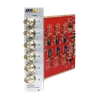
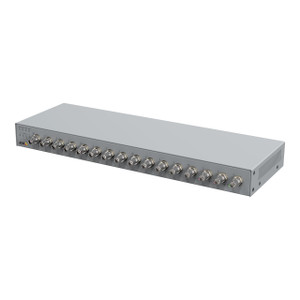
Axis 0584-001 6-Channel D1 Video Encoder Blade
Overview
The Axis Q7436 Video Encoder Blade (0584-001) is a six-channel analog-to-IP encoder designed to slot into the AXIS Q7920 and AXIS Q7900 blade chassis, as well as the AXIS 2911U. If you're running legacy coaxial infrastructure in a facility that isn't yet ready for a full IP camera replacement — airports, correctional facilities, large campuses — the Q7436 is the practical path to getting that footage into a modern VMS without ripping out cabling. Rather than replacing analog cameras one by one, you swap in encoder blades and convert entire camera banks at once.
The 0584-001 handles up to six channels per blade, encoding at D1 resolution with H.264 or Motion JPEG compression. At 60 fps on NTSC or 50 fps on PAL systems, you're getting smooth motion rendering — relevant for lobbies, corridors, or any scene where subjects move quickly through frame. This isn't a speculative migration tool; it's a deliberate transition product for integrators who need IP-grade management and VMS integration without the capital cost of a full camera refresh.
Key Features
- Six Channels per Blade: A single 0584-001 blade handles six analog inputs, so a fully populated Q7920 chassis can deliver dense channel counts from a small footprint. That density matters when you're migrating a 48- or 96-camera legacy analog system — fewer blades, fewer connections, less rack space consumed.
- H.264 Compression: H.264 encoding cuts bandwidth and storage load significantly compared to uncompressed analog or Motion JPEG streams — on a six-channel blade running 24/7, that's a meaningful reduction in NVR storage requirements across the retention window. Motion JPEG is still available per-channel when frame-by-frame forensic accuracy is needed.
- D1 Resolution at up to 60/50 fps: D1 (720×480 NTSC / 720×576 PAL) matches the native output of most analog cameras, so you're capturing everything the camera delivers without upscaling artifacts. The 60/50 fps ceiling ensures fluid motion in high-traffic zones where sub-30 fps would create blur in crowded scenes.
- Coax PTZ Control: If your existing analog PTZ cameras are wired with coax-carried control signals (RS-485 over coax), the Q7436 passes that PTZ control through to the IP network — your operators keep joystick control of legacy PTZ domes without re-wiring anything. This alone can justify the encoder approach over camera replacement in facilities with a large PTZ inventory.
- Video Motion Detection: On-blade VMD means the encoder itself can trigger event logic without consuming VMS processing cycles. You can configure motion-based recording rules at the edge, reducing the volume of continuous-record data sent to storage and keeping NVR CPU load manageable across a large channel count.
- Tampering Alarm: The Q7436 can detect video signal loss or camera tampering — useful in facilities where cameras are occasionally blocked, spray-painted, or physically disturbed. Alerts surface in the VMS immediately rather than requiring manual review of blank recordings after the fact.
- Blade Form Factor for Q7920/Q7900/2911U: The blade architecture means hot-swap-friendly deployment inside a supported chassis. You're not running individual encoder boxes with separate power and network connections; the chassis handles all of that, which simplifies cabling and reduces points of failure in the head-end rack.
Integration and Compatibility
The Axis Q7436 blade is purpose-built for the Axis surveillance chassis ecosystem — specifically the AXIS Q7920, AXIS Q7900, and AXIS 2911U. Before ordering, confirm your chassis model and available blade slots; the Q7436 populates one slot per unit. As part of the broader video encoder product category, it integrates with AXIS Camera Management software and is broadly compatible with ONVIF-compliant VMS platforms. Integrators running Milestone, Genetec, or other major VMS platforms should verify encoder profile compatibility with their specific VMS version before commissioning a large-scale deployment.
Coax PTZ control support makes the Q7436 particularly useful in sites where a mix of fixed and PTZ analog cameras are wired to the same coax runs. For new installations where cabling is not yet run, consider whether a direct IP camera deployment might be more cost-effective than encoder blades — encoders are the right call when infrastructure already exists. For storage planning on a multi-blade chassis deployment, review your NVR channel capacity and storage provisioning before go-live; H.264 at D1/60fps across a fully populated chassis generates meaningful sustained bitrate.
Frequently Asked Questions
Q: What chassis is the Axis Q7436 (0584-001) compatible with?
A: The Q7436 blade is designed for the AXIS Q7920, AXIS Q7900, and AXIS 2911U chassis. It is not a standalone unit — it requires installation inside one of these supported blade enclosures.
Q: How many analog cameras can one 0584-001 blade encode?
A: Each Q7436 blade handles up to six analog camera channels simultaneously, encoding them into IP streams for delivery to a VMS or NVR.
Q: What video compression formats does the Q7436 support?
A: The Q7436 supports H.264 and Motion JPEG (MJPEG). H.264 is the primary compression for bandwidth and storage efficiency; MJPEG is available when individual frame integrity is the priority.
Q: Does the 0584-001 support PTZ control over coaxial cable?
A: Yes. The Q7436 includes coax PTZ control, allowing RS-485-over-coax PTZ signals from legacy analog PTZ cameras to pass through to the IP network. Existing coaxial PTZ camera installations do not require re-wiring.
Q: What is the maximum frame rate supported by the Q7436?
A: The Q7436 supports up to 60 fps on NTSC systems and 50 fps on PAL systems, at D1 resolution per channel.
Q: Does the Q7436 include video motion detection or analytics?
A: Yes. The Q7436 includes on-blade video motion detection and a tampering alarm. These allow event-based recording triggers at the edge without requiring the VMS to handle motion processing for every channel.
The 0584-001 is a blade I'd reach for specifically in large analog legacy environments where ripping out coax is either cost-prohibitive or operationally disruptive — think correctional facilities, large municipal buildings, or university campuses with analog cameras embedded in conduit runs that aren't going anywhere soon. The six-channel-per-blade density inside a Q7920 chassis is what makes this practical at scale: you get meaningful channel consolidation without a tower of individual encoder boxes.
Technical Highlights:
- Six Channels per Blade: At six inputs per 0584-001, a fully populated Q7920 chassis converts a large analog camera bank in one head-end footprint — far simpler to manage than equivalent standalone encoders with individual network connections.
- H.264 at D1/60fps: D1 captures the native resolution of the analog source without over-engineering the stream. H.264 keeps sustained bitrate manageable across multi-blade chassis; Motion JPEG remains available per-channel for forensic review requirements.
- Coax PTZ Passthrough: The coax PTZ control capability is underrated on this blade. Sites with large PTZ inventories — RS-485-over-coax wiring — get full operator joystick control in the VMS without re-wiring a single camera. That's a real deployment cost avoidance on any site with more than a dozen PTZ units.
Deployment Considerations:
- Verify available blade slots in your Q7920, Q7900, or 2911U chassis before ordering; the Q7436 is chassis-dependent and will not operate as a standalone device. Plan channel count per chassis carefully up front.
- D1 is the ceiling here — this is not the blade for sites requiring higher-resolution IP output. If forensic detail at distance is a priority, a full IP camera refresh is the correct path; the Q7436 is the right answer when analog infrastructure is staying and IP management is the goal.
For a municipal campus or large institutional site running 48–96 analog cameras with a mixed PTZ population and existing coax infrastructure, the Q7436 in a Q7920 chassis is a straightforward, low-disruption migration to IP management — without the capital expenditure of a full camera refresh program.