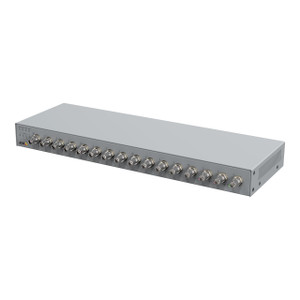
Axis 0518-004 Single-Channel Video Encoder for Analog-to-IP Migration
Overview
The Axis Q7411 video encoder, part number 0518-004, is the right tool when you need to extend the life of existing analog cameras without ripping out coax infrastructure. Rather than treating legacy cameras as a complete write-off, the Q7411 digitizes their output at up to 60/50 fps in H.264 — feeding modern network video recorders and VMS platforms over IP while keeping your coax cabling in place. If you're managing a phased IP migration at a facility where budget or operational disruption rules out a full-camera swap, this encoder earns its spot in the architecture.
The 0518-004 (often searched as 0518 004) accepts power via PoE (IEEE 802.3af) or a direct 8–28 VDC supply, giving you flexibility on how you power it in the field — near the camera head or at a patch panel. Coax PTZ control pass-through means your existing PTZ cameras retain full pan/tilt/zoom functionality through the encoder rather than losing that capability at the IP boundary, which is a common pain point when integrators choose encoders that treat PTZ control as an afterthought.
Key Features
- H.264 (Main and Base Profile) with Motion JPEG fallback: H.264 cuts bandwidth and storage requirements substantially versus raw analog capture or MJPEG-only paths — relevant when you're aggregating multiple encoder streams onto shared NAS or NVR storage. Motion JPEG remains available for clients or integrations that need frame-accurate single-image access without decoder overhead.
- 60/50 fps output: Full 60 fps (NTSC) and 50 fps (PAL) throughput means no frame-rate penalty compared to the source analog signal. For scenes where motion clarity matters — retail loss prevention, casino floors, active loading docks — you're not introducing judder or dropped frames at the encoding stage.
- PoE (IEEE 802.3af) power input: Standard 802.3af draw keeps this encoder compatible with virtually any managed PoE switch without requiring a dedicated power run to the encoder location. Pair this with a PoE network switch to simplify your wiring layout at the IDF or camera closet.
- 8–28 VDC alternative power: The wide DC input range accommodates legacy power supplies already present at analog camera locations, so you aren't forced to rewire for PoE if a local 12V or 24V supply is already available and accessible.
- Coax PTZ control: Passes PTZ commands through the existing coax connection to the camera, preserving pan/tilt/zoom operation on analog PTZ heads. Without this, migrating PTZ cameras to IP typically requires a separate control cable run or controller replacement — the Q7411 avoids that cost.
- microSDHC / NAS local and network storage: Edge recording to a microSD card provides resilience if the network link to your central NVR drops. NAS support gives you a middle-tier storage option for sites where a full NVR isn't justified but centralized local storage is preferred over cloud or pure-edge.
- Video motion detection analytics: On-camera VMD reduces the load on your VMS by filtering recording triggers at the edge. Useful in bandwidth-constrained encoder deployments where you want event-driven recording rather than continuous streams on every channel.
- Audio support with alarm I/O: Audio input/output capability and alarm I/O contacts let you integrate the Q7411 into access control or intercom workflows — attaching door sensors, motion contacts, or audio devices without a separate interface module. Explore the broader Axis video encoder and camera line if you need multi-channel encoder options for larger analog arrays.
Integration and Compatibility
The Q7411 outputs standard IP video streams compatible with ONVIF-conformant VMS platforms, making it a practical fit alongside video management software deployments from vendors like Milestone, Genetec, or Axis Camera Station. The H.264 Main and Base profile support covers the widest range of downstream decoders and recorders. VMD events can be used to trigger recording rules or alarm notifications in your VMS without requiring additional analytics licenses on the server side.
For storage, the microSD slot supports SDXC-class cards for longer local retention, and NAS integration supports standard protocols expected by enterprise storage environments. The encoder's coax PTZ control compatibility covers standard PTZ protocols passed over the analog coax — verify your specific PTZ camera's protocol is supported before deploying at scale. For complementary edge storage planning, review your NAS and edge storage options to match retention requirements to capacity.
Frequently Asked Questions
Q: Can the Axis 0518-004 control PTZ cameras over coax?
A: Yes. The Q7411 includes coax PTZ control, which passes pan/tilt/zoom commands from your VMS or NVR through the existing coax connection to compatible analog PTZ cameras. Verify your PTZ camera's specific control protocol is supported before deployment.
Q: What power options does the 0518-004 support?
A: The Q7411 accepts power via PoE (IEEE 802.3af) from a standard PoE switch or injector, or via a direct 8–28 VDC power supply — useful if a local low-voltage supply already exists at the analog camera location.
Q: Does the Q7411 support local recording without a network connection?
A: Yes. The encoder supports edge recording to a microSDHC card, providing resilience if the network link to your NVR or VMS is interrupted. NAS-based recording is also supported for network-local storage scenarios.
Q: What video compression formats does the 0518-004 output?
A: The Q7411 encodes to H.264 (Main and Base profile) and Motion JPEG. H.264 is recommended for bandwidth and storage efficiency; MJPEG remains available for compatibility with clients requiring individual frame access.
Q: What is the maximum frame rate of the Axis Q7411?
A: The Q7411 supports up to 60 fps for NTSC sources and 50 fps for PAL sources, preserving the full frame rate of the original analog signal without degradation at the encoding stage.
Q: Does the Q7411 include alarm inputs and outputs?
A: Yes. The encoder includes alarm I/O contacts, allowing integration with door contacts, motion sensors, or other dry-contact devices for event-triggered recording or VMS alarm rules.
The 0518-004 is a product I recommend specifically in phased-migration contexts where the customer has a working analog PTZ infrastructure and no appetite for a full rip-and-replace — the coax PTZ control pass-through on the Q7411 is what makes that migration viable rather than just theoretical.
Technical Highlights:
- 60/50 fps throughput: Full frame-rate preservation from NTSC and PAL analog sources — no motion artifacts introduced at the encode stage, which matters on PTZ cameras covering high-traffic zones like casino floors or active dock doors.
- Dual power input (PoE 802.3af + 8–28 VDC): The wide DC input range is a real practical advantage — installers can tap an existing 12V or 24V camera supply without rewiring for PoE, or use a managed PoE switch if the infrastructure supports it. Both paths on one encoder SKU reduces field inventory complexity.
- microSDHC edge recording + NAS support: The combination of local card storage and NAS compatibility gives you two fallback layers below your primary NVR — SD card holds recordings through a network outage, NAS serves as a mid-tier option before traffic hits central storage. VMD-triggered recording further reduces the write load.
Deployment Considerations:
- Coax PTZ control is protocol-dependent — before specifying the Q7411 across a site, audit your existing PTZ cameras' control protocols to confirm compatibility. A mismatch here means PTZ control goes dark at IP handoff, which defeats a primary reason for choosing this encoder over a simpler fixed-channel unit.
- The Q7411 does not support H.265 or Zipstream — if storage efficiency is a primary constraint on a large multi-encoder deployment, factor in that H.264-only encoding will require more NAS or NVR capacity than a newer encoder with H.265 output. Size storage accordingly before committing to this platform at scale.
The Q7411 is the right call for security teams extending the operational life of an analog PTZ array at facilities — manufacturing plants, distribution centers, stadiums — where the analog camera heads are still serviceable and the real cost driver is avoiding a full camera and cabling replacement before the next major capital cycle.