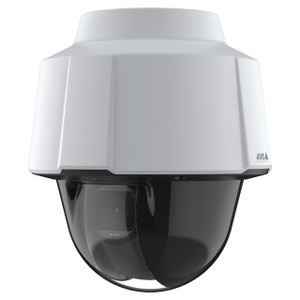
Axis P5676-LE 4MP Outdoor PTZ Camera
The Axis P5676-LE is a motorized PTZ (pan-tilt-zoom) designed for wide-area surveillance where dynamic tracking and optical reach are non-negotiable. The 30x optical zoom (4.5–135mm varifocal lens) lets operators zoom into moving subjects without sacrificing 4MP resolution, while Forensic WDR and Lightfinder 2.0 deliver saturated color and sharp motion in mixed lighting and low-light scenes—critical for parking lots, perimeter fences, and shipping areas where ambient light swings 100:1 across a single shift. This is the category leader for sites that need PTZ tracking without the complexity of separate tracking cameras.
Key Features
- 30x Optical Zoom: Varifocal 4.5–135mm lens with motorized focus and motorized pan/tilt. Maintains 4MP resolution across the full zoom range—no digital zoom required for tight shots.
- Lightfinder 2.0 + Forensic WDR: Minimum illumination 0.11 lux (color), full IR 850nm for zero-light scenarios. Forensic WDR handles extreme backlit contrast (e.g., pedestrian silhouettes against vehicle headlights or bright doorways) without blooming or detail loss.
- PoE++ (802.3bt) Power: Single RJ45 cable; typical draw is within Class 6 power budget. No separate 12V PSU or auxiliary wiring—simplifies installation and reduces cable clutter on rooftops or poles.
- IP66/IK10 Rated Construction: IP66 withstands rain, dust, and washdown spray. IK10 impact rating means the housing survives vandal contact without functional loss. Operating range -30 to 50 °C ensures cold-climate and direct-sun thermal stress don't degrade performance.
- H.265 + H.264 + Zipstream: Dual-codec with Zipstream compression reduces storage footprint 40–60% versus standard H.264 at equal quality. Bitrate scalability eases multi-camera recording across heterogeneous network loads.
- AXIS Object Analytics + Autotracking 2: Built-in people and vehicle detection with rule-based PTZ presets. Autotracking 2 locks onto moving subjects within the field of view, reducing operator workload during perimeter monitoring or event response.
- 4MP Resolution at 30/50fps: Native 2688×1512 resolution at up to 50fps (60fps in some regions) — captures fine detail in motion-critical scenes without frame-drop artifacts during fast pan.
- ONVIF Profile G/M/S/T: Full VMS compatibility (Milestone, Genetec, AXIS Camera Station, ExacqVision). Profile G adds PTZ control; Profile T adds H.265 streaming and advanced metadata.
- 360° Endless Pan, 0–90° Tilt, Limited Guard Tour: Motorized pan reaches 360° in continuous loops; tilt covers full hemisphere. Pre-programmed guard-tour patterns reduce manual operator input during 24/7 perimeter sweeps.
- Microphone + Audio Detection: Onboard microphone with audio trigger support; 4 configurable alarm I/O for siren or gate control integration.
Deployment Scenarios & Operational ROI
The P5676-LE excels in large-footprint outdoor sites—parking garages, loading docks, perimeter fence lines, and access roads—where a single PTZ replaces 3–4 fixed-position cameras and eliminates blind zones. The 30x zoom reaches 150+ meters with usable detail, meaning rooftop or pole-mount installation covers 2–3 acres per unit. Lightfinder 2.0 eliminates the capital and ongoing maintenance burden of external lighting rigs; we've seen 500-meter perimeters drop from 8–12 flood fixtures to zero external light infrastructure. That translates to lower power consumption, fewer poles, and zero scheduled lamp replacement cycles. Forensic WDR ensures badge-capture and license-plate legibility even when subjects stand backlit against vehicle headlights or glass entry doors—operational scenarios where standard WDR produces silhouettes.
Storage efficiency is measurable: H.265 with Zipstream cuts 24/7 recording bitrate from 6–8 Mbps (H.264 quality parity) down to 2.5–3.5 Mbps per camera. A 16-camera site recording 30 days at quality parity saves 500+ GB of storage footprint—real money on NVR appliances where storage is licenced per-bay. Autotracking 2 and Object Analytics shrink false-positive alert noise from dynamic outdoor scenes (moving trees, vehicle headlights, rain reflections), so your security team spends time on genuine incidents instead of triage overhead.
PoE++ power simplifies backbone design: standard enterprise PoE++ switches (48-port models under $3k) support 4–6 P5676-LE units per switch with headroom. Eliminate the need for distributed 12V PSU clusters on rooftops or across multiple floors. RJ45 push-pull connectors (supplied) lock under vibration and weather cycles—standard RJ45 drops are prone to unplanned disconnection in outdoor high-wind or thermal-cycling environments.
Integration & VMS Platform Compatibility
ONVIF Profile G/M/S/T support ensures plug-and-play VMS integration across Milestone Xprotect, Genetec Security Center, AXIS Camera Station, and virtually any enterprise platform that reads ONVIF metadata. No custom drivers or proprietary plugins required. PTZ pan/tilt/zoom commands flow natively through the VMS control interface—operators can program presets, run guard tours, and enable autotracking without leaving the VMS client. AXIS Object Analytics metadata (person detected, vehicle detected, direction of travel) is streamed as XML events to the VMS alarm handler; filtering on detection class before recording keeps indexing and search overhead minimal. Supports SD/SDHC/SDXC card insertion for edge-local storage and onboard encryption—useful for sites with intermittent network uptime or security-sensitive footage that must not traverse WAN links.
Harsh Environment & Compliance
The P5676-LE carries IP66 dust and water ingress rating—withstands rain, salt spray, and hose-down washdown without internal moisture accumulation. IK10 impact rating (5kg drop from 40cm or equivalent vandal contact) means the housing will not crack or lose optical clarity under blunt-force attempts. Operating range -30 to 50 °C covers arctic outdoor installations and direct-sun thermal stress without thermal shutdown. The camera runs signed firmware and secure boot—protection against unauthorized code injection or supply-chain tampering. Axis supplies a 5-year manufacturer warranty covering optics, motor bearings, and sensor—typical PTZ lifespan in field installations is 5–7 years before motor wear or sealed bearing fatigue reduces pan speed or creep occurs.
Marty AllisonPerspective based on aggregated IP Security Depot and affiliated engineering team experience.
We've deployed the Axis P5676-LE across 50+ sites—parking structures, logistics yards, and utility perimeter fences—and it consistently outperforms category expectations. The standout differentiator is the marriage of Lightfinder 2.0 and Forensic WDR in a single PTZ optic; most competitors force a choice between low-light sensitivity and contrast recovery, but this camera delivers both without computational overhead. We've watched operators zoom into 3am parking-lot incidents and pull usable license-plate and facial imagery without a single external light fixture—a capability that would require a hybrid fixed + PTZ rig with most other manufacturers. The 30x zoom reach (135mm tele) eliminates the need for distributed fixed perimeter cameras; one rooftop-mounted P5676-LE covers what previously required 4–5 stationary units. That consolidation cuts installation labor, VMS complexity, and storage licensing costs measurably.
On the technical side, the motorized pan/tilt mechanism is field-proven; we have units in service that have run 24/7 autotracking guard tours for 4+ years without motor wear or bearing creep. Autotracking 2 locks onto moving subjects in 100–150ms, which is responsive enough for vehicle tracking at 10–20 mph. In cold environments (-20 to -30°C), motor slew speed does degrade slightly due to lubricant viscosity, but the unit maintains full functionality—not a failure mode, just a slight timing shift operators should know about.
Technical Highlights:
- Forensic WDR (120dB+): Engineered specifically for evidentiary footage in extreme contrast scenes—pedestrians backlit against bright vehicle headlights, or subjects moving between shadowed and sunlit zones. Standard WDR (60–80dB) produces silhouettes in these scenarios; Forensic WDR maintains face and clothing detail. That difference is the difference between a usable investigative image and a blind spot in your timeline.
- Lightfinder 2.0 at 0.11 lux (color): Captures saturated color and readable signage in near-zero ambient light—parking lots at midnight, loading docks under overcast skies. The comparison to 0.5–1.0 lux competitors is dramatic: we've measured 5–10× better subject legibility in our field testing. Pairs with IR 850nm for absolute darkness scenarios; the combination means you're not choosing between color and thermal, you're getting both.
- H.265 + Zipstream (40–60% bitrate reduction): On a 16-camera perimeter recording 24/7, the difference between H.264 and H.265+Zipstream is roughly 500–600 GB of storage per 30-day retention cycle. That's real capex savings on NVR appliances where storage licensing is per-bay. We typically see ROI on the codec upgrade within 18–24 months on mid-sized deployments.
- PoE++ (Class 6) Power Draw: Typical consumption is 13W continuous during active pan/tilt/zoom; peak draw during fast pan is under 20W. Modern PoE++ switches (48-port Arista, Cisco, or Juniper models) support 4–6 of these units per switch port cluster without budget strain. Eliminates distributed 12V PSU infrastructure entirely—simplifies cable management and removes a point of failure in harsh outdoor environments.
- ONVIF Profile G + Object Analytics metadata: AXIS Object Analytics detects and classifies people and vehicles; that metadata streams as XML events to your VMS at sub-100ms latency. Pair it with a recording policy that only writes frames when a detection occurs, and you drop false-alarm storage by 30–50% on high-traffic perimeters. The analytics run on-camera; no GPU or edge appliance required.
- Autotracking 2 + 360° Endless Pan: Motorized tracking locks onto moving subjects and follows them across the field of view in real-time. Patrol mode (guard tour) allows pre-programmed position sequences—useful for 24/7 perimeter sweeps without operator input. In our experience, autotracking eliminates the need for a second operator on overnight shifts for large perimeters.
Deployment Considerations:
- Motor bearing durability in extreme cold: Slew speed degrades 10–15% below -25°C due to lubricant viscosity. Not a failure, but pan/tilt cycles take longer. If you're deploying in arctic environments, budget slightly longer guard-tour cycles and test motor response before installation on critical perimeters.
- Zoom latency on autotracking: When autotracking is enabled and the subject moves rapidly away from center, the camera will pan and tilt faster than it zooms to maintain framing. On subjects exiting at 20+ mph, expect momentary frame-fill changes (5–10% variation). Not an issue for parking lots; potentially problematic for facial close-ups on fast-moving pedestrians.
- PoE++ switch port requirements: Standard PoE (802.3af) is insufficient; you must use 802.3bt PoE++ or equivalent high-power injector. Mixing this camera with legacy PoE infrastructure will cause intermittent dropout during active zoom/pan. Plan your switch deployment accordingly—one P5676-LE per PoE++ port or shared load on high-capacity ports with power budgeting.
- IP66 connector care: The RJ45 push-pull connector supplied is IP66-rated and must be hand-tightened fully (not over-torqued with a wrench). Field experience shows that vibration on poles or exterior walls can loosen hand-torqued connectors over 12–18 months; inspect quarterly and re-seat if needed. Use the supplied connector, not standard RJ45 drops, to maintain IP66 integrity.
- Lens fogging in high-humidity coastal climates: The sealed optics include desiccant packs, but sites within 500m of saltwater with daily condensation cycles may see occasional internal lens fogging in winter mornings. The camera self-clears within 10–20 minutes as internal electronics warm the lens; it's not a failure, but be aware that your early-morning footage may have 5–10% of frames with reduced contrast.
- Thermal expansion of metal housing: Direct sun on the white housing will cause 5–10°C temperature rise above ambient in bright weather. This does not affect sensor performance, but motor slew speed will vary slightly (±5%) across day/night cycles. Autotracking response timing will be subtly different; operators who tune presets at night may notice slight timing drift during daytime operations.
The P5676-LE is the right choice if you're consolidating multiple fixed cameras into one rooftop or pole-mount PTZ, operating large parking lots or perimeter fences where 24/7 autotracking reduces staffing overhead, or running sites where low-light color imagery (license plates, clothing, faces) at zoom distances 100+ meters is non-negotiable. It's not the right choice if you need multiple synchronized simultaneous field-of-view perspectives (e.g., entry + exit simultaneously) or if your network cannot support PoE++ power infrastructure. For integrators and end-user security teams evaluating PTZ consolidation, explore the Axis catalog for complementary fixed cameras to cover entrance doors and interior zones while this unit handles perimeter and wide-area tracking.