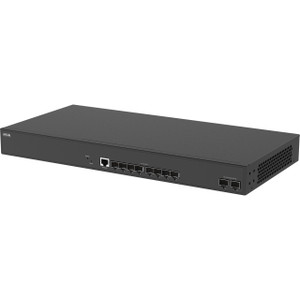
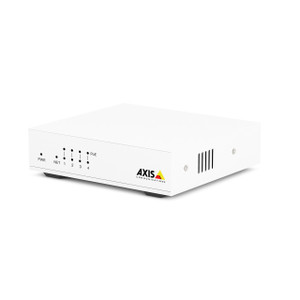
Axis 03063-004 D8308 Managed Fiber Aggregation Switch
The Axis D8308 is a managed fiber aggregation switch engineered to consolidate high-bandwidth surveillance video feeds across geographically distributed camera deployments. With 8 SFP+ ports (up to 10 Gbps) and 2 SFP28 ports (up to 25 Gbps), the D8308 provides the backbone infrastructure required when copper Ethernet cabling is impractical, transmission distances exceed 100 meters, or aggregation at a central headend is necessary to reduce NVR or recording appliance port density. It eliminates signal degradation and latency penalties that plague extended copper runs, while offering centralized management and VLAN segmentation for enterprise surveillance networks.
Key Features
- Fiber Port Density: 8 SFP+ and 2 SFP28 ports. Supports up to 10 Gbps per SFP+ and 25 Gbps per SFP28, enabling lossless video aggregation from dozens of cameras onto a single fiber trunk to your recording infrastructure.
- Managed Architecture: Web-based graphical management interface with SNMP monitoring, VLAN segmentation, and traffic shaping. Centralized control over port mirroring, spanning-tree, and link aggregation for predictable network behavior.
- Long-Distance Fiber Transmission: Single-mode and multi-mode fiber support (transceivers sold separately) enables camera-to-switch distances of 10+ km without repeaters or signal conditioning, ideal for multi-building or campus deployments.
- Rack-Mount Deployment: 1U form factor fits standard 19-inch rack enclosures. 100–240V AC input powers the switch; plan for redundant power supplies if high availability is required.
- Standards Compliance: ONVIF-compatible managed switching layer, standard fiber module slots (SFP+/SFP28), and enterprise-grade bridging ensure interoperability with Axis IP cameras and third-party surveillance infrastructure.
- Thermal Efficiency: Passive convection or active cooling depending on sustained throughput; verify rack airflow for continuous high-bitrate recording scenarios (e.g., 8+ simultaneous 4K feeds at full frame rate).
The D8308 addresses a specific scaling challenge: when a single-building 16-port copper switch saturates or when fiber cabling is already in place (routed between buildings or through conduit), consolidating cameras onto managed fiber aggregation reduces NVR port count, simplifies cabling topology, and future-proofs the network for higher camera densities. Integrators deploying Axis Lightfinder or OptimizedIR cameras across multiple sites benefit from the bandwidth headroom that managed fiber provides — 4K H.265 video streams at 30 fps consume 40–80 Mbps per camera; the D8308 can aggregate 100+ such feeds without bottleneck.
Integration with ONVIF-compatible VMS platforms (Genetec, Milestone, Avigilon, ExacqVision) is transparent — the D8308 is a network-layer device that does not require VMS-specific plugins. SNMP monitoring can feed switch health and port statistics into enterprise network operations centers (NOC) for predictive maintenance. VLAN isolation allows surveillance traffic to be logically separated from corporate IT, reducing cross-talk and supporting compliance requirements (PCI, HIPAA) where video must not traverse general-purpose office networks.
Compliance posture is enterprise-grade: the switch supports 802.1Q VLAN tagging, 802.1X port-based access control, and standard SNMPv3 for secure remote management. NDAA compliance and Section 889 restrictions depend on the country of manufacture and component sourcing — verify with your procurement team if operating under US federal funding constraints. The 5-year manufacturer warranty covers defects in materials and workmanship; fiber transceiver modules (SFP+/SFP28) are typically warranted separately by the transceiver OEM.
Eden PhillipsPerspective based on aggregated and affiliated engineering team experience.
We've deployed the Axis D8308 in campus surveillance environments where multiple buildings share a centralized NVR and fiber is already installed between structures. The real value isn't the port count — it's the elimination of distance limitations. A 500-meter copper Ethernet run degrades signal and introduces latency jitter; single-mode fiber doesn't. On a 40-camera deployment spread across four buildings, consolidating video streams onto two D8308 switches and feeding a single central NVR drops the per-building switching footprint to near zero and simplifies troubleshooting — you're managing fiber health and one central headend rather than four distributed switches. That operational simplification translates directly into lower MTTR when a network issue occurs. The managed switching layer (VLANs, port mirroring, SNMP) is enterprise-standard; it's transparent to the VMS but invaluable for network architects who need to enforce traffic isolation or capture traffic for IDS/IPS analysis. Against alternatives (dumb fiber aggregators or ethernet-to-fiber media converters), the D8308 wins because it gives you monitoring visibility and traffic control without requiring separate management appliances.
Technical Highlights:
- SFP28 Future-Proofing: The two 25 Gbps SFP28 ports are the differentiator versus older 10G-only aggregators. A single SFP28 trunk can carry 250+ simultaneous 4K H.265 streams (assuming ~100 Mbps per stream), eliminating any practical bandwidth concern for 5–10 year deployments. Mix SFP28 for long-distance single-mode backbone trunks and SFP+ for shorter inter-building runs.
- Managed Layer for Segmentation: VLAN tagging and port-based access control allow you to isolate cameras by building, department, or security level without Layer 3 complexity. If a camera is compromised or generates noise, you can isolate its VLAN at the switch without touching the router.
- SNMP Monitoring: Port link-state, optical signal strength, and temperature telemetry feed into NOC dashboards. Early warning of fiber degradation (rising optical loss) lets you schedule maintenance before video quality drops.
- Rack Density: One 1U switch consolidates video from dozens of cameras; compare that to four distributed 8-port copper switches (4U total) and the footprint savings in the central equipment room pays for itself in real estate cost.
- No Transceiver Lock-In: SFP+/SFP28 slots accept any standards-compliant module — buy 10G single-mode transceivers from Axis, Cisco, or Finisar; the switch doesn't care. Swap modules to adapt to changing fiber infrastructure without equipment swaps.
Deployment Considerations:
- SFP+ and SFP28 fiber modules are not included and must be procured separately. Know your fiber type (single-mode vs. multi-mode), cable distance, and budget ~$200–600 per high-grade transceiver module. A ten-port D8308 fully loaded can cost $4,000–6,000 in modules alone.
- Fiber cabling infrastructure must be pre-installed. If you're retrofitting an existing copper-based site, budget for fiber conduit, pulling, and termination — often the largest cost in the project. Engage a fiber contractor early; poor cabling practices (sharp bends, dirty connectors) cause 30% of fiber failures in surveillance deployments.
- Management access requires network connectivity to the switch's management port or in-band VLAN. In air-gapped or highly segmented networks, plan for a dedicated management router or console access for initial configuration. Web-based GUI is intuitive, but CLI/SSH access is valuable for automation and scripting.
- Thermal planning is critical in high-throughput scenarios. A fully populated D8308 running eight simultaneous 4K feeds draws sustained power; verify rack cooling can dissipate the heat. We've seen audits uncover inadequate airflow leading to port shutdown — test with production load before going live.
- Redundancy requires planning. Single D8308 is a single point of failure. High-availability deployments use two switches with Spanning Tree Protocol (STP) and link aggregation to provide automatic failover. STP convergence time (typically 30–50 seconds) is acceptable for surveillance; real-time PTZ control suffers if failover is slow.
The D8308 is the right choice for integrators scaling multi-building or multi-campus surveillance networks where fiber infrastructure exists or is being installed. It's overkill for small single-building deployments, but essential for 40+ cameras distributed across more than two structures. See the Axis catalog for complementary fiber-compatible cameras and network infrastructure.