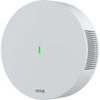
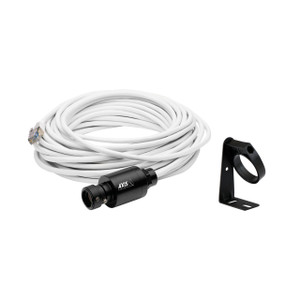
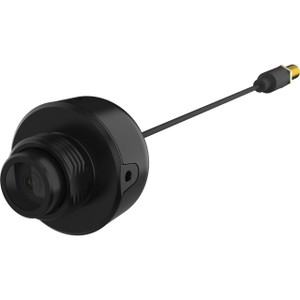
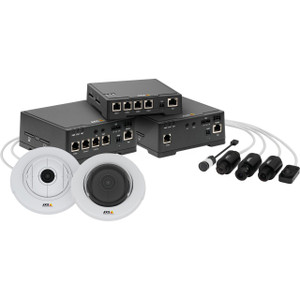
Axis 03069-001 D6210 Air Quality Sensor
The Axis 03069-001 is an inline environmental monitoring module that extends Axis network cameras and strobe siren systems with real-time air quality detection. Unlike standalone sensors requiring separate network ports and power feeds, the D6210 uses Portcast technology—integrating directly between a host device and its power source—to deliver air quality telemetry without infrastructure overhead. This matters because it eliminates the need for additional cabling runs, dedicated PoE budget, and network drops, significantly reducing deployment cost and installation complexity across multi-building campuses or retrofits.
Key Features
- TVOC (Total Volatile Organic Compounds) measurement: Detects airborne pollutants and volatile off-gases; useful in healthcare and commercial environments where air quality links directly to occupant health and compliance (e.g., infection control in hospitals, off-gassing in renovated spaces).
- PM2.5 and PM10 particulate monitoring: Tracks fine and coarse dust; critical for facilities managing HVAC efficiency or responding to external pollution events—actionable data for real-time system optimization.
- Vaping and smoking detection: Automated alerts trigger when air quality thresholds breach, enabling rapid facility response in restricted zones (school restrooms, healthcare facilities, corporate offices).
- Portcast passthrough architecture: Power and data consolidate into a single connection path; no additional network configuration, no standalone power supply, no extra wall outlets required—simplifies scaling across dozens of locations.
- Real-time threshold-based automation: Air quality breaches can trigger coordinated actions—notification lights, strobe alerts, HVAC adjustments, or system notifications—without external software middleware.
- Compatible with Axis network cameras and strobe sirens: Works inline with existing Axis deployments, so organizations leverage current infrastructure investments rather than purchasing parallel monitoring systems.
Integration & Compatibility
The D6210 integrates seamlessly with any compatible Axis surveillance infrastructure. Installation is straightforward: insert the sensor inline between the host device (camera or siren) and its power connector. Environmental data flows directly through the host device and into your management software or VMS via standard Axis APIs and ONVIF, eliminating the need for custom integrations. Because Portcast consolidates power and data, existing PoE switches and cabling remain unchanged—no power budget strain, no port saturation. This approach scales: organizations can deploy sensors incrementally across a facility, building out coverage as budgets and priorities shift.
Deployment Scenarios
Educational institutions: Schools deploy D6210 sensors in restrooms and common areas to detect vaping; automated alerts notify staff immediately, enabling swift intervention.
Healthcare facilities: Real-time TVOC tracking supports infection control protocols and air quality assurance; data informs HVAC adjustments during high-acuity periods.
Commercial buildings: Facilities managers use PM2.5 and PM10 data to optimize HVAC scheduling, reduce energy waste, and maintain occupant comfort—particularly valuable in dense urban environments or industrial zones.
The 03069-001 works best where existing Axis camera or siren infrastructure already exists. If your environment lacks Axis devices or requires standalone, battery-powered sensors, consider alternative solutions not dependent on host device integration.
Frequently Asked Questions
Q: Can the D6210 operate independently without an Axis camera or siren?
A: No. The 03069-001 is a passthrough module designed to integrate with a compatible Axis host device. It requires a network camera or strobe siren to function.
Q: Does the D6210 require additional network ports or PoE budget?
A: No. Portcast technology consolidates power and data into the host device's existing connection. The sensor draws no additional PoE from your switch.
Q: What air quality thresholds can I set for automated alerts?
A: Threshold configuration depends on your VMS and Axis host device software. Real-time data streams to your management platform, allowing you to define custom alert rules based on TVOC, PM2.5, PM10, or combinations thereof.
Q: Is the D6210 suitable for outdoor environments?
A: The D6210 is an inline sensor module; environmental rating depends on the host device it connects to. If your host camera or siren is IP66-rated and mounted in a weatherproof enclosure, the D6210 can tolerate that environment. Consult the host device datasheet for exact operating conditions.
Q: What VMS platforms support D6210 data integration?
A: The D6210 integrates through the host Axis device using standard APIs and ONVIF. Most major VMS platforms (Milestone, Genetec, Axis Camera Station, etc.) that support Axis cameras can process air quality events. Verify with your VMS vendor for specific event mapping.
Q: How often does the D6210 refresh air quality data?
A: Data flows in real-time through the host device. Exact refresh intervals and reporting granularity are determined by the host camera or siren firmware and your VMS configuration.
Jerry TildsenPerspective based on aggregated IPSD and affiliated engineering team experience.
The Axis 03069-001 D6210 is a smart tactical play for environments where occupant safety intersects with existing Axis camera deployments. The Portcast passthrough architecture is the real story here—it eliminates a common integration friction point: the need to provision separate network drops, manage additional PoE budget, or maintain a second sensor network parallel to your video infrastructure. If you already have Axis cameras wired through your facility, adding air quality monitoring becomes a matter of inserting the D6210 inline; no new cable runs, no switch reconfiguration.
Technical Highlights:
- TVOC, PM2.5, PM10 triple-parameter monitoring: Covers the core air quality spectrum—volatile compounds, fine particulates, and coarse dust—so you're not flying blind on vaping/smoking, dust storms, or off-gassing events. Real-time data feeds into automation rules without middleware overhead.
- Portcast consolidation: Power and data flow through a single host connection, reducing your infrastructure footprint by one port, one PoE budget allocation, and one installation labor cycle per site. Matters significantly when scaling across 20+ locations.
- Host device dependency: The D6210 works only when wired to a compatible Axis network camera or strobe siren. It is not standalone, not battery-powered, not Wi-Fi-capable. This is a constraint—not a flaw, but a design boundary you must respect during sizing.
Deployment Considerations:
- Verify host device compatibility before ordering. Not every Axis camera or siren supports Portcast passthrough. Check the specific host device model against Axis compatibility matrices.
- Air quality alert thresholds and automation chains depend on your VMS platform and the host device's firmware version. TVOC and particulate data are only useful if your VMS can map them to actionable rules; test threshold logic in a pilot before rolling out fleet-wide.
- The sensor itself has no environmental rating independent of the host device. If your host camera is indoor-rated only, the D6210 is also indoor-only—don't assume outdoor capability without confirming the host device's IP/IK rating and enclosure specifications.
Position the 03069-001 for schools and healthcare facilities where vaping detection and air quality compliance are documented priorities, and where Axis camera infrastructure already exists. It's a cost-efficient add-on for occupant safety workflows, not a standalone air quality solution.