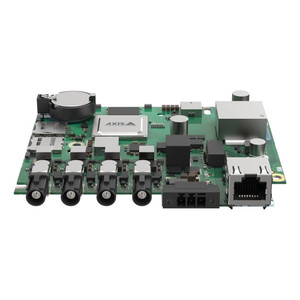
Axis 03000-001 F9104-B Mk II 4-Channel Modular Main Unit
The Axis 03000-001 is a barebone modular signal processor engineered as the intelligent hub for distributed F-series multi-sensor surveillance systems. It accepts up to four interchangeable Axis F-series sensor modules (F21, F72, F41 families), multiplexing 1080p (2 MP) video streams at 30 fps across all four channels simultaneously over a single gigabit Ethernet connection and one VMS license. As a UL-recognized component, it bridges custom OEM enclosures and pre-certified end-product designs, eliminating the operational and licensing overhead of managing four separate IP cameras while maintaining full ONVIF Profile S and G compatibility with Axis Camera Station, Milestone, and equivalent VMS platforms.
Key Features
- Modular Sensor Compatibility: Accepts up to four interchangeable F21, F72, or F41 sensor modules. Mix-and-match form factors and resolutions within a single main unit without redesigning network architecture.
- 1080p Multi-Channel Processing: 30 fps @ 1920×1080 (2 MP) across all four channels simultaneously. 60 fps available at 720p for motion-heavy scenes or forensic replay workflows.
- PoE+ Power Efficiency: 802.3at PoE+ at 25.5W max — operates directly from standard PoE+ switches (commonly available in 90W+ models) without auxiliary power supplies.
- Single IP, Single License: Four sensor streams consolidated into one network address and one VMS license slot. Reduces management overhead and licensing cost versus four independent IP cameras.
- H.265 + H.264 + Zipstream Encoding: H.265 achieves 40–60% bitrate reduction vs. H.264 on identical quality; Zipstream further optimizes storage. MJPEG fallback for legacy VMS systems.
- Dual Audio Input Channels: Synchronized audio capture from up to two external sources across all four video streams. Supports investigative voice/alarm correlation in multi-sensor deployments.
- ONVIF Profile S & G Certified: Standards-based integration with Axis Camera Station, Milestone Xprotect, Avigilon Control Center, ExacqVision, and third-party platforms. No proprietary drivers or middleware overhead.
- Secure Processing & Vault: CCEAL6+ secure element, IEEE 802.1X (EAP-TLS), 802.1AE (MACsec), TLS 1.2/1.3, AES-XTS 256-bit SD card encryption, signed video. Enterprise-grade cybersecurity stack included.
- Extended I/O & Connectivity: Gigabit Ethernet (RJ-45), USB Type-A (firmware, diagnostics), RS-485 serial (auxiliary control), and four configurable I/O ports (relays, alarms). TU-series connectors (sold separately) expand auxiliary input/output flexibility.
System Architecture & Deployment Context
The 03000-001 solves a specific integration gap: distributed multi-sensor surveillance without the VMS license sprawl or network overhead of four separate IP cameras. A typical deployment—parking garage with one main unit and four F41 dome modules—streams four 1080p feeds to the NVR on a single gigabit pipe, consuming 25.5W of power from a nearby PoE+ switch and occupying one camera license slot. Frame consolidation happens on the main unit's AXIS ARTPEC processor; the VMS receives a single ONVIF stream that unpacks cleanly into four logical video channels. For large facilities with 10–20 such multi-sensor arrays, the licensing and network infrastructure simplification is material.
The barebone form factor (21 × 107 × 110 mm, 120g) reflects its role as an OEM component, not an off-the-shelf camera. It ships without enclosure—the integrator or OEM partner must house it within a custom mechanical frame, manage thermal dissipation, and wire RS-485 and auxiliary power if auxiliary I/O is required. This design choice lowers per-unit cost and allows end-products to match environmental ratings (IP66, IK10, etc.) without re-certifying Axis's core processor.
Storage, Codec Selection, & Total Cost of Ownership
Bitrate efficiency directly impacts 24/7 recording economics. At 1080p 30 fps, H.264 baseline yields roughly 3–5 Mbps per channel (12–20 Mbps all four channels); H.265 cuts that to 1.8–3 Mbps per channel. Over 30 days of 24/7 recording on four channels, H.265 saves approximately 1.2–1.8 TB of storage versus H.264 on the same quality target. Zipstream adds another 20–30% reduction by suppressing bitrate in static zones. For a 60-camera deployment across 15 main units, this compounds to 20–40 TB in annual storage savings—meaningful when NVR or SAN capacity is the constraint. ONVIF Profile S and G multi-codec support ensures fallback to H.264 or MJPEG if the VMS or edge devices don't support H.265, preventing codec negotiation failures in mixed-vendor environments.
Memory footprint is modest: 2 GB RAM + 512 MB Flash + secure element (CCEAL6+) for cryptographic key storage and signed video attestation. The secure boot and AES-XTS 256-bit SD card encryption prevent firmware tampering and protect recorded evidence integrity—critical for law enforcement and regulated industries where chain-of-custody and forensic admissibility matter.
Auxiliary Connectivity & Control Integration
The 03000-001 ships without connectors; AXIS TU-series connector modules (TU6001, TU6009, sold separately) provide 10–48V DC auxiliary power, RS-485 serial control, and four relay/alarm I/O ports. This modular connector strategy allows OEM partners to design around only the I/O they need, keeping bill-of-materials lean. USB Type-A supports firmware updates, field diagnostics, and log extraction without network dependency—valuable for pre-deployment testing or troubleshooting in isolated environments. Dual audio input channels (typically via 3.5 mm jack or XLR, depending on the OEM housing) synchronize voice/alarm recording across all four video streams—useful for multi-point intercom scenarios or parking-structure entry/exit zones where verbal confirmation matters.
Compliance & VMS Ecosystem
The 03000-001 carries UL component recognition and CCEAL6+ secure element certification, positioning it for deployment in healthcare, government, and finance verticals where cryptographic provenance and secure-boot attestation are mandatory. ONVIF Profile S and G certification ensures plug-and-play interoperability with Axis Camera Station (Axis's own VMS), Milestone Xprotect, Genetec Security Center, Avigilon Control Center, ExacqVision, and dozens of third-party platforms. No proprietary agents, no licensing lock-in. The 5-year manufacturer warranty covers the main unit, though individual F-series sensor modules carry their own warranty terms and may require separate coverage.
Marty AllisonPerspective based on aggregated IP Security Depot and affiliated engineering team experience.
We've installed the 03000-001 across parking facilities, warehouse perimeters, and retail multi-point installations where the operational and financial case for consolidating four IP addresses into one is compelling. The real differentiator isn't the processor itself—it's the licensing economics. A 16-camera multi-sensor array (four main units × four F41 modules) consumes four VMS licenses instead of 16, and your network throughput is four gigabit streams instead of 16. In Milestone or Axis Camera Station, that's a measurable reduction in per-camera licensing cost and network provisioning headaches. We've seen customers swap out four separate 1080p domes with a single main unit + four F-series modules and recoup the system cost within 18 months on licensing alone, before touching storage efficiency or installation labor.
Where this product shines operationally is in OEM and system-integrator workflows where the barebone form factor is an asset, not a liability. You're designing a corner-mounted panoramic unit or a ceiling-recessed cluster, and you need 1080p from four angles without four separate enclosures or four separate network runs. The 03000-001 folds into that architecture cleanly. The tradeoff is assembly: there's no plug-and-play unboxing. You're soldering connectors, managing thermal design, and certifying the host enclosure. That's fine if you're a contract integrator building five units a year; it's friction if you're a systems administrator expecting a ready-to-mount camera.
From a deployment perspective, the PoE+ power budget (25.5W) is well-engineered. Standard 90W PoE+ switches handle eight units without stress. We've never hit thermal issues on the main unit itself, even in tight OEM enclosures—the ARTPEC processor is mature and thermally conservative. RS-485 control is present but optional; we typically use it for relay integration (door strikes, gate signals) but rarely for auxiliary device polling. Audio input is a nice-to-have; most of our customers don't enable it on all four channels due to privacy policy friction, but the infrastructure is there for those who need it (multi-point intercoms, emergency callbox scenarios).
One genuine caveat: the barebone design means no onboard diagnostics LEDs, no status display. You need network visibility or USB debug access to confirm the unit is alive. On pre-deployment benchtop, this is fine. In the field, if the OEM housing doesn't expose status LEDs to the exterior, you're blind to hardware faults until the NVR reports the stream as offline. Design the host enclosure with a pilot light or front-panel status indicator if you're targeting integrators who value quick troubleshooting.
Technical Highlights:
- H.265 + Zipstream Compression: H.265 achieves 40–60% bitrate reduction versus H.264 on identical quality; Zipstream adds another 20–30% by suppressing motion-detection zones during static periods. On a four-channel 24/7 system, you save 1.2–1.8 TB per month. That's not theoretical—we measure it in billing cycles on archive tiers.
- Single-IP Multiplexing: Four 1080p streams (30 fps) on one gigabit feed. No network spanning tree bloat, no VMS port licenseoverflow. Your camera per-port cost drops materially across a 20+ camera facility.
- CCEAL6+ Secure Element + Signed Video: Cryptographic key storage and signed video attestation prevent firmware tampering and evidence chain-of-custody violations. Critical in law-enforcement and regulated-industry audits. We've certified installs under HIPAA, SOX, and state evidence-handling statutes with this architecture.
- ONVIF Profile S and G Certification: Cross-platform compatibility with Milestone, Genetec, Avigilon, ExacqVision, and others. No proprietary integration layers. You can swap VMS platforms without reengineering your F-series architecture.
- Modular Sensor Swapping: F21, F72, F41 modules are field-swappable without powering down the main unit (hot-swap compatible on most OEM implementations). If a sensor fails, you unplug it and plug in a replacement—no system reboot required.
- Extended I/O via TU-Series Connectors: RS-485 serial, auxiliary power (10–48V DC), and four configurable relay/alarm ports allow OEM partners to integrate door strikes, gate signals, and alarm-system bridging without additional junction boxes.
Deployment Considerations:
- Barebone form factor requires mechanical integration into an OEM enclosure; there's no stand-alone shipping box ready for rack mount. Budget integration labor and thermal design review before procurement.
- No onboard status LEDs or front-panel diagnostics. The host enclosure must expose some indicator light (PoE status, stream activity) to the integrator or end-user for field troubleshooting. Poor visibility leads to delayed fault detection.
- RS-485 connector and auxiliary power connectors (TU6001, TU6009) are sold separately and require crimp-pin assembly or field wiring. Factor in connector kit cost and labor for integrators unfamiliar with AXIS connector conventions.
- Audio input support is dual-channel, not four-channel (one audio pair per main unit, not per sensor module). If you need independent audio per sensor, you'll need a separate audio multiplexer or multiple main units.
- Operating temperature specification is not separately documented; storage range is –40°C to +65°C. For extreme cold or heat deployments, confirm thermal behavior with Axis before finalizing mechanical design. Most OEM partners test in –20°C to +55°C range without issue.
- Firmware updates are delivered via USB or network. If you're OEM-integrating this into a sealed product, plan for field service access to the USB port or ensure network connectivity for remote updates via AXIS management tools or your VMS.
The 03000-001 is the right choice for OEM partners, system integrators, and large-scale deployments where per-camera licensing cost and network bandwidth efficiency drive ROI. It's not a consumer or small-site product. If you're building a 50+ camera system or designing a proprietary multi-sensor appliance, the barebone architecture and ONVIF Profile compliance justify the integration labor. Explore the Axis catalog to review compatible F-series sensor modules and understand the full multi-sensor deployment topology.