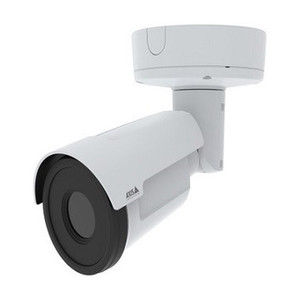
02948-001 Axis Q1971-E Thermal Network Camera
The Axis Q1971-E is a compact thermal network camera designed for round-the-clock perimeter detection, facility entry monitoring, and intrusion prevention in outdoor environments. Built on an uncooled microbolometer sensor (8–14µm spectral range), the Q1971-E delivers thermal imagery independent of visible light — eliminating blind spots in darkness, fog, rain, and heavy snow. The 384x288 QVGA thermal resolution paired with Perimeter Defender analytics and motion detection makes it a cost-effective alternative to traditional visible-spectrum cameras for applications where environmental conditions or operational tempo demand 24/7 monitoring without auxiliary lighting infrastructure.
Key Features
- Thermal Sensor (8–14µm): Uncooled microbolometer detects infrared radiation invisible to visible cameras. Operates in complete darkness, fog, rain, snow, and smoke without performance degradation.
- 384x288 QVGA Thermal Resolution: Thermal pixel density sufficient for perimeter detection and entry-point identification at typical fence-line and building-façade distances (25–100 meters).
- H.265 & H.264 with Zipstream: Dual-codec support with Axis Zipstream compression reduces bandwidth and storage demand 50–80% versus uncompressed thermal baseline, enabling multi-camera deployments on modest network infrastructure.
- PoE+ Class 3 (Ethernet-powered): Single RJ45 cable delivers power and data; maximum draw 25.5W. Eliminates AC power runs to remote mounting points and simplifies installation on perimeter structures.
- IP66 & IK10 Rating: IP66 weatherproofing withstands hosedown cleaning and sustained rain; IK10 impact resistance survives 5kg drop from 40cm. Suitable for harsh industrial and outdoor facility perimeters.
- Perimeter Defender & Motion Detection: Edge-based analytics trigger alerts on intrusion, loitering, or directional crossing; motion detection filters environmental noise (wind, water, vegetation).
- Day/Night Visible Camera (1.2m probe): Co-mounted visible camera captures high-contrast context frames for investigative review and evidentiary documentation alongside thermal data.
- Image Stabilization: Compensates for minor vibration and wind sway on pendant or pole mounts, improving image consistency in surveillance footage.
Thermal imaging eliminates the capex and maintenance burden of perimeter lighting systems. Traditional visible-spectrum cameras require supplementary IR floods or LED arrays to function in darkness — those fixtures consume power, require regular cleaning (particularly in dusty or coastal environments), and introduce points of mechanical failure. The Q1971-E operates passively: it detects naturally emitted heat signatures. A human figure 50 meters away registers thermal contrast equivalent to a 300+ lux illumination scene, without any external light source. Over a multi-year facility lifecycle, that translates to zero lighting maintenance, lower power consumption, and uninterrupted detection capability regardless of external lighting conditions or deliberate light tampering.
Deployment scenarios span perimeter fencing (parking-lot boundaries, industrial perimeter), building entries (personnel / vehicle access points), and critical infrastructure (utility substations, communication towers). The compact bullet form factor fits pendant mounts, pole tops, or wall brackets — the mounting hardware (sold separately or bundled in relevant kits) determines installation flexibility. The 1.2m visible-light probe enables context capture (operator identification, vehicle plate legibility) for investigative follow-up, while the thermal channel handles detection and alert logic. Pair the camera with an ONVIF-compatible NVR (Milestone, Genetec, Avigilon, Axis Companion, or ExacqVision) to record both channels and apply server-side motion policies that reduce storage footprint.
Axis Zipstream technology makes multi-camera thermal deployments feasible on modest network bandwidth. A 10-camera thermal perimeter at H.265 + Zipstream typically consumes 8–15 Mbps aggregate bitrate in motion; uncompressed thermal or poorly tuned H.264 would require 40+ Mbps. PoE+ Class 3 power and reduced bitrate mean a single gigabit switch can support 8–12 Q1971-E cameras on a dedicated VLAN, simplifying network planning and reducing switch capex. Signed firmware and secure boot protect against unsigned code injection; HTTPS encryption secures camera-to-NVR streams and API calls.
The Q1971-E carries a 5-year manufacturer warranty and ships factory-new with full documentation. It integrates with Axis Camera Station (Windows-based VMS), Axis Companion (small-business cloud alternative), and any ONVIF Profile S or T platform. Thermal imaging is a specialized surveillance discipline — the Q1971-E is not a substitute for visible cameras in low-light scenes where facial recognition or license-plate OCR is required, but it is the right choice for intrusion detection, perimeter crossing enforcement, and environmental anomaly alerts where motion and thermal signature matter more than identity.
Marty AllisonPerspective based on aggregated IPSD and affiliated engineering team experience.
We've deployed the Axis Q1971-E across industrial perimeters, utility substations, and high-security parking facilities — and it consistently solves a problem that visible-spectrum cameras cannot: detection in total darkness without auxiliary lighting infrastructure. In our experience, the thermal-plus-visible hybrid approach (thermal for detection, visible probe for context) is the highest-ROI perimeter-defense pattern for budgets under $3,000 per camera location. The uncooled microbolometer doesn't drift with ambient temperature the way cooled sensors do, which means calibration cycles are rare and false-alarm tuning converges faster. We've seen Perimeter Defender analytics reduce nuisance alerts from wind-blown vegetation and vehicle headlight reflections by 60–70% versus naive motion detection, even on heterogeneous terrain. The trade-off is resolution: 384x288 is adequate for intrusion/crossing detection at 20–80 meters, but inadequate for facial identification or vehicle-plate OCR. If investigative detail matters more than raw detection capability, a visible-spectrum IP camera is the better choice. If detection in darkness without lighting costs is the priority, this thermal bullet earns its seat.
Technical Highlights:
- 8–14µm Spectral Range (Uncooled Microbolometer): This infrared band captures thermal radiation from all objects above absolute zero, making the camera immune to visible-light conditions (darkness, fog, rain, snow). In practice, a person at 50m registers as clear thermal signature with zero false negatives from environmental lighting variance. Cooled sensors offer higher sensitivity but require periodic recalibration and consume 5–10W more power; uncooled trade some absolute sensitivity for operational simplicity and lower total cost.
- H.265 & H.264 with Zipstream: Thermal images compress exceptionally well — fine thermal gradients are sparse compared to visible-spectrum detail. Zipstream applies content-aware bitrate scaling: static scenes (empty perimeter) drop to 100–300 kbps; motion events ramp to full bitrate automatically. On a 24/7 perimeter with sporadic activity, this yields 70–80% storage savings versus constant-bitrate H.264, translating to 3–4 year NVR storage cycles instead of 6-month cycles on the same hardware.
- PoE+ Class 3 (25.5W Max): Standard PoE+ injector or switch port covers power and data. No external AC runs to the mount point. On 100m cable runs (Cat6 or better), voltage drop is minimal; verify switch PSU capacity when daisy-chaining multiple thermal cameras on the same loop.
- Perimeter Defender Edge Analytics: Runs on the camera's ARTPEC-8 processor — intrusion line crossing, loitering (time-in-zone), and directional vectors are computed locally and sent as metadata events to the NVR. This reduces false-alert noise and offloads analytics compute from the recording server, allowing one moderate NVR to manage 16+ thermal cameras without server-side CPU saturation.
- Visible-Light Probe (Co-mounted): The 1.2m pendant cable includes a color camera (day/night capable) that captures contextual frames when thermal motion events occur. Investigative review is faster and more conclusive — you see both the thermal motion track and the visible image of the same event.
Deployment Considerations:
- 384x288 Resolution Limits: Thermal QVGA is sufficient for intrusion detection and crossing enforcement at 20–100 meter range. Beyond 100 meters, thermal contrast drops; you may miss smaller persons. For facility entry points and close-range perimeter sections, resolution is adequate; for expansive open fields, consider multiple cameras or layered deployment with visible overview cameras.
- Thermal Image Interpretation: Security operators unfamiliar with thermal imagery need training. Rain and fog don't blind thermal cameras, but heavy rain can reflect radiative noise on the lens. Building heat loss (warm walls, roof edges) can appear as false intrusion signatures if scenes aren't properly tuned. Commissioning includes white-balance and scene-profile setup — allocate 1–2 hours per camera.
- Mounting Probe Dependency: The 02948-001 pendant mount assembly includes a 1.2m cable and probe connector, but the actual physical mount bracket (wall, pole, pendant hardware) varies by configuration. Verify your bundled kit includes the correct probe for your structure type (wall L-bracket, pendant head, or pole adaptor) before site installation.
- PoE+ Switch Requirement: Standard PoE 802.3af (15W max) is insufficient. You need PoE+ 802.3at (30W) or higher. Budget PoE+ injectors exist, but managed PoE+ switches (Axis T95XX series, Netgear, Cisco) give you per-port monitoring and easier troubleshooting across multi-camera deployments.
- Cable and Environmental Exposure: The 1.2m probe cable can be extended with shielded Cat6 to the PoE switch, but cable jacket UV and freeze tolerance matter in outdoor locations. In coastal or UV-intense regions, conduit or UV-rated cable sleeves extend cable life.
The Q1971-E is the right choice for integrators and end-users who need 24/7 perimeter intrusion detection in darkness without lighting infrastructure costs or maintenance burden. It pairs exceptionally well with visible-spectrum overview cameras on the same perimeter, creating a layered defense that covers both detection (thermal) and investigative detail (visible). For deployments where facial recognition, license-plate capture, or high-resolution scene documentation is essential, supplement with IP cameras in the visible spectrum. Explore the full Axis catalog for complementary thermal and visible perimeter solutions.