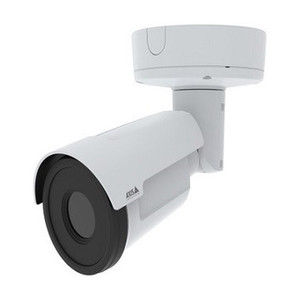
Form Factor:
cable
Resolution:
384x288
Video Compression:
H.265
Audio Support:
Audio input
Analytics:
Perimeter Defender; VMD
IP Rating:
IP66
Vandal Rating:
IK10
Mount Type:
Wall; Ceiling
Compatibility:
PoE
Type:
Q1971-E Thermal Network Camera
Product Type:
Thermal
Warranty:
5 Year(s)
Power Type:
PoE+
PoE Class:
3
IR Distance:
1.2m
Built In IR:
Yes
Day Night:
Yes
Image Stabilization:
Yes
Storage Support:
microSD
Outdoor Ready:
Yes
Signed Firmware:
Yes
Secure Boot:
Yes
HTTPS Encryption:
Yes
Night Vision:
Yes
Visible Resolution:
Thermal
Housing Color:
White
Environment Rating:
Outdoor
Mounting:
(Probe Dependant)
mount_type:
Pendant
Length:
1.2m
Compatible With:
perimeter
PoE:
PoE
Color:
stainless
Form_Factor:
Cable
IP_Rating:
IP66, NEMA 4X
IK_Rating:
IK10
PoE_Power:
PoE+ (Class 3)
Image Sensor:
Uncooled microbolometer
Max Frames Per Second:
8.3 / 30 / 30 / 30 / 8.3 / 30 / 8.3 / 8.3 / 8.3 / 30
Thermal Palettes:
Yes
Horizontal Field Of View:
55 / 15 / 55 / 19 / 19 / 10.5 / 10.5 / 15 / 29 / 29 °
Vertical Field Of View:
41 / 11 / 41 / 15 / 15 / 8 / 8 / 11 / 22 / 22 °
Zipstream:
Yes
H.264:
Baseline, High, Main
Audio Detection:
Yes
Active Tampering:
Yes
Alarm Inputs/outputs:
1/1
Video Motion Detection:
Yes
Signed OS:
Yes
Local Storage (memory Card Slot:
Yes
Operating Temperature:
-40 to 60 °C
Variants:
AXIS Q1971-E 7 mm AXIS Q1971-E 13 mm AXIS Q1971-E 19 mm AXIS Q1971-E 25 mm AXIS Q1971-E 35 mm
Near Focus Distance:
1.2 m (3.9 ft) 13 mm , F1.0; 18.2 m (60 ft) 35 mm , F1.14; 31.3 m (103 ft); 4.7 m (15.4 ft) 19 mm , F1.24; 8.3 m (27.2 ft) 25 mm , F1.0
Lens:
Athermalized 7 mm , F1.18
Model:
ARTPEC-8
Compute Capabilities:
Deep learning processing unit (DLPU)
Frame Rate:
Up to 8.3 fps and 30 fps
Video Streaming:
Up to 20 unique and configurable video streams Axis Zipstream technology in H.264 and H.265 Controllable frame rate and bandwidth VBR/ABR/MBR H.264/H.265 Video streaming indicator
Image Settings:
Contrast, brightness, sharpness, exposure zones, compression, rotation: 0°, 90°, 180°, 270° including corridor format, mirroring, dynamic text and image overlay,polygon privacy mask, electronic image stabilization, thermal palettes
Image Processing:
Axis Zipstream
Features:
Automatic gain control Speaker pairing Spectrum visualizer
Input:
10-band graphic equalizer Input for external unbalanced microphone, optional 5 V microphone power Digital input, optional 12 V ring power Unbalanced line input
Output:
Output via speaker pairing
Encoding:
24bit LPCM, AAC-LC 8/16/32/48 kHz, G.711 PCM 8 kHz, G.726 ADPCM 8 kHz, Opus 8/16/48 kHz Configurable bitrate
Network Protocols:
IPv4, IPv6 USGv6, ICMPv4/ICMPv6, HTTP, HTTPS , HTTP/ 2, TLS , QoS Layer 3 DiffServ, FTP, SFTP, CIFS/SMB, SMTP, Bonjour, UPnP , SNMP v1/v2c/v3 (MIB-II), DNS/ DNSv6, DDNS, NTP, PTP, NTS, RTSP, RTP, SRTP/RTSPS, TCP, UDP, IGMPv1/v2/v3, RTCP, DHCPv4/v6, S
Application Programming Interface:
Open API for software integration, including VAPIX®, metadata and AXIS Camera Application Platform (ACAP); specifications at axis.com/developer- community . One-click cloud connection ONVIF® Profile G, ONVIF® Profile M, ONVIF® Profile S, and ONVIF®
Video Management Systems:
Compatible with AXIS Camera Station Edge, AXIS Camera Station Pro, AXIS Camera Station 5, and video management software from Axis’ partners available at axis.com/vms .
Onscreen Controls:
Electronic image stabilization Video streaming indicator Privacy masks Media clip Heater
Edge-to-edge:
Speaker pairing
Event Conditions Audio:
audio detection, audio clip playing, audio clip currently playing
Event Conditions Device Status:
above/below/within operating temperature, IP address removed, new IP address, network lost, system ready, ring power overcurrent protection, live stream active, shock detected Digital audio input status
Event Conditions Edge Storage:
recording ongoing, storage disruption, storage health issues detected
Event Conditions I/O:
digital input, manual trigger, virtual input
Event Conditions MQTT:
stateless
Scheduled And Recurring:
schedule
Event Conditions Video:
average bitrate degradation, tampering
Event Actions Audio Clips:
play, stop
Event Actions I/O:
toggle I/O once, toggle I/O while the rule is active
Event Actions MQTT:
publish
Event Actions Notification:
HTTP, HTTPS, TCP and email Overlay text Pre- and post-alarm video or image buffering for recording or upload
Event Actions Recordings:
SD card and network share
Event Actions SNMP Traps:
send, send while the rule is active
Upload Of Images Or Video Clips:
FTP, SFTP, HTTP, HTTPS, network share and email
Built-in Installation Aids:
Pixel counter
Included:
AXIS Video Motion Detection, AXIS Motion Guard, AXIS Fence Guard, AXIS Loitering Guard, active tampering alarm, audio detection
Supported:
AXIS Perimeter Defender Support for AXIS Camera Application Platform enabling installation of third-party applications, see axis.com/ acap
Product Markings:
CSA, UL/cUL, CE, KC
Supply Chain:
TAA compliant
EMC Canada:
ICES(A)/NMB(A)
EMC Japan:
VCCI Class A
EMC Korea:
KS C 9835, KS C 9832 Class A
EMC USA:
FCC Part 15 Subpart B Class A
EMC Railway:
IEC 62236-4
Safety:
CAN/CSA C22.2 No. 62368-1 ed. 3, IEC/EN/UL 62368-1 ed. 3
Cybersecurity:
ETSI EN 303 645, BSI IT Security Label, FIPS-140
Edge Security Software:
Signed firmware, brute force delay protection, digest authentication and OAuth 2.0 RFC6749 Client Credential Flow/OpenID Authorization Code Flow for centralized ADFS account management, password protection, Axis Cryptographic Module (FIPS 140-2 level
Edge Security Hardware:
Axis Edge Vault cybersecurity platform TPM 2.0 (CC EAL4+, FIPS 140-2 Level 2), secure element (CC EAL 6+), system-on-chip security (TEE), Axis device ID, secure keystore, signed video, secure boot, encrypted filesystem (AES-XTS-Plain64 256bit)
Network Security:
IEEE 802.1X (EAP-TLS, PEAP-MSCHAPv2) , IEEE 802.1AE (MACsec PSK/EAP-TLS), IEEE 802.1AR, HTTPS/HSTS , TLS v1.2/v1.3 , Network Time Security (NTS), X.509 Certificate PKI, host-based firewall
Documentation:
AXIS OS Hardening Guide Axis Vulnerability Management Policy Axis Security Development Model AXIS OS Software Bill of Material (SBOM) To download documents, go to axis.com/support/ cybersecurity/resources To read more about Axis cybersecurity suppor
Casing:
IP66/IP67-, NEMA 4X- and IK10-rated Aluminum and polycarbonate (PC)
Connectors Network:
Shielded RJ45 10BASE-T/100BASE-TX/ 1000BASE-T PoE
Connectors Audio:
3.5 mm mic/line in
Connectors I/O:
Terminal block for 1 supervised alarm input and 1 output (12 V DC output, max. load 50 mA)
Operating Conditions:
-40 °C to 60 °C (-40 °F to 140 °F) Maximum temperature according to NEMA TS 2 (2.2.7): 74 °C (165 °F) Humidity 10–100% RH (condensing)
Effective Projected Area (epa:
0.022 m (0.24 ft )
Dimensions:
For the overall product dimensions, see the dimension drawing in this datasheet.
Weight:
1.4 kg (3.1 lb)
Box Content:
Camera, installation guide, drill template, TORX® L-keys, RESISTORX® L-key, terminal block connector, connector guard, cable gaskets, owner authentication key
Optional Accessories:
AXIS T94F01M J-Box/Gang Box Plate, AXIS T91A47 Pole Mount, AXIS T94P01B Corner Bracket, AXIS T94F01P Conduit Back Box, AXIS Weather Shield K, Axis PoE Midspans AXIS T8415 Wireless Installation Tool AXIS Surveillance Cards For more accessories, go to
System Tools:
AXIS Site Designer, AXIS Device Manager, product selector, accessory selector, lens calculator Available at axis.com
Languages:
English, German, French, Spanish, Italian, Russian, Simplified Chinese, Japanese, Korean, Portuguese, Polish, Traditional Chinese, Dutch, Czech, Swedish, Finnish, Turkish, Thai, Vietnamese
Export Control:
This product is subject to export control regulations, and you should always comply with all applicable national and international export or re-export control regulations.
Part Numbers:
Available at axis.com/products/axis-q1971-e#part- numbers
Substance Control:
PVC free, BFR/CFR free in accordance with JEDEC/ECA Standard JS709 RoHS in accordance with EU RoHS Directive 2011/65/ EU/ and EN 63000:2018 REACH in accordance with (EC) No 1907/2006. For SCIP UUID, see echa.europa.eu
Materials:
Screened for conflict minerals in accordance with OECD guidelines To read more about sustainability at Axis, go to axis. com/about-axis/sustainability
Environmental Responsibility:
axis.com/environmental-responsibility Axis Communications is a signatory of the UN Global Compact, read more at unglobalcompact.org
Detect:
1.5 pixels
Recognize:
6 pixels
Identify:
12 pixels; 12 pixels We used Johnson’s criteria to calculate the theoretical values assumed to be 1.8 x 0.5 m and 4.0 x 1.5 m, respectively. Thoroughly evaluate your scene using, for example, AXIS when determining actual
Lens Focal Length:
7 mm
Ingress Protection:
IP66, IP67
Impact Rating:
IK10
NEMA Rating:
NEMA 4X
Image Sensor Resolution:
QVGA (384x288 pixels)
Shipping Weight:
3.640 lb
Video Codecs:
H.264, H.265
Digital Input Output:
2 supervised I/O ports
Standards Compliance:
ONVIF, UL listed, MIL-STD-810H / 521.4
Country of Origin:
Poland
UNSPSC:
46171610