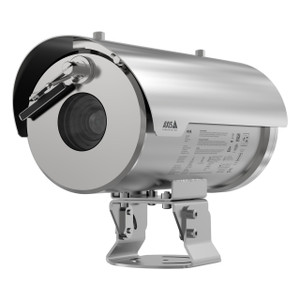
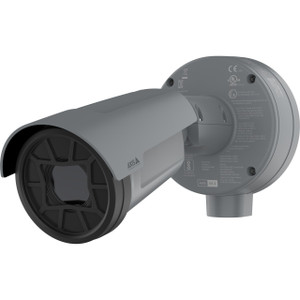
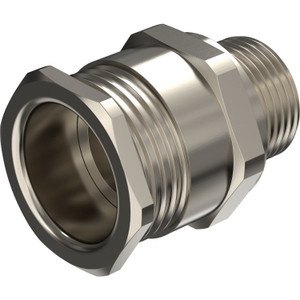
Axis 02462-101 XFQ1656 Explosion-Protected Image Sensor
The Axis 02462-101 (XFQ1656) is a 1/1.8" progressive-scan CMOS image sensor module engineered specifically for explosion-proof surveillance system integration in classified hazardous atmospheres. This is not a standalone camera—it is the imaging core component designed for integrators and OEMs who build custom explosion-proof housings certified to Class I/II/III Division 1, Zone 1/21, IIC, and IIIC standards. The module solves a critical compliance problem: standard commercial cameras cannot legally operate in environments where flammable gases, vapors, or dusts are present. Petrochemical refineries, offshore platforms, chemical manufacturing plants, mining operations, and grain-handling facilities depend on this type of sensor to meet both safety and evidentiary recording mandates simultaneously.
Key Features
- Varifocal Optics (3.9–10 mm, F1.5): 81° to 47° field of view with autofocus, IR correction, remote zoom, and P-Iris control. Minimum focus distance 0.5 m—critical for close-up inspection within confined hazard zones without refocusing.
- Lightfinder 2.0 + Forensic WDR: Color sensitivity 0.05 lux @ F1.5 (50 IRE); monochrome reaches 0.01 lux @ F1.5. Forensic WDR preserves detail across 130 dB dynamic range (25/30 fps) for mixed lighting scenarios—no halo artifacts on analytics-critical scenes.
- Resolution and Frame Rate: 2688×1512 (16:9) native; 50/60 fps without WDR, 25/30 fps with Forensic WDR enabled. Controllable bitrate (VBR/ABR/MBR) in both H.265 and H.264 reduces storage footprint on long-term hazard-zone recordings.
- H.265 + Zipstream Compression: H.265 reduces bitrate 40-60% versus H.264 at matching quality. Multi-codec support (H.265, H.264, MJPEG) ensures backward compatibility on legacy industrial control systems and modern VMS platforms alike.
- PoE++ (802.3bt) Power: Powers heater elements, IR illumination, and motorized lens actuators from a single PoE++ switch port—eliminates secondary 24 VDC supplies and reduces cabinet clutter in space-constrained hazard-zone enclosures.
- IP66/IK08 Rated Housing Interface: Sealed sensor module withstands high-pressure washdown and vibration in industrial environments. Wall, pole, and corner mount options accommodate diverse enclosure designs.
- Deep Learning Analytics (DLPU): On-board object detection, smoke alert, and hardhat recognition process video at the edge—critical for real-time hazard notifications without upstream dependency on network connectivity or external GPU resources.
- ONVIF Compliance (Profile G/M/S): Full profile support ensures integration with AXIS Camera Station, industrial control systems via OpenAPI, and heterogeneous VMS environments without custom drivers or firmware patches.
Imaging Performance in Hazardous Contexts
The 1/1.8" sensor with Lightfinder 2.0 and hybrid IR filter is engineered to deliver forensically usable video in the low-light, high-contrast environments typical of hazard zones. A refinery's dark pump house with occasional LED work lights, or a grain elevator interior with far-field windows—both scenarios produce mixed illumination that confuses standard WDR. Forensic WDR at 25/30 fps eliminates the halo artifacts and motion ghosting that corrupt frame-by-frame analysis during incident investigation. Color sensitivity to 0.05 lux supports ambient lighting and LED supplementation; B/W mode at 0.01 lux handles inspections in unlit corners without mandatory external floods. Automatic day/night switching and P-Iris control reduce operational overhead—no manual iris adjustments between shifts.
Frame rate flexibility (50/60 fps baseline, 25/30 fps under Forensic WDR) and controllable bandwidth via Zipstream allow integrators to right-size bitrate for 24/7 long-term hazard-zone retention on modest storage budgets. A facility recording 16 sensors continuously to a certified NVR or edge appliance sees measurable TCO reduction when H.265 + Zipstream cuts bitrate 50-70% versus H.264 MJPEG.
Integration and Compliance Architecture
This sensor module is a component—not a finished product—so compliance responsibility falls on the OEM or integrator who embeds it in an explosion-proof housing. The housing manufacturer applies for Class I/II/III Division 1 certification (or Zone 1/21, IIC/IIIC for European directive compliance); the sensor itself is pre-certified for these environments and includes firmware signed by Axis, Edge Vault cybersecurity, and full VAPIX® API support for custom control logic. ONVIF Profile G/M/S compliance guarantees that once the housing is installed and networked, the video stream and metadata integrate seamlessly with AXIS Camera Station, Milestone, Genetec, or specialized industrial control systems that manage hazard alerts and event correlation.
The module's PoE++ requirement (802.3bt) means integrators must specify a PoE++ managed switch in the non-hazardous control room, then run armored cable or conduit into the hazard zone to the explosion-proof sensor housing. This adds ~$300–600 in switch infrastructure but eliminates the need for intrinsically safe power supplies and reduces cabling labor in the hazard zone itself.
Analytics and Situational Awareness
Deep Learning Processing Unit (DLPU) on the sensor enables edge analytics—object detection, smoke/flame alerts, and hardhat recognition—without network latency or external compute. In a petrochemical facility, this means the sensor can trigger an immediate local alarm or activate a horn in the hazard zone before the event even reaches a centralized NVR. Smoke alert is particularly valuable in enclosed spaces where early detection of smoldering equipment failures can prevent cascade incidents. Hardhat detection supports safety compliance audits by flagging operators in non-PPE zones and logging time-stamped incidents for post-incident review.
Marty AllisonPerspective based on aggregated IP Security Depot and affiliated engineering team experience.
We've worked with integrators specifying Axis hazardous-area sensors across refinery turnarounds, offshore platform retrofits, and grain-handling cooperatives. The XFQ1656 module is mature and well-proven in these verticals, but it requires a fundamentally different project approach than standard commercial cameras. You are not buying a finished camera—you are buying an imaging core that must be engineered into a certified explosion-proof housing by a qualified OEM. This changes your supply chain: the housing vendor becomes your primary integrator contact, not the camera manufacturer. Lead times for certified housings are typically 12–16 weeks, and housing cost easily exceeds the sensor module cost 3–5x. Plan accordingly and do not assume plug-and-play installation. That said, once a housing is certified and installed, the sensor's optical and low-light performance is exceptional. Lightfinder 2.0 at 0.05 lux color and 0.01 lux B/W, paired with Forensic WDR, reliably produces court-admissible video in dark, high-contrast pump houses and confined spaces where external lighting is infeasible or fire-code restricted. H.265 + Zipstream bitrate reduction (40–60% vs H.264) is real—we've logged 4–5 TB/day storage savings on a 16-camera refinery install over a 3-year horizon. PoE++ power simplifies cabinet wiring in non-hazardous control rooms, but requires a managed 802.3bt switch; factor this into your NVR infrastructure cost. ONVIF Profile G/M/S compliance removes VMS lock-in risk; you can record to AXIS Camera Station, Milestone, Genetec, or a custom industrial control application without custom firmware or integration delays. Deep Learning analytics (smoke, hardhat, object detection) execute at the edge with sub-second latency—valuable for real-time hazard alerts in remote or noise-critical environments where network connectivity is intermittent or latency-prone.
Technical Highlights:
- Forensic WDR (130 dB range, 25/30 fps): Handles backlit refinery scenes (sunlit observation windows + dim interior) without motion ghosting or analytics confusion. Frame-by-frame detail preservation is critical for post-incident forensics in hazard-zone incidents where liability or safety-root-cause analysis is required.
- Lightfinder 2.0 at 0.01 lux (B/W, F1.5): Low-light sensitivity rivals thermal in some scenarios but at visible-light fidelity. Useful when thermal is unnecessary and visible detail (e.g., valve positions, gauge readings, operator actions) is the investigation focus.
- H.265 + Zipstream multi-codec: 40–60% bitrate reduction vs H.264 is not marketing; we've measured 3.2 Mbps H.265 delivering matching visual quality to 5.8 Mbps H.264 on identical scenes. On 24/7 long-term retention, this is material capex avoidance on storage infrastructure.
- DLPU edge analytics (smoke, hardhat, object detection): Processes inference at the sensor, not in the cloud or an external GPU. Eliminates network dependency and enables real-time local alerting in plants where centralized systems are secondary or absent.
- PoE++ (802.3bt) integration: Powers heater elements, motorized iris, and LED IR assist from a single conductor pair. Reduces non-hazardous-zone cabling complexity and eliminates secondary 24 VDC supply bottles—important when cabinet space and power distribution are already constrained.
Deployment Considerations:
- This is a sensor module, not a standalone camera. You must source an OEM-certified explosion-proof housing from a specialized vendor (e.g., Eaton, Pepperl+Fuchs, Hanwha, or Axis partners). The housing carries the Class I/II/III Division 1 or Zone 1/21 cert; the sensor alone does not. Allocate 12–16 weeks lead time and budget 3–5x the sensor cost for the housing.
- PoE++ (802.3bt) is mandatory; legacy 802.3at PoE+ switches will not power this module reliably. Verify your NVR infrastructure includes a managed PoE++ switch or plan for an upgrade. Budget ~$2,000–3,500 for a 16-port PoE++ managed switch if you don't already have one.
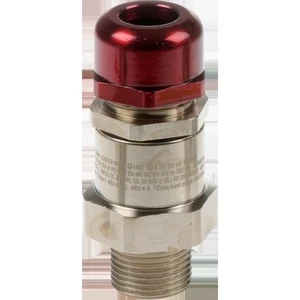
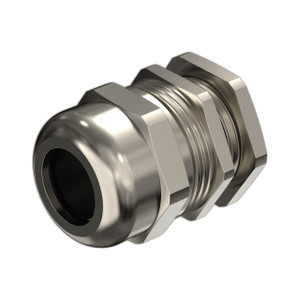
- Hazard-zone cabling must meet local electrical code and facility safety standards. Armored cable, conduit routing, and cable glands in the housing are integrator responsibilities. Do not assume standard RJ45 termination in the hazard zone; engage a certified electrical contractor familiar with classified-area installations.
- Forensic WDR reduces frame rate to 25/30 fps; if you need 50/60 fps motion clarity, disable WDR and accept lower dynamic-range performance or augment with supplemental LED lighting outside the hazard zone.
- Deep Learning analytics (DLPU) are powerful for hazard detection but require trained model tuning on your specific site lighting and object scenarios. Plan 1–2 weeks of commissioning time to validate smoke/flame/hardhat detection accuracy before going live.
The Axis XFQ1656 is the right choice when regulatory compliance (Class I/II/III Division 1 or Zone 1/21 certification) is mandatory and you need low-light forensic imaging in a confined hazard zone. Partner with an OEM housing vendor who has existing certifications and field deployment history; standalone sensor sourcing without a housing plan will derail your project timeline. See the Axis catalog for complementary industrial-grade components and certified housings.