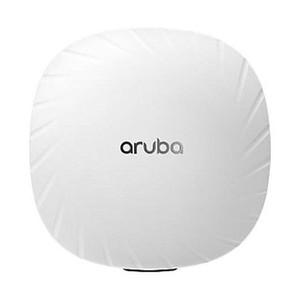
HPE JZ332A Wi-Fi 6 Dual-Radio 4x4 MIMO Campus Access Point
Overview
The HPE Aruba Networking AP-534, sold under part number JZ332A, is a dual-radio Wi-Fi 6 (IEEE 802.11ax) campus access point built for environments where dozens or hundreds of clients compete for airtime simultaneously. Hospitals, large open-plan offices, university lecture halls, training centers — anywhere you cannot afford RF congestion to drag down real application performance. With a combined aggregate data rate of up to 2.97 Gbps across its 2.4 GHz and 5 GHz radios and a 4x4 MIMO antenna array on each band, the 530 Series is architected for density, not just coverage. Explore the full HPE Aruba networking catalog to see how the AP-534 fits within the broader switching and wireless infrastructure line.
Key Features
- Wi-Fi 6 (802.11ax) with up to 2.97 Gbps aggregate: Wi-Fi 5 (802.11ac) maxes out around 1.7 Gbps on a dual-radio AP — Wi-Fi 6 gets you to 2.97 Gbps on the JZ332A. That headroom matters when you have 60+ clients per AP in a meeting facility or hospital ward, because Wi-Fi 6 splits that capacity more efficiently across concurrent sessions rather than serializing them.
- OFDMA (Orthogonal Frequency Division Multiple Access): Where older Wi-Fi standards send one transmission to one client per channel slot, OFDMA subdivides each channel into resource units and serves multiple clients simultaneously. In practice, this is the difference between a 50-client conference room that works and one that stalls during a packed all-hands presentation.
- Bidirectional MU-MIMO (4x4): Four spatial streams in both directions means the AP can talk to and hear from multiple clients at the same time — not just downstream as in earlier MU-MIMO implementations. For video conferencing-heavy environments, the upstream gain is the underrated spec here.
- Target Wait Time (TWT) for power efficiency: TWT lets the AP schedule when each client wakes to transmit, reducing radio contention and allowing IoT and mobile devices to sleep longer between transactions. In a hospital with hundreds of badge readers, nurse call devices, and handheld scanners on the same SSID as laptops, TWT meaningfully extends battery life on the constrained-power devices.
- Zero Touch Provisioning: New APs can be deployed in branch offices or remote sites without on-site technical expertise — the AP calls home to HPE Aruba Networking Central on first power-up, downloads its config, and is production-ready. This reduces travel costs and speeds rollout for multi-site enterprise deployments.
- Dual-band (2.4 GHz + 5 GHz): The 2.4 GHz radio provides extended range and backward compatibility for legacy IoT clients; the 5 GHz radio carries the bulk of high-throughput client traffic. Running both simultaneously means you don't have to choose between device breadth and performance.
- Integrated Bluetooth: The onboard Bluetooth radio supports location services, asset tracking, and BLE-based IoT onboarding workflows — functions typically requiring a separate overlay hardware deployment. For healthcare and warehouse environments tracking mobile assets, this removes a hardware cost and an installation step.
- HPE Aruba Networking Central management: A single-pane-of-glass cloud management platform that covers wired and wireless LANs, WANs, and VPNs in one interface. AI-powered analytics, end-to-end orchestration, and security policy enforcement are built into the platform — reducing the per-site management overhead that grows linearly in unmanaged deployments.
- Limited Lifetime Warranty: HPE covers the 530 Series hardware for the life of the product under its limited lifetime warranty — a meaningful factor in total cost of ownership calculations for multi-year campus infrastructure projects.
Integration & Compatibility
The AP-534 (JZ332A) is designed to operate within the HPE Aruba Networking ecosystem, managed through HPE Aruba Networking Central for cloud-managed deployments or through on-premises controllers for organizations with existing controller-based Aruba infrastructure. The Zero Touch Provisioning workflow integrates with Aruba Central's onboarding tools, making it practical to deploy across multiple sites from a central IT team without dispatching engineers to each location.
For organizations planning a full wired and wireless refresh, pair the AP-534 with PoE-capable network switches that can supply the required power class — verify the AP's PoE draw against your switch's per-port and chassis power budget before finalizing your PoE infrastructure plan. The 530 Series is a campus-class product; for outdoor or ruggedized deployments, evaluate HPE Aruba's outdoor-rated access point families instead.
If you are designing a mixed wired/wireless network from the ground up, HPE Aruba's switching, SD-WAN, and security portfolio integrates natively with Central — review the Wi-Fi 6 access point category for the full range of 802.11ax options across different density and coverage profiles.
Frequently Asked Questions
Q: What wireless standard does the JZ332A support, and what does that mean for existing Wi-Fi 5 clients?
A: The JZ332A is a Wi-Fi 6 (IEEE 802.11ax) access point. It is backward-compatible with Wi-Fi 5 (802.11ac), Wi-Fi 4 (802.11n), and earlier clients — existing devices will connect and operate normally, they simply won't benefit from Wi-Fi 6 features like OFDMA and TWT. New Wi-Fi 6 clients will see improved performance and efficiency, especially in congested environments.
Q: What is the aggregate data rate of the AP-534 (JZ332A)?
A: The combined aggregate data rate across both radios is up to 2.97 Gbps. This is a theoretical maximum under ideal conditions; real-world throughput depends on client density, channel conditions, and the wired uplink capacity to the AP.
Q: Can the JZ332A be deployed without on-site IT staff?
A: Yes. The 530 Series supports Zero Touch Provisioning — an AP powered on and connected to the network will reach out to HPE Aruba Networking Central, authenticate, and pull its configuration automatically. This makes large-scale multi-site rollouts practical without sending engineers to each location.
Q: What management platform does the AP-534 use?
A: The AP-534 is managed through HPE Aruba Networking Central, a cloud-based platform that provides a unified view of wired LANs, wireless LANs, WANs, and VPNs. It includes AI-powered analytics, orchestration, and built-in security policy management.
Q: What is the warranty on the JZ332A?
A: HPE covers the 530 Series with a limited lifetime warranty on the hardware.
Q: Does the AP-534 support Bluetooth in addition to Wi-Fi?
A: Yes. The JZ332A includes an integrated Bluetooth radio, which supports location services, asset tracking, and BLE-based IoT device onboarding — use cases that would otherwise require separate overlay hardware.
The JZ332A sits in a category where the spec sheet looks similar across vendors, so it's worth being specific about what actually differentiates it in a real deployment. The 4x4 MIMO configuration on both radios — not just the 5 GHz side — is meaningful: it gives you four spatial streams for both transmit and receive, which is the right spec when your client mix includes a lot of laptops and modern smartphones that can negotiate three or four streams. The 2.97 Gbps aggregate is a headline number, but the mechanism behind it — OFDMA subdividing the channel into resource units per client — is what actually holds up under a 60-client meeting room load.
Technical Highlights:
- OFDMA multi-user scheduling: Instead of serializing client access to the channel (the Wi-Fi 5 model), OFDMA assigns resource units per client within a single transmission window. Under dense client loads, this reduces average latency per client significantly — the difference is most visible during packed all-hands calls where Wi-Fi 5 APs struggle with upstream congestion.
- Bidirectional MU-MIMO (4x4): Upstream MU-MIMO is the Wi-Fi 6 addition most overlooked in procurement conversations. If your environment has a high proportion of video conferencing or VoIP traffic, the upstream path from client to AP is as congested as the downstream — bidirectional MU-MIMO addresses both directions simultaneously.
- Target Wait Time (TWT): TWT is primarily a power-efficiency mechanism, but it has a secondary benefit: by scheduling client transmissions, it reduces uncoordinated channel access and the associated collisions. In IoT-heavy environments — nurse call, asset tags, badge readers — TWT extends battery life on constrained devices while also cleaning up the RF environment for latency-sensitive traffic.
Deployment Considerations:
- Zero Touch Provisioning through Aruba Central requires the AP to reach Aruba's cloud infrastructure on first boot — confirm outbound internet access from the deployment VLAN before shipping units to site, or the provisioning workflow will stall silently and require a truck roll to diagnose.
- The 530 Series is a campus-class indoor AP; it is not rated for outdoor or harsh-environment installation. If your project includes covered walkways, loading docks, or parking structures, those areas need a separate outdoor-rated access point selection — do not assume the AP-534 covers edge-of-building scenarios.
For a multi-building university campus or a large hospital network undergoing a Wi-Fi 6 refresh, the AP-534 is the right unit for high-occupancy interior spaces — lecture halls, patient floors, open-plan offices — where client density and bidirectional throughput are the governing constraints, and where Zero Touch Provisioning makes the difference between a two-week deployment and a two-month one.