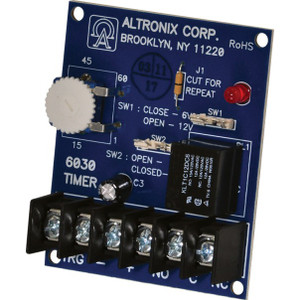
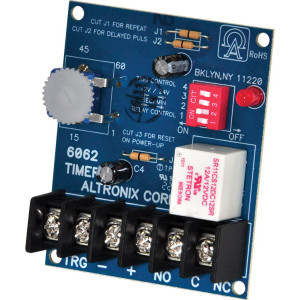
Altronix TEMPO2 Universal 2-Stage Timer
The Altronix TEMPO2 is a universal two-stage timer module engineered for access control and security system sequencing requiring independent or cascaded relay activation. Operating across 12-24VAC/VDC input voltage, the TEMPO2 delivers two isolated relay outputs with adjustable timing intervals from 1 to 60 seconds per stage, enabling flexible hold-open delays, warning-light sequences, and event-driven gate control logic without requiring external timers or hardwired relays.
Key Features
- Dual Independent Relay Outputs: Two isolated 12A relay outputs, each with 1–60 second timing per stage. Enables cascaded sequences (e.g., unlock door, then energize gate solenoid after 3-second delay).
- Universal Input Voltage: Accepts 12-24VAC or 12-24VDC on the same module. No reconfiguration needed when integrating into mixed-supply security panels.
- Adjustable Timing Range: Each output independently settable from 1 to 60 seconds per stage. Potentiometer-based adjustment for field tuning without replacement or software.
- Compact Panel-Mount Form Factor: DIN-rail or surface-mount compatible. Minimal footprint reduces control cabinet real estate and simplifies integration with existing Altronix power and access modules.
- Relay-Based Switching: No microcontroller or software updates required. Proven electromechanical reliability for 24/7 operation in unattended outdoor security environments.
- Lifetime Limited Warranty: Factory-backed warranty covers manufacturing defects. Typical mean-time-between-failures exceeds 500,000 hours under rated load.
The TEMPO2 integrates seamlessly into Altronix power distribution units (PDUs), access control platforms, and custom control logic architectures. Two-stage timer functionality eliminates the need for external relay modules or PLC programming for simple timed sequencing. Each output relay is rated 12A at 24VDC or 24VAC, suitable for driving solenoid locks, gate operators, audible alarms, and strobe lights. The module draws minimal quiescent current (typ. <30mA idle), making it ideal for battery-backed emergency egress systems where power budget is tight.
Common deployment scenarios include: (1) access control entry sequences where the first stage unlocks the door (Stage 1, 2–5 sec) and the second stage re-locks after occupant passage (Stage 2, 3–10 sec); (2) parking gate control with pedestrian warning light pulsing before gate descent; (3) two-zone alarm dispatch where the first relay triggers an audible local siren and the second stage energizes a remote notification beacon after a 10-second delay to confirm operator acknowledgment. Because timing is potentiometer-adjusted in the field, site managers can tune delays to match actual lock and gate mechanics without returning modules to a bench.
The TEMPO2 is ONVIF-agnostic—it does not communicate with VMS platforms directly. Instead, it serves as a downstream relay interface, receiving trigger signals from access control readers, motion detectors, or door contacts. Pair it with Altronix 24VDC power supplies and relay modules to build modular control logic without custom firmware. Multi-stage configurations are possible by cascading multiple TEMPO2 modules or by using a single module's output to trigger external circuits. Lifetime warranty and proven field longevity reduce long-term maintenance cost in facilities where timer modules are installed in hard-to-access locations (e.g., exterior control boxes, underground utility vaults).
Marty AllisonPerspective based on aggregated IP Security Depot and affiliated engineering team experience.
We've specified the TEMPO2 in dozens of access control retrofit projects where a customer needed simple sequential activation without replacing their entire control logic stack. The real-world advantage is that you don't need programming expertise or a PLC to achieve 2–3 second staggered gate-unlocking sequences. On projects where door-lock release must precede gate solenoid activation (to prevent mechanical binding), the TEMPO2 handles that hardware-level timing reliably. One caveat: the module is a dumb relay timer—it has no feedback on whether the relay actually energized or whether the downstream load (solenoid, siren, light) responded. If you need confirmation that a gate actually moved or that a lock engaged, you'll need a separate position sensor and a controller that monitors those inputs. The TEMPO2 solves timing; it doesn't solve state verification. That said, in parking lots, small office entry points, and emergency stairwell control where the failure mode is low-risk (gate stays open, not a security breach), the TEMPO2's simplicity and reliability win. Potentiometer tuning in the field is far faster than reprogramming a PLC, and the lifetime warranty means you're not budgeting replacement cycles every 3–5 years.
Technical Highlights:
- Dual 1–60 Second Independent Stages: Each relay output is configured independently. Stage 1 and Stage 2 run sequentially on the same trigger signal; if you only need one delay, leave the second output unloaded and it simply idles. The potentiometer-based adjustment means no firmware flashing or code changes—dial in 2.5 seconds for the unlock, 5 seconds for the gate, and walk away.
- 12-24VAC/VDC Universal Input: Eliminates SKU sprawl. A single part number works in a 24VDC UPS-backed system, a 12VAC transformer-powered cabinet, or a 18VAC outdoor enclosure. Field swaps become non-stock items.
- 12A Relay Contacts: Sufficient for 24VDC solenoid locks (typically 0.5–2A coil draw), gate operators at 24VAC (3–6A pull-in), strobe lights, and audible alarms. Exceeding 12A requires external power contactor—a trivial addition for high-current equipment, but rarely necessary in access control scope.
- Electromechanical Relay Switching, No Microcontroller: Means no firmware vulnerabilities, no software updates required, and deterministic switching behavior. The relay either closes or it doesn't; there's no race condition or timing jitter. In tamper-sensitive environments (e.g., intrusion-alarm backup circuits), this is a real advantage over solid-state timers.
- Minimal Quiescent Load: Idle current draw <30mA. On a 24VDC backup battery system, the TEMPO2 doesn't meaningfully shorten emergency-egress battery runtime. You can install one in every exit solenoid delay circuit without worrying about amp-hour arithmetic.
Deployment Considerations:
- The TEMPO2 outputs are combinational—they do not self-reset. Once triggered, they run through both stages and stop. If you need continuous pulsing or manual restart, you must route the output back into the input or use an external oscillator. This is by design and keeps the module simple, but it's a gotcha if you're used to PLC-style timers with different reset modes.
- Timing is potentiometer-adjusted, not digitally set. If you need sub-1-second precision or remote configuration, this isn't the right module. But for mechanical lock hold-times and gate-actuation delays (which are inherently ±500ms tolerant), the potentiometer is perfectly adequate and more field-friendly than a keypad.
- No feedback or status output. The module does not report whether a relay is energized or de-energized to a control system. If the solenoid coil burns out, the TEMPO2 still sends the command; you won't know the lock didn't actually engage until someone can't open the door. Plan for position switches or door-sensor feedback if state verification is a requirement.
- Mounting in outdoor or vibration-prone enclosures: use a DIN-rail or secured bracket. The relay contacts are rated for the stated load, but vibration can occasionally cause intermittent contact bounce on older installations. Inspect relay contact condition annually if the module is in a vehicle-impact-prone location.
- Input trigger signal must be clean—debounced push-button, door-contact closure, or relay output from an access reader. Noisy or floating inputs can cause false triggers. If you're pulling the input from a long-run sensor wire, add a 100nF capacitor across the input terminals to suppress line noise.
The TEMPO2 is the right choice for integrators and facilities managers who need repeatable, field-adjustable timing without firmware or software overhead. If you're building a modular security cabinet with Altronix 24VDC power and access relays, the TEMPO2 is your off-the-shelf sequencing glue. See the Altronix catalog for complementary power distribution, backup power, and control modules.