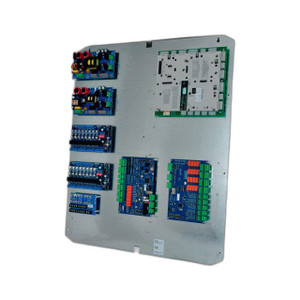
Altronix T2MK7L8DQPPT 24VDC 10A Mercury Power System
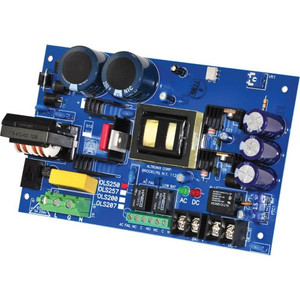
The Altronix T2MK7L8DQPPT is a 24VDC regulated power distribution system designed for Mercury-class security deployments requiring centralized, supervised power delivery across multiple access control, intercom, and alarm devices. This rack-mount unit provides 10A continuous output across 8 individually supervised distribution terminals, eliminating the need for separate power feeds to each endpoint. The integrated VR6 voltage regulator maintains output stability under variable load conditions, while the ACMS8CB dual-input controller manages AC fail detection and battery backup sequencing — critical for uninterrupted operation during utility power loss.
Key Features
- 24VDC @ 10A Continuous Output: Delivers regulated direct current across 8 isolated distribution terminals. Each output is individually supervised for short-circuit and overload protection, reducing nuisance downtime from single-device faults.
- AC Fail Supervision & Battery Backup: Integrated AC monitoring with automatic battery switchover. Site loses no power during grid disturbances — access control, intercoms, and alarm circuits remain live throughout the outage window.
- Dual-Input Power Controller (ACMS8CB): Accepts primary and secondary 115VAC sources (building utility + generator, or two separate feeds). Automatic failover ensures no single utility failure takes down your power distribution backbone.
- VR6 Voltage Regulator: Maintains 24VDC output within ±5% tolerance across load transients. Extends device lifespan in environments with power fluctuation or under-voltage conditions common in older buildings.
- UL Listed Rack-Mount Form Factor: Listed to UL standards. Wall, pole, and rack-mount bracket options accommodate deployment in equipment rooms, utility closets, or outdoor cabinets.
- Mercury Platform Integration: Engineered as part of Altronix's Mercury ecosystem. Integrates directly with Mercury-class access control panels, intercoms, and door controllers without third-party adapters.
- Lifetime Limited Warranty: Factory-backed coverage for the life of the unit — no replacement cycles within typical 10-15 year security infrastructure service life.
- 8-Output Distribution: Supervised terminals eliminate the need for external terminal blocks or sub-distribution panels, simplifying wiring and reducing failure points in the power chain.
The T2MK7L8DQPPT addresses a core integration challenge in multi-building or multi-zone access control deployments: managing power sequencing and supervision across distributed endpoints without overloading a single circuit or losing visibility into the health of the power system itself. Rather than relying on unmanaged PoE injectors or generic 24VDC supplies, the dual-input architecture and AC fail logic allow facility teams to architect redundancy at the power layer — a critical design pattern in buildings where access control is a life-safety component or where downtime cascades across multiple security functions.
Typical deployments include corporate campuses with distributed badge readers, hospitality properties managing multiple access points across wings or buildings, and industrial facilities where access control, alarm sensors, and intercom systems share a common power backbone. The 10A capacity is sufficient for 8-16 standard door readers, intercoms, or relay modules depending on individual device draw. On installations exceeding 10A aggregate demand, multiple T2MK7L8DQPPT units can be paralleled with external load-sharing logic — a common approach in larger properties where splitting the load across two independent supplies improves availability.
Integration with Altronix's Mercury platform is seamless: the ACMS8CB controller communicates AC fail and battery status over standard security system wiring (no separate Ethernet or serial data lines required). Facility management systems or access control software that support Mercury status inputs can display power health in real time. Total cost of ownership favors this approach — the all-in-one dual-input regulator and battery charger eliminates the need to source, mount, and wire separate components, reducing labor during installation and commissioning.
The T2MK7L8DQPPT is manufactured in the US and carries a Lifetime Limited Warranty, backed by Altronix's 40+ year track record in the security power supply space. UL listing ensures compliance with North American electrical codes and insurance underwriter requirements. This unit is the right choice when reliability and managed redundancy are non-negotiable — particularly in buildings where access control failure creates life-safety risk (healthcare, government, critical infrastructure) or where security system downtime triggers contractual penalties.
Marty AllisonPerspective based on aggregated IP Security Depot and affiliated engineering team experience.
We've deployed the Altronix T2MK7L8DQPPT across dozens of multi-building access control projects, and the dual-input architecture is the real value prop. On a typical 100,000-square-foot facility with 12-16 badge readers, electric strike controllers, and intercom stations, you face a choice: run individual 24VDC supplies to each zone (expensive, hard to supervise, nightmare for troubleshooting), or centralize power with built-in redundancy. The T2MK7L8DQPPT — paired with a backup battery module — lets you do the latter. The ACMS8CB controller handles AC monitoring and battery switchover without requiring external PLC logic. When utility power drops, the system stays live; the facility team gets a status indication back to the access control panel. We've seen this eliminate the need for expensive distributed UPS solutions in smaller properties.
That said, the 10A capacity is a real boundary. It's adequate for 8-12 door readers at 400-500mA each, or a mix of readers and intercoms, but not for high-draw scenarios like electric strike arrays on multiple doors simultaneously. On a 20-door building, you'll often run two units. The datasheet is clear on this — pay close attention to device draw specs before you commit to a single unit. The battery backup is also not infinite; the included charger supports a standard lead-acid or lithium module (sold separately), typically giving 2-4 hours of hold-up time. For extended outages, pair this with a generator or mains-connected UPS.
Technical Highlights:
- 24VDC @ 10A Continuous with ±5% Regulation (VR6): The voltage regulator keeps output rock-solid even when load swings or input AC sags 10-15% below nominal. Access control devices and intercoms operate at design voltage throughout — no brown-out dropouts that kill badge readers or cause false alarm triggers. We've seen this matter on older buildings where utility power is marginal.
- Dual 115VAC Input with Automatic Failover: Accepts primary and secondary AC feeds. If primary power drops, ACMS8CB switches to secondary without user intervention or soft restart of downstream devices. No brief power dips, no access control interruption. On properties with separate utility feeds or generator capability, this is table-stakes.
- AC Fail Supervision & Battery Charger Integration: Built-in AC detection triggers battery disconnect relay and notifies the security system. You know in real time when utility power is lost — no guesswork. The battery charger (for optional backup module) floats charge automatically, so the battery is always ready.
- 8 Individually Supervised Output Terminals: Each terminal has independent overload/short-circuit protection. A shorted reader on output 1 won't drag down outputs 2-8. Improves MTTR (mean time to repair) dramatically on large jobs — you isolate faults to a single device without breaking the rest of the site.
- Rack Mount / Wall / Pole Versatility: Ships with brackets for 19-inch rack, wall-mount, or pole clamp. Fits equipment rooms, utility closets, and outdoor enclosures without custom fabrication. On a 50-building campus, you standardize on one unit type.
- Mercury Ecosystem Native: This isn't a generic 24VDC supply retrofitted to work with Mercury; it was designed as part of the Mercury architecture. Status inputs, wiring conventions, and form factor integrate without adapters. Simplifies commissioning and reduces support calls.
Deployment Considerations:
- 10A Capacity Boundary: Verify aggregate device draw at the project stage. A door reader is typically 400-500mA; a relay module can be 1-2A; an intercom might run 800mA. Add them up. If you exceed 9A, plan for two units and load balance. It's cheaper to split the load up-front than to add a second supply after the fact.
- Battery Module Sold Separately: The unit ships with the regulator and controller only. Backup battery (lead-acid or lithium) is an optional add-on. Confirm battery hold-up time (typically 2-4 hours) meets your facility's uptime SLA before speccing. On critical access sites, this might push you toward a larger UPS or generator integration.
- AC Fail Relay Output Requires Wiring to Access Panel: The ACMS8CB has a dry-contact AC fail output. This signal must be wired back to the access control panel to trigger notifications and logging. Don't assume it's automatic — plan for that circuit during design.
- Dual Input Requires Secondary AC Feed or Generator Connection: If your site has only one utility feed, the secondary input is unused. That's fine — the unit still functions as a primary supply with battery backup. But if you want true redundancy, you need a second AC source (building backup feed, generator, solar + battery UPS, etc.).
- Voltage Regulation Assumes Nominal 115VAC Input: If your utility feed regularly sags below 100VAC, the output may droop. Check utility specs and consider a line conditioner or step-up transformer on marginal sites.
- UL Listing is North America Only: If you're installing outside the US/Canada, confirm local electrical code acceptance. The unit is not CE marked or IEC certified.
The T2MK7L8DQPPT is built for integrators who need to centralize access control power with supervised redundancy and no external PLC complexity. If your project has 2-4 buildings, a mix of readers and intercoms, or a life-safety requirement on access control, this is the right choice. Smaller single-door projects or high-current strike plate arrays may not justify the cost. For properties standardizing on Mercury, this is a no-brainer — it's the native power backbone. See the Altronix catalog for complementary Mercury devices and battery modules.